Monday, July 31, 2017

"Flight Risk"

Young adult author Jennifer Fenn has been filling notebooks since she was in elementary school. She’s never without a book! Fenn is terrified of corn fields but has jumped out of a plane, eats her cereal without milk, and has run a marathon.

She is a graduate of Lycoming College and Rosemont College’s MFA program, and lives with her husband, daughter and Scottish terrier in Downingtown, PA.

Fenn applied the Page 69 Test to her new novel, Flight Risk, and reported the following:
Page 69 of Flight Risk delves into the main character Robert’s struggle with ADHD, one of several factors that eventually lead him to steal a small airplane. The text also alludes to Robert’s growing obsession with flight simulators and planes: “With his newfound concentration, could Robert make it in the air force?” Robert notes that while on Adderall, “his knees ceased their hyperactive jig. He could sit still, could read for fifteen minutes at a time.” He stays inside working on his virtual take-offs and landings, returning to school “as pale as the digital clouds he’d spent all summer navigating through.” Robert’s mother, Deb, however, has mixed feelings about Robert being treated with Adderall, and so she takes him off his prescription. This page contains one of my favorite details in the book: when Robert is off Adderall, he eats “a dozen candy canes in one sitting, crunching them between his teeth while his mother cringes.”

Is it representative of the rest of the book? Yes and no. The book is written in a collage style, with several points of view; Robert’s is the most frequent, but there are also TV transcripts, interviews and newspaper articles. A lot of Flight Risk deals with Robert’s plane thefts, his attempts to outrun Yannatok Island’s sheriff and how he becomes both a notorious outlaw and a hero, which this page doesn’t include. Still, I like the writing on this page, and it does provide a valuable insight into the protagonist’s psyche. I hope that would encourage a reader to keep going!
Visit Jennifer Fenn's website.

--Marshal Zeringue

Saturday, July 29, 2017

"The Lost History of Stars"

A native of south Chicago, Dave Boling is a sports columnist in the Seattle area. His first novel, the international best-selling Guernica, was translated into 13 languages with an English-language edition sold worldwide. Prior to becoming a journalist, Boling was a football player at the University of Louisville, an ironworker in Chicago, a logger in the Pacific Northwest, a bartender and bouncer, and a laborer in a car factory and in steel mills. He took up fiction writing at age 53.

Boling applied the Page 69 Test to his new novel, The Lost History of Stars, and reported the following:
Trying to inhabit the mind of my female narrator, Aletta Venter, I interviewed a fair number of psychologists--all women. I probed their insights into coping and survival mechanisms that might help an early teen girl stay strong and resilient in the face of overwhelming circumstances.

The Brits had torched much of the South Africa veld during the Anglo-Boer War at the turn of the 20th century. After burning the Boers’ homes, the Brits interned the women and children in lethally mismanaged concentration camps. It was a grim slice of history that has been largely overlooked.

So, how could Aletta, a small but determined insurgent, find the courage to not only survive, but continue fighting her private war against the might of an empire? The doctors agreed she would be in a transitional time of life, dealing with a turbulent confluence of powerful factors. All the usual adolescent issues of self-doubt, uncertainty and hormonal changes would be incalculably compounded by the influences of fear, malnutrition, and the profound emotions of loss.

Within this high-pressure crucible, she would need an unbending inner purpose. And for sanity, she would be driven to latch on to any shred of normalcy and grip it like a life-line.

The scene that is already under way when come to Page 69 has Aletta with her new best friend, Janetta, who was far more worldly, having grown up in a town rather than on the remote veld. Aletta discovers that Janetta has kissed a boy at school, and wants Janetta to teach her how it’s done. On Page 68, Janetta tells Aletta that her lips must be shaped as if to whistle, but Aletta has trouble doing it without actually whistling. She feels hopelessly naïve. In the last sentence of Page 68, Aletta asks about the eyes--what should she do with her eyes?

From page 69:
“Closed … you’re supposed to do that.”

I thought that was terrible advice … you might miss, or go too slowly or too fast. Wouldn’t seeing it be part of the experience?

“Like this …” She leaned toward me, eyes closed. Her breath touched me first, and her lips settled lightly on the apple of my cheek.

“Now you,” she said.

I stared at her cheek, estimating the range before closing my eyes and easing in. I felt softness and warmth, and tiny pale hairs against my lips.

“That’s right,” she said, “but soft, and keep your eyes closed.”

I leaned in again, but softer.

“Like that,” she said. “Good.”
The scene is several pages long, and serves as a tender counterpoint. Aletta otherwise sustains her purposeful acts of resistance, of minor heroism and compassion, but in this scene, she’s merely finding her way on the path toward being a young woman.
Visit Dave Boling's website.

Writers Read: Dave Boling.

--Marshal Zeringue

Thursday, July 27, 2017

"Devastation Road"

Jason Hewitt is a novelist, playwright and actor. He was born in Oxford, and lives in London. His debut novel, The Dynamite Room, was long-listed for the Desmond Elliott Prize and the Authors' Club First Novel Award.

Hewitt applied the Page 69 Test to his latest novel, Devastation Road, and reported the following:
Page 69 in Devastation Road comprises of a short quiet scene that I often forget I wrote, and yet it brings to the forefront many of the novel’s themes.

Owen begins the novel by waking in a field somewhere in Europe. He’s injured and wearing clothes that don’t belong to him, and has no idea of where he is, or even when it is. In fact it’s May 1945 and the conflict he has very little recollection of is now only days away from ending. The novel is ultimately about his attempts to get back home through the chaotic aftermath of war.

By page 69 Owen has been joined by Janek, a 16-year old Czech boy who speaks little English. They have formed an uneasy alliance, neither trusting each other yet neither wanting to make their journeys on their own. In this scene they are nearing the end of their second day together. They rest in a crop of forested trees and Owen sits on a stump poking around with a broken watch that Janek had been intent on throwing away…
He wondered if he could mend it. He had managed to prise the back off. Inside, the springs and wheels stood stationary. He gave each a gentle nudge with the blunt tip of the pencil but nothing wanted to move. He took the watch to pieces and emptied all its cogs and coils and tiny screws into his hand. Now though, scattered out across his palm, none of the parts seemed to bear any correlation to the others. He poked at one or two of them with his fingernail, uncertain even what they were. If he could navigate his way around anything as complex as an instrument panel, he could navigate his way around something as simple as a watch.

Even as a child he had taken things to pieces – clocks, wirelesses, gearboxes and carburettors – and then tried to rebuild them, only better. He liked to see how things worked, the design and construction – even of a living creature. He had dissected a frog once, all on his own. He had pinned it to a slab of wood while it was still alive and then had been disappointed when, the moment he had nervously cut it open, it had promptly died. He had so wanted to watch its tiny pumping heart.
Owen has long-term memory loss, so just as he is trying to fix the pieces of the watch together and can make no sense of them, so too is he trying to piece his frayed memories together, and, with that, his former life. Mending the watch should be easy for Owen. We know that he was once a draughtsman and has an engineering background; he sees the world around him as if everything is mechanical and yet he knows that this was not why he was in Europe. There must have been some other reason. The novel therefore is as much about his journey of self-discovery. The watch is significant too. We don’t yet know where Janek got it from but it has its own narrative, swapping and changing hands as the story develops, before eventually finding its own true home.

While Owen is deliberating the broken watch, Janek smokes. He thinks the war has made a man of him and yet he is still a child. He wants to be a resistance fighter like his missing brother and yet has no real comprehension of what that means.
Janek wandered back, pinging his cigarette stub into the grass and then stepping up on to one of the stumps, and then from that on to another and to another, having to jump sometimes, barely crossing the gap. He suddenly appeared on the same stump as Owen, behind him, his toe kicking at Owen’s backside. He peered over Owen’s shoulder at what he was doing before leaping off on to the next.
The scene holds a rare moment of conciliation between them, but they will soon be joined by another character and everything is turned on its head.
Visit Jason Hewitt's website.

My Book, The Movie: Devastation Road.

--Marshal Zeringue

Tuesday, July 25, 2017

"Unraveling"

Once upon a time, Sara Ella dreamed she would marry a prince and live in a Disney-style castle. Today, she is a winner of the ECPA Christian Book Award for her debut novel Unblemished, which released to magical applause: “a stunning journey into a fascinating new world of reflections” (RT Book Reviews). Sara spends her days throwing living room dance parties for her two princesses and conquering realms of her own imaginings. She believes “Happily Ever After Is Never Far Away.”

Ella applied the Page 69 Test to her latest novel, Unraveling, and reported the following:
This test is always a fun one, and fortunately for me, so far, my page 69s always fall at the opening of a chapter. Go, Pub Team! You make this easy.

Chapter openings are always my faves. Don’t get me wrong, middles and endings are great too, but openings are the icing on the cake, the topping that makes you want to dig into the substance underneath. When I write an opening I ask myself, “How can I begin this in a way that will entice the reader to, well, keep reading?”

Page 69 in Unraveling, the second book in my Unblemished trilogy, brings us to the opening of Chapter 11 which is entitled "Change." I love this chapter because I know exactly what’s going to happen. I know who my main character, Eliyana, will meet and what she will discover. But you don’t, so it’s my job to make sure you’ll want to find out. So, here goes...
Chapter 11 ~ Change

If I wasn’t in my right mind I’d chuck this blasted mirrorglass crown off the hill. What good does it do me? No one looks to me. Listens. They still think of Joshua as their leader. And can I blame them? One look at him and people think, Noble. Worthy. King. What do they think when they look at me? Imposter? Intruder? Wannabe?

“Don’t be ridiculous, Em. This insecurity is the old you. You know better. The Verity chose—”

“Just leave me alone.” The smallest burst of Verity burns in my gut. As if it’s staging a silent protest to my words. I tug at the ends of my hair. Regret my harsh tone. None of this is Ky’s fault. “I’m sorry.”

I know. It’s fine.” Though his words reassure, his voice in my head reveals a pinch of hurt.

Ugh. This sucks. Joshua and I are at odds—again—and now I’ve hurt Ky? Maybe. I don’t know. He’s probably not even real. Of course he’s not.

Or is he?

I’d like to scream my head off now if you don’t mind. Okay, thanks.

Anxiety revs my nerves as I enter the door leading into the kitchens. Old memories lift from storage. I take them out, dust them off, and see them anew. The frame around a not-so-long- ago...
What?! A not so long ago what?! Would you turn the page to keep reading? I hope so. For those #TeamKy fans out there, I’m pretty sure you can tell this is leading somewhere that has to do with him. I won’t say too much more about that, but let’s just say the farther you read, the closer you’ll get to discovering what in the world is going on. El can hear Ky’s voice in her head? How is that even possible?

And what is this about a mirrorglass crown? And why is El having her doubts? For those who read Unblemished, you know all the awesomeness she’s capable of. For those who didn’t, you’re probably wondering what the Verity is and why this girl is doubting herself so much. Good. If you’re new to the series and couldn’t care less about this Ky person, hopefully I’ve confused you enough to make you turn the page. I really hope you’ll want answers. And if you do?

Just keep reading...
Visit Sara Ella's website.

The Page 69 Test: Unblemished.

--Marshal Zeringue

Sunday, July 23, 2017

"Dead Is Good"

Jo Perry earned a Ph.D. in English, taught college literature and writing, produced and wrote episodic television, and has published articles, book reviews, and poetry. She lives in Los Angeles with her husband, novelist Thomas Perry. They have two adult children. Their three cats and two dogs are rescues.

Perry applied the Page 69 Test to her latest novel, Dead is Good, and reported the following:
From page 69:
Rose and I osmose through the closed door, watch Grace pay the driver and take a photograph of him—unsmiling out of the driver’s side window as per her directions--with her iPhone camera.

The cab driver is a passionate man. He shouted into the speaker of his cell phone in Russian during the way-above-the-speed-limit ride from the hospital to this three-story brick apartment-turned condo building on Fountain Avenue in West Hollywood.

I never visited this place in life.

When Grace and I were together, I had a studio apartment in Hollywood––right off Hollywood Boulevard on Cahuenga––and she lived in Santa Monica where she had a studio filled with large canvases and wire sculptures.

The morning sky is clear with an almost-transparent and full moon suspended like a bubble in the eastern sky.

A wind I cannot feel scatters shadows of a flowering tree on the sidewalk.

Don’t expect me to tell you what time it is.

Someone took my watch and my cell phone when I died.

What I know about the living world I see with my two dead eyes and hear with my two dead ears--thank you very goddamn much.
Page 69 above is representative of Dead Is Good in that it is a first-person narration by Charles Stone, a ghost who cannot be seen or heard in the living world and who cannot directly effect the living in any way. Rose is his canine companion in death--which the reader probably wouldn't realize from reading this page--and who suffers the same limitations as Charles (silent invisibility). Right now Charles is observing the one woman he truly loves returning to her apartment after she's jumped from the Santa Monica Pier (and for which she was briefly hospitalized).

This brief passage allows the reader to learn a little about Charles––he's dead,rueful, and sweary––and about the relationship he once had with Grace, an artist in a phase of life that is alien to Charles.

What the reader wouldn't know is that Grace's sister has killed herself, that Grace is in danger, and that Charles loves Grace more deeply than ever. Still, I hope that Rose, the woman getting out the cab, and the ghostly narrator would prove interesting or mysterious enough to keep the reader reading. A lot is going to happen after page 69.
Visit Jo Perry's website.

Coffee with a Canine: Jo Perry & Lola and Lucy.

My Book, The Movie: Dead Is Good.

--Marshal Zeringue

Saturday, July 22, 2017

"Mrs. Smith's Spy School for Girls"

Beth McMullen is the author of the Mrs. Smith’s Spy School for Girls series and several adult mysteries. Her books have heroes and bad guys, action and messy situations. An avid reader, she once missed her subway stop and rode the train all the way to Brooklyn because the book she was reading was that good. She lives in Northern California with her family, two cats and a parakeet named Zeus, who is sick of the cats eyeballing him like he’s dinner.

McMullen applied the Page 69 Test to Mrs. Smith’s Spy School for Girls and reported the following:
From page 69:
Toby regroups and stands up straighter.

“Okay,” he says. “Pay attention. When you go back to school, act normal. Say nothing about what you’ve heard here today to anyone. That includes all those girls you hang around with.”

Well, that’s easy. Because I’m never talking to those girls again. None of this would be happening if they hadn’t blabbed about my escape.
This is the moment when Abby Hunter finds out that her boarding school sits atop a secret training facility for young spies. While trying to escape, she comes up against a mysterious man who tries to kidnap her. Fortunately, Toby was on to her and a rescue arrived just in time. But things are going to get much more complicated. Unbeknownst to Abby, her mother is a spy, too.
Visit Beth McMullen's website.

--Marshal Zeringue

Thursday, July 20, 2017

"Watch Me Disappear"

Janelle Brown is the New York Times bestselling author of the novels All We Ever Wanted Was Everything, This Is Where We Live, and the newly released Watch Me Disappear.

Brown applied the Page 69 Test to Watch Me Disappear and reported the following:
Page 69 of Watch Me Disappear lands perfectly at the first page of chapter 4, which just happens to be the chapter where the story starts to take off.

Watch Me Disappear is the story of Olive and Jonathan Flanagan, who have been struggling to cope after Billie Flanagan – wife of Jonathan, mother to teenage Olive – disappears on a solo hiking trip in Desolation Wilderness. It’s been a year since Billie vanished from the trail and was declared dead (her cell phone and a hiking boot were found, but not her body); but without a death certificate or any kind of real closure, Jonathan and Olive still haven’t quite accepted that she’s gone.

In fact, Olive has started to experience strange hallucinations – she calls them “visions” – in which her mother seemingly insists that she’s still alive and wants Olive to look for her. Jonathan is (rightfully) worried that his daughter is emotionally unstable; and so, in chapter 4, he decides that it’s finally time to start getting rid of his wife’s belongings, so that they both can move forward with their lives:
Jonathan sits on the floor of his bedroom closet, sorting through sixteen years of his wife’s existence. Stacks of musty sweaters and grass-stained running shoes; socks missing their mates, holes at the heels; silk scarves received as Christmas gifts from Jonathan’s mother and rarely worn. Bowls full of unidentified buttons, a dusty stack of old Outside magazines, a box stuffed full of Olive’s preschool artwork.

A growing line of shopping bags stands sentry outside the closet, scrawled with Sharpie instructions: Save - Discard - Donate - Give to Olive.

He’s already tackled the vanity and the overflowing master bathroom drawers. Billie’s hairbrush, still woven with dark threads: Into the trash. The oxycodone she’d been prescribed after a biking accident, but had never taken: Put aside for recycling. Her jewelry box, filled with tangled chains: Save for Olive. Congealing bottles of expensive hand lotion, yellowing packets of holiday novelty tissues, four different kinds of sport sunscreen. Flotsam of little importance – just stuff -- and yet together it somehow adds up to a human being; each worn-out sandal or solitary earring a moment, a decision, a reflection of taste and opinion.
As Jonathan undergoes this emotional purging, however, he discovers some alarming things about his wife that he hadn’t expected, outright lies that make him wonder who his wife really was; and, even more disturbing, whether she’s even dead. All those memories, all those sentimental sandals and earrings – how much do they really tell him about Billie, after all? Were any of his memories real?

So this is a critical moment in the book! It introduces the theme that we sometimes see only what we want to see about the people we love; that we construct neat little family narratives and try to fit our loved ones inside, even if it’s all an illusion.
Learn more about the book and author at Janelle Brown's website.

The Page 69 Test: All We Ever Wanted Was Everything.

--Marshal Zeringue

Wednesday, July 19, 2017

"Death On Delos"

Gary Corby is the author of the Athenian Mystery series, starring Nicolaos, his girlfriend Diotima, and his irritating twelve year old brother Socrates.

The author lives in Sydney, Australia, with his wife, two daughters, two ducks, two budgerigars, and a brush turkey that is almost as irritating as Socrates.

Corby applied the Page 69 Test to the latest book in the Athenian Mystery series, Death on Delos, and reported the following:
I always enjoy this challenge, because I'm very firmly of the view that every page must add something to a story. Every time I'm asked to do one of these I immediately worry about what's on page 69. One of these days I'm going to write a book that is specifically engineered to have something weird and wonderful on page 69.

My latest, seventh(!) book of the Athenian Mysteries is called Death On Delos. Delos was the holy isle of the ancient Greeks. It was the birthplace of two gods: Apollo the Sun God and Artemis the Huntress. A strange but true fact is that in ancient times it was illegal to either die or be born upon Delos. Which makes it all the more tricky when a pregnant Diotima, my heroine and the detective of our tale, arrives and is required to solve a murder.

Page 69 sees Diotima start work. The revelation that his wife has been assigned to the case comes to my hero Nico on the page before. He has no problems with that. What disturbs him slightly more is discovering that he's the prime suspect.
"Of course, I’ll have to interview you first,” said my wife. “You’re the prime suspect.”

“Me?” I said, horrified. “I expected that sort of response from Anaxinos, but not from my own wife.”

“Well, you were the one standing over the victim’s body,” she pointed out. “Face it, Nico, if you were in my position, you’d be insisting that you did it, and demanding that we learn more about your dubious past.”

“I like to think you’re already familiar with my dubious past,” I said bitterly. “You contributed to a lot of it.”
So I had a lot of fun with this! Diotima is on her way as the lead detective, with an inordinate number of disasters, revelations, twists, turns and brilliant deductions to get them to the end.
Visit Gary Corby's website.

My Book, The Movie: Death on Delos.

--Marshal Zeringue

Tuesday, July 18, 2017

"Another Man's Ground"

Claire Booth is a former true crime writer, ghostwriter, and reporter. She lives in California. The Branson Beauty, featuring Sheriff Hank Worth, is her first novel.

Booth applied the Page 69 Test to Another Man's Ground, the second Sheriff Hank Worth Mystery, and reported the following:
A critical chapter ends on page 69 with these last five lines. It’s a text conversation between the two main characters. Sheila Turley is the chief deputy of the Branson County Sheriff’s Department and she’s at a crime scene. She texts her boss, Sheriff Hank Worth, while he’s stuck at a campaign luncheon.
At John Doe site in the woods.

He pretended to drop his napkin and texted her back as he bent to retrieve it.

Another what?

He straightened and waited for her response.

Body. It’s a kid.
What’s revealed in this conversation is a key turning point in the novel. Crime intrudes on Hank’s campaign for sheriff, and it’s an election he has to win or else he’ll be out of law enforcement job all together. But he hates politics and he’s been looking for any excuse to get out of campaigning, so he seizes on Sheila’s text and the impossibly difficult criminal investigation that follows. With his attention split between the two tasks, will he succeed at either one?
Visit Claire Booth's website.

My Book, The Movie: Another Man's Ground.

--Marshal Zeringue

Monday, July 17, 2017

"Tornado Weather"

Deborah E. Kennedy is a native of Fort Wayne, Indiana and a recent graduate of the Iowa Writers' Workshop. She has worked as both a reporter and editor, and also holds a Master's in Fiction Writing and English Literature from Miami University in Oxford, Ohio.

Kennedy applied the Page 69 Test to Tornado Weather, her debut novel, and reported the following:
From page 69:
When Shannon was a girl, she used to love to visit her grandmother's stately home on Peach Street, to get lost in the upstairs bedroom while Granny made a pie or ironed Grandpa's shirts. Granny always left her alone to wander the house, to go from room to room, picking up knick knacks and making up stories. Back then she didn't like to share Granny or her house with anyone if she could help it, not even Rhae Anne. The only time she remembered playing with another person at Granny's was the summer Camila lived with them and her memory of those days was sketchy. Mostly she recalled walking with the beautiful girl through the back hall where the linoleum – yellow roses on a silver background – echoed their steps back at them. And their breathy version of “Follow the Yellow Brick Road.” Together they traced the chains of flowers from doorway to doorway, their feet kicking up dust motes in the half-light of the hall like disturbed spirits. At one point, Camila whispered, “I want to stay here forever.”

“Forever,” Shannon whispered back.
On page 69 of Tornado Weather, Shannon Washburn – grieving the loss of her mother and trapped in a toxic relationship and dead-end job – is visiting with her grandmother following a race-fueled dust-up at the laundromat where she works. Shannon drops in on her grandmother as often as she can to keep the old woman company and do light housework, but it's been too long since her last visit and Shannon's conscience smotes her. While helping Granny to some angel food cake, she is reminded of a different time, when visiting her grandmother was less of a burden and more of a joy. Readers who start on this page would probably think they were in for a rather sad ride, but one page later they would encounter Johnny Carson, Granny's battery-powered parrot shrieking “Land Ho!” and they'd have a better idea of the general tone of the book. Heartfelt, I'd say, but always on the lookout for the absurdity of human existence.
Follow Deborah E. Kennedy on Facebook and Twitter.

My Book, The Movie: Tornado Weather.

--Marshal Zeringue

Sunday, July 16, 2017

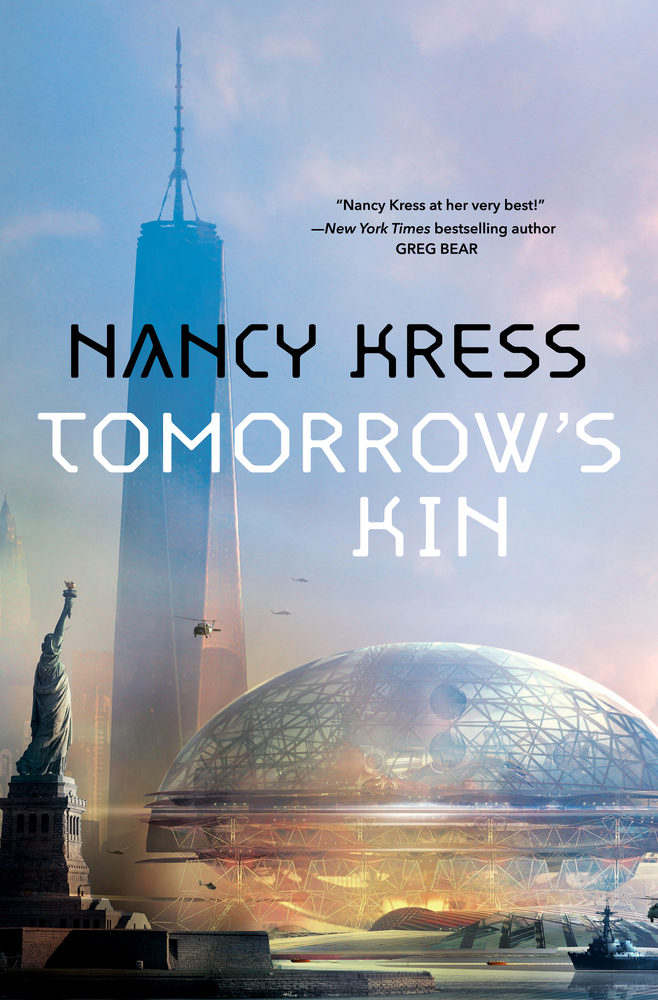
"Tomorrow's Kin"

Nancy Kress is the bestselling author of multiple science-fiction and fantasy novels, including Beggars in Spain, Probability Space, and Steal Across the Sky. Her SF has won six Nebulas, two Hugos, a Sturgeon, and the John W. Campbell Award. Her most recent book is Tomorrow's Kin, an expansion of the Nebula-winning novella “Yesterday’s Kin,” which takes the story forward several generations. Her fiction has been translated into multiple languages, including Klingon.

Kress applied the Page 69 Test to Tomorrow's Kin and reported the following:
How representative does a single book page have to be to count as “representative”? Page 69 of Tomorrow’s Kin depicts part of a confrontation between Noah Jenner, wayward son of protagonist Marianne Jenner, and an alien. Only the alien isn’t, exactly—he’s the descendent of humans taken from Earth 140,000 years ago by unknown beings. DNA analysis has verified this. Noah feels a shock of recognition, however, that goes beyond the 6,000-generation-ago family tie. The shock has to do with something going on in Noah’s brain caused by his heavy use of a drug called sugarcane. The recognition will have major plot consequences. So—I guess that page 69 is, if not representative, at least heavily congressional.

Tomorrow’s Kin is based on my Nebula-winning novella, “Yesterday’s Kin,” and extends the story for ten more years. It is the first of a trilogy, all of which are written, because the novella turned out to be only the start of a complex story that I very much wanted to tell. It involves two planets, three global disasters, and four generations. They get around, those Jenners. And in doing it, they alter the course of human history.
Follow Nancy Kress on Twitter and Facebook.

--Marshal Zeringue

Friday, July 14, 2017

"Girl on the Leeside"

Kathleen Anne Kenney is an author, freelance writer, and playwright. Her writing has appeared in Big River, Coulee Region Women, and Ireland of the Welcomes, as well as other publications. She has had numerous short plays presented in Minnesota theaters and has published the play The Ghost of an Idea, a one-actor piece about Charles Dickens. Her play New Menu was a winner in the 2012 Rochester Repertory Theatre’s national short-play competition. She is currently at work on a novel based on her 2014 stage play, The Bootleg Blues.

Kenney applied the Page 69 Test to her new novel, Girl on the Leeside, and reported the following:
This is really intriguing! Page 69 doesn’t include the main character, Siobhan, but two secondary characters discussing her:
There was a pause, then Tim said, “You know them well.” His voice held an unconscious hint of envy.

Maura smiled. “I’ve been friends with Siobhan since we were five and met at school. My favorite stories had always been those about fairies and kelpies and sprites, and, I thought, here one was! For the longest time I was convinced she was only temporarily in human form, and would be disappearing back into her fairy mound one day.”

“I’ve gotten that feeling, too,” Tim admitted.

“I’m not surprised. But she’s real. Just in her own world. Unfortunately. She was so full of stories as a child, always full of stories. Even by the age of eight or nine she was an expert in ancient tales and legends. When she was telling one of those it was the only time she really came alive, came out of herself. It’s almost the same today.” Maura’s voice was a little sad.

It was a relief to Tim that someone else, someone who knew her so well, also saw Siobhan as being too secluded.

“Has she never been away from here?” he asked.

“Oh, sure. Keenan has taken her on a few day trips, to Iona, Wexford, and such. Always, of course, to visit the ancient stones and ring forts and dolmens and that. I remember once our family was going on holiday to Scotland for a week, and I was desperate for Siobhan to come along. My da said it would be all right. Siobhan didn’t even really want to come but I was determined to make her. We were both about ten, I think. I got up my courage to ask Kee. He said no.”

“Do you think he’s still overprotective of her?”

Maura hesitated and Tim felt he’d gotten too personal. Maura studied his face for a moment before she answered.

“Yes. Although he doesn’t have to be. She’s an expert at it herself.”
I do think this passage reflects the fact that most of the characters in the novel think about Siobhan quite a bit, and that the story moves ahead because of their interaction with and reaction to her as the protagonist. It also gives a glimpse into what kind of person she is: overly protected and withdrawn.
Visit Kathleen Anne Kenney's website.

My Book, The Movie: Girl on the Leeside.

--Marshal Zeringue