Monday, June 15, 2015

"Long Black Curl"

Alex Bledsoe grew up in west Tennessee an hour north of Graceland (home of Elvis) and twenty minutes from Nutbush (birthplace of Tina Turner). He has been a reporter, editor, photographer and door-to-door vacuum cleaner salesman. He now lives in a Wisconsin town famous for trolls.

Bledsoe applied the Page 69 Test to his new novel, Long Black Curl, the third novel of the Tufa, following The Hum and Shiver and Wisp of a Thing, and reported the following:
Page 69 of Long Black Curl describes a crucial meeting between two characters. One of them is Mandalay Harris, the 12-year-old girl who is the hereditary leader of half the Tufa, a race descended from exiled Celtic faerie folk and now living in modern Appalachia. The other is Luke Somerville, a 12-year-old boy from the other half of the Tufa. Mandalay has gotten lost in the snow, something that really shouldn’t be possible given her Tufa blood, and Luke has just discovered her.
The shape stopped. The dog barked once. “Who’s there?” the shape called.

“My name’s Mandalay Harris. I reckon I’m lost. Who’s that?”

“Luke Somerville. Lord a’mighty, girl, how’d you end up all the way out here?”

“Like I said, I got lost. Reckon I have a talent for it.”

“You sure do.” He came closer, and she could see his face. He was about the same age as her, black haired and big eyed. She’d seen him around school, but he belonged to Rockhouse’s people, and they tended not to interact with her folks anywhere but the Pair-A-Dice. She wondered if he knew who she was.
Among other things, Long Black Curl is about the dangers inherent in forming relationships across borders, whether it be family, clan, or society. The central couple, Bo-Kate Wisby and Jefferson Parker, once did so, and it led to horrific events that caused them to be the only Tufa ever banished. Now Mandalay seems on the verge of doing the same thing; given her standing in the Tufa community, the potential for even more destruction is very real.

But at the same time, the potential for great good is there as well. The relationship between Romeo and Juliet, after all, ended their families’ feud. As the modern world encroaches on the Tufa, making it harder and harder to continue hiding in plain sight after centuries of isolation, these relationships may be their only hope. Unless, of course, they lead to their destruction.
Learn more about the book and author at Alex Bledsoe's website and blog.

The Page 69 Test: Wisp of a Thing.

Writers Read: Alex Bledsoe.

--Marshal Zeringue

Saturday, June 13, 2015

"Escape to Hangtown"

Larry D. Sweazy (pronounced: Swayzee) is the author of ten novels, Escape from Hangtown, See Also Murder: A Marjorie Trumaine Mystery, Vengeance at Sundown, The Gila Wars, The Coyote Tracker, The Devil's Bones, The Cougar's Prey, The Badger's Revenge, The Scorpion Trail, and The Rattlesnake Season. He won the WWA (Western Writers of America) Spur award for Best Short Fiction in 2005 and for Best Paperback Original in 2013. He also won the 2011 and 2012 Will Rogers Medallion Award for Western Fiction for books the Josiah Wolfe series. He was nominated for a Derringer award in 2007 (for the short story "See Also Murder"), and was a finalist in the Best Books of Indiana literary competition in 2010. Sweazy was awarded the Best Books in Indiana in 2011 for The Scorpion Trail. And in 2013, he received the inaugural Elmer Kelton Fiction Book of the Year for The Coyote Tracker, presented by the AWA (Academy of Western Artists). Sweazy has published over sixty nonfiction articles and short stories, which have appeared in Ellery Queen's Mystery Magazine; The Adventure of the Missing Detective: And 25 of the Year's Finest Crime and Mystery Stories!; Boys' Life; Hardboiled; Amazon Shorts, and several other publications and anthologies. He lives in the Midwest with his wife, Rose.

Sweazy applied the Page 69 Test to Escape from Hangtown:
From page 69:
“You look like your sister,” Little Ling said with a whisper.

You knew my sister? For some reason, the announcement of such a thing surprised Celia—until she looked closer.
This start of the first full paragraph on page 69 of Escape from Hangtown is representative of the book, and I’m glad of that. Even though this is a Lucas Fume Western novel, I really think this is Celia Barlow’s book. Celia was beaten within an inch of her life for falling in love with Zeke Henry, a black man, for breaking a terrible taboo of the time, even though no innocent lines had been crossed. The beating left Celia paralyzed, but wholly alive and unable to speak, unable to care for herself in any way. Lucas Fume’s goal in this book is to prove that Zeke Henry is innocent of harming Celia, that the perpetrator of the horrible assault was actually her father, the power senator, Lancaster Barlow. Lucas wants Zeke to be as free as he is; a repayment for Zeke’s efforts to see Lucas free of being falsely imprisoned in the first book (Vengeance at Sundown) of the series. It’s a tough task for Lucas, wrought with peril, and the first part of his plan is to take possession of Celia and get her in a safe place. Little Ling is her caretaker, a longtime family friend who has sided with Lucas. This scene takes place shortly after Celia has been whisked away from a neglectful sanatorium, and she starts to find some long sought after comfort. Lucas’s intervention has given Celia something she thought would never have again, at least in this life… She now has a glimmer of hope, and that, ultimately, is what this book is about.
Learn more about the book and author at Larry D. Sweazy's website and blog.

Coffee with a Canine: Larry D. Sweazy & Brodi and Sunny (April 2011).

Coffee with a Canine: Larry D. Sweazy & Brodi and Sunny (April 2013).

Writers Read: Larry D. Sweazy.

My Book, The Movie: Escape to Hangtown.

--Marshal Zeringue

Thursday, June 11, 2015

"The Far End of Happy"

Long a leader in the Southeastern Pennsylvania writing scene, writing teacher and developmental editor Kathryn Craft is the author of The Art of Falling.

She applied the Page 69 Test to her second novel, The Far End of Happy, and reported the following:
From page 69:
“Where are your rings?”

For years he had ignored her in every way that counted; Ronnie was surprised he’d even noticed. She hadn’t meant to make a public statement. As kindly as she could, she said, “Let’s talk tonight, Jeff. At home, like we planned.”

After Tae Kwon Do, they got drive-through burgers and ate on the way to parent-teacher night. Ronnie—and Jeff too, she was sure—pretended to listen to the teachers and look at the projects on the wall, slapping smiles over twisting guts and draining hearts. When they finally got home and Jeff declined her invitation to join in on the boys’ bedtime rituals, she skipped reading the boys a book by promising two the next night.

Ronnie rejoined him in the living room. He sat on the love seat; she sat on the couch.

Jeff spoke first.
“I was going to shoot myself tonight.”
She wasn’t sure she heard him right. He wasn’t hysterical. He could have been saying, I was going to watch football, but the Eagles weren’t playing. Ronnie couldn’t focus on the magnitude of what he was saying; she got stuck on the word “shoot.”

It only took another moment to add it up: he’d already come up with a plan, and it involved a gun.
Based on the twelve hours of my first husband’s suicide standoff at our idyllic little farm in rural Pennsylvania, The Far End of Happy explores the perspectives of three women—Ronnie, her mother Beverly, and Jeff’s mother Janet, all whisked to the safety of a nearby fire hall—who must make tough choices and face shameful secrets while awaiting word about Jeff’s standoff against police at the farm.

This backstory excerpt contextualizes the tragedy unfolding in this marriage. Ronnie, no longer able to handle her husband’s drinking and financial secretiveness, takes one symbolic action to assure herself that she can control her destiny—she removes her wedding rings—and in doing so her life spins further out of control. Modern mothers will no doubt relate: busy as she is ferrying her two active sons from one thing to the next, in recent years Ronnie has assumed that she and her husband had hit a rough patch that would resolve as the boys grew older, missing signs that he was losing his grip on life.

Ronnie and Jeff will live through the night depicted in this excerpt, but she can only protect herself and her children if she leaves the marriage behind. This won’t be easy. Breaking her vow to the man she has loved for fifteen years has already drained her. At the opening of the novel Ronnie bolsters her spirit with the notion that today Jeff will move out.

But Jeff has no intention of leaving. He pulls into the driveway drunk and armed, and after his son’s 911 call, digs in against police. For every agonizing moment that remains of that day, Ronnie must decide whether she will cave in to Jeff’s demands or face off against her decision’s life-or-death stakes.
Visit Kathryn Craft's website, Facebook page, and Twitter perch.

--Marshal Zeringue

Wednesday, June 10, 2015

"The Ways of the World"

Robert Goddard is the Edgar Award–winning, internationally bestselling author of The Ways of the World; Long Time Coming; Into the Blue, which won the first WHSmith Thumping Good Read Award; and Past Caring. He teaches history at the University of Cambridge and lives in Cornwall.

Goddard applied the Page 69 Test to The Ways of the World and reported the following:
Page 69 of The Ways of the World finds our hero, James ‘Max’ Maxted, at the CafĂ© Parnasse in Paris in the early spring of 1919, in the company of his late father’s secret lover, Corinne Dombreux. They have something in common. Unlike just about everyone else involved, they believe Sir Henry Maxted didn’t die in an accidental fall from the roof of the apartment block where Corinne lives – he was pushed. The question is: who pushed him – and why?

Quite a lot of the story emerges on this one page: the alliance between Max and Corinne; the wish of officialdom that no scandal be allowed to touch the post-war peace conference, where Sir Henry was serving as an advisor to the British delegation; the police’s theory that Sir Henry went onto the roof to spy on an Italian artist he suspected of being a rival for Corinne’s affections; the belief shared by Max and Corinne that Sir Henry actually went up there in pursuit of an intruder; the significance, ignored by the police, of the skylight broken from the inside.

‘How sure are you that he was murdered, Corinne?’ Max asks. And she replies, ‘You mean how sure can I make you?’ But the truth, which Corinne probably senses, is that Max is already sure. And he is not going to rest until he discovers the truth – or dies in the attempt.

Welcome to Paris, in the first year of a peace that for some will be deadlier than the war that preceded it.
Visit Robert Goddard's website.

My Book, The Movie: The Ways of the World.

--Marshal Zeringue

Tuesday, June 9, 2015

"Death Ex Machina"

Gary Corby is the author of the Athenian Mystery series, starring Nicolaos, his girlfriend Diotima, and his irritating twelve year old brother Socrates.

The books in order are The Pericles Commission, The Ionia Sanction, Sacred Games, The Marathon Conspiracy, and the newest addition, Death Ex Machina.

Corby applied the Page 69 Test to Death Ex Machina and reported the following:
I'm afraid life isn't getting any easier for the only private agent in ancient Athens, but at least he has a chance to get into show biz.

It’s the time of the Great Dionysia, the most important arts festival of the ancient world, and a crisis is well underway, because a ghost is haunting the theater. Already too many things have gone wrong and the show promises to be a disaster.

Page 69 sees a wet actor join Nico and Diotima in sheltering from the rain. The actor is a man named Romanos.
“What are you doing out in this weather?” I asked him.

“I was at the theater,” he said. “I was rehearsing the new third actor in his lines.”
The actors are rehearsing for Sisyphus, King of Corinth, written and directed by a fellow named Sophocles, who is becoming increasingly distraught at the state of his play.

This conversation is an important scene. Romanos has clues to offer and, more to the point, insights to offer about himself. He’s a foreigner, from the distant land of Phrygia, come to Athens to find work. Romanos’s greatest desire is to become a citizen of Athens.

Athens at this time had a problem all too familiar to modern western nations: an enormous influx of migrants. How Athens coped with immigration is one of the sub-plots of the story.

What clues have Nico and Diotima found? Will Romanos win his citizenship? You’ll have to read the story to find out!
Visit Gary Corby's blog.

The Page 69 Test: The Pericles Commission.

My Book, The Movie: The Pericles Commission.

My Book, The Movie: The Ionia Sanction.

The Page 69 Test: The Ionia Sanction.

The Page 69 Test: Sacred Games.

My Book, The Movie: Sacred Games.

The Page 69 Test: The Marathon Conspiracy.

My Book, The Movie: The Marathon Conspiracy.

Writers Read: Gary Corby.

My Book, The Movie: Death Ex Machina.

--Marshal Zeringue

Monday, June 8, 2015

"Hover"

Anne A. Wilson was born and raised in Phoenix, Arizona. She graduated from the U. S. Naval Academy in Annapolis, Maryland, with a degree in ocean engineering, followed by nine years of active duty service as a Navy helicopter pilot. Following her military service, she worked for four years in the semi-conductor industry, and currently, owns a triathlon coaching business, Camelback Coaching, with her husband, now in its twelfth year of operation. She lives in Fountain Hills, Arizona with her husband and two sons.

Wilson applied the Page 69 Test to her new novel, Hover, and reported the following:
From page 69:
“So then what?” Em says.

I’m giving her the play-by-play of my stay on the Lake Champlain following a tortuously long day. The check flight for Sabercat 55 took a full thirteen hours to complete, all sitting next to a live wire in Commander Claggett.

“Hold that thought,” I say. “I have got to get something in my stomach or I’m going to pass out.”

Entering the empty wardroom, I make a beeline to the counter that supplies bread, peanut butter and jelly. I put together a sandwich, fill a glass with lemonade, and drop into a wide, stainless steel chair—one of thirty or so positioned on either side of seven long, rectangular tables.

Having just departed the Lake Champlain, I gain a new appreciation for the ample size of our wardroom. Our tables are arranged end-to-end to form a U shape, filling the middle of the space. A lounge area with couches and a TV occupies the far corner. There’s even room for a sizeable salad bar.

Steel blue-gray dominates—the color of the heavy duty plastic table coverings. The chairs are a lighter shade of gray and this all contrasts not so nicely with bulkheads painted a stale yellow-cream, just like our stateroom.

I stare ahead at nothing as I eat, my mind crowded with images from my stay on the Lake Champlain. I’m so wholly engrossed in my thoughts that I don’t notice the arrival of the ship’s operations officer.

“Hey, Sara,” he says in his slimy way. “Imagine finding you here.”

“Yeah, imagine that, Sir.”
I rely heavily on dialogue to tell my stories, so page 69 is “rare” in that descriptive paragraphs occupy a greater amount of real estate than the words within quotes. Having said that, though, page 69 does give a glimpse into my insights about life on a U. S. Navy ship and the inner workings of a U. S. Navy battle group.

I served in the navy as a helicopter pilot for nine years active duty. And since living and working in a navy battle group is not something most people get to experience, I feel I’ve been granted the opportunity to bring my readers into this unique place and give them a taste of what it’s like.

In this scene, the main protagonist, Sara, who is a gifted helicopter pilot, has just returned to her ship, the USS Kansas City, after spending two nights on the guided-missile cruiser, USS Lake Champlain. An aircraft malfunction forced an emergency landing of her helicopter on the deck of the Lake Champlain, so now, she’s recalling her experience to her roommate, Emily.

Normally, the back and forth banter between Sara and Emily is snappy and quick and the pages fly when these two are at it. But on this occasion, Sara needed food fast, so she darted to the wardroom to grab a snack. The wardroom on a ship is where the officers eat, so I offer a brief description of what a wardroom looks like.

The reader is also introduced to the operations officer on the ship, a person Sara is clearly not happy to see.

For me, the jury is out on this one. If someone was skimming, I’m not sure they’d be compelled to read the whole book after reading page 69. I would probably answer differently if we were talking about the pages just before or just after. If they could read these pages, the reader would learn of a romantic plotline and a Navy SEAL mission. But since it’s page 69, I would hope that it’s enough to pique the reader’s interest, and that it’s written in such a way that the reader would know they’re in good hands, and that they’re going to receive an authentic glimpse of life on a navy ship.
Visit Anne A. Wilson's website.

--Marshal Zeringue

Sunday, June 7, 2015

"The Brass Giant"

Brooke Johnson is a stay-at-home mom, amateur seamstress, RPG enthusiast, and art hobbyist, in addition to all that book writing. As the jack-of-all-trades bard of the family, she adventures through life with her fiercely-bearded paladin of a husband, their daughter the sticky-fingered rogue, and their cowardly wizard of a dog, with only a sleep spell in his spellbook.

They currently reside in Northwest Arkansas, but once they earn enough loot and experience, they'll build a proper castle somewhere and defend against all manner of dragons and goblins, and whatever else dares take them on.

Johnson applied the Page 69 Test to her new novel, The Brass Giant: A Chroniker City Story, and reported the following:
I don’t yet have the bound paperback of the novel from the publisher yet (that comes out June 23!), but estimating where page 69 might be in the print version…
She entered the lift and turned in a circle as she examined all the exposed gears and belts, pulleys, linkages, and electric wires, forgetting her disappointment, forgetting her worries and her doubts. Emmerich followed her in, the curved glass door of the lift closing behind him.

Buttons decorated a freestanding podium at the back of the lift, each one seeming to correspond with a floor in the east tower. There was a large lever on one side of the podium; Emmerich produced a key and slid it into a locking mechanism on the other side. Petra heard a distinct click within, and then, above the lift chamber, the drive motor whirred. Emmerich pressed a button labeled with an ornate O at the top right of the panel and pulled a knob at the bottom. The gearbox within the drive motor shifted, and a white bulb above the podium ignited.

“Ready?” He placed both hands on the large lever.

Petra nodded, and he put all of his weight into pulling the lever back. The whirring of the drive motor slowed for a moment, and with a loud click, the driveshaft locked. She held her breath. The spring-loaded lever snapped back to its original position, and the lift slowly rose above the lobby floor.

Petra’s heartbeat quickened, the steady hum of machinery whirring beneath her feet, vibrating through her bones. She could not help but smile, the gears spinning in perfect, deliberate harmony—a sound fashioned by the hands of a skilled engineer. This was why she wanted to be a part of the Guild, why she tried so hard to prove herself; she wanted to build things that sang, machines so expertly designed that they never faltered, so innovative that she changed the very motions of the world.

She wanted to build the future.
Is it representative of the rest of the book? Absolutely yes. The Brass Giant is full of descriptions like this, detailing the machines of Chroniker City through an engineer’s eyes. Petra lives and breathes machines, and Chroniker City is an integral part of who she is. Would a reader skimming this page be inclined to read on? If a wide variety of mechanical contraptions intrigue them, yes. I would hope so anyway. The Brass Giant is very much a love letter to Victorian science. If that interests you, then this is the book for you.
Learn more about the book and author at Brooke Johnson's website.

My Book, The Movie: The Brass Giant.

--Marshal Zeringue

Friday, June 5, 2015

"What Lies Behind"

J.T. Ellison is the New York Times bestselling author of thirteen critically acclaimed novels, including What Lies Behind, When Shadows Fall and All the Pretty Girls, and is the co-author of the A Brit in the FBI series with bestselling author Catherine Coulter. Her work has been published in more than twenty countries. Her novel The Cold Room won the ITW Thriller Award for Best Paperback Original, and Where All The Dead Lie was a RITA® Nominee for Best Romantic Suspense. She lives in Nashville with her husband and twin kittens, where she enjoys fine wine and good notebooks.

Ellison applied the Page 69 Test to What Lies Behind and reported the following:
I love this test. It’s fascinating to me, to see what the story says at this particular point in the narrative. As it happens, for once, I have a hugely compelling and important moment in the book on page 69. Former medical examiner, Dr. Samantha Owens, is dropping by a crime scene at the request of her friend, homicide lieutenant Darren Fletcher. The scene is a bad one, one victim murdered, the second clinging to life in a coma, and they are making their way through the apartment when Sam makes a discovery that changes the course of the investigation:
Most importantly, what was an undercover FBI agent doing in the apartment of a Georgetown University medical student?

She took a deep breath, trying to clear her head. Smelled something off, something close. Deeper than the tang of blood and the effluvia of dead bodies. Sweet, almost flower-like, but not. She couldn’t place it, had never come across the scent before. It wasn’t pleasant, and it wasn’t a natural part of the crime scene, she was sure. It smelled a bit like overripe honeysuckle, but sharper, with some mint, perhaps, both scents overlaid with a sickly rot that made her gorge rise.

Where was it coming from? She saw nothing unusual, or out of place, except for the copious streaks of blood.

“Fletch, come here. Do you smell anything?”

Fletcher breathed in deep. “Blood and gore and carpet cleaner. Maybe some old pot smoke. Bacon grease.”

“Nothing flower-like? Like old flowers left to mold in a vase of water?”

“Like the way patchouli smells? I’ve never liked it, but I can’t say—”

“No, that’s not it.”

Fletcher came closer, sniffing. “Ugh. Yeah, I smell it now. What the hell? It wasn’t here earlier.”

Sam edged to the breakfast bar, wrinkled her nose as the smell grew stronger. She looked closer at the bar. Runnels of blood had come off the counter, streamed down the paneling. There was a break in the blood, almost as if a ruler had been placed in the down flow and the blood had run over it in a perfect line.

“Do you have a Maglite?” she asked.

“Sure,” Fletcher replied, handing her the flashlight he’d stuffed in his jacket pocket.

She shone the light on the edges of the counter, then down into the paneling. In one small area, about twelve inches across, the blood dribbled into nowhere, just plain disappeared.
Now you have to turn the page to find out what she’s discovered, right?

I don’t often have such a monumental event on page 69, this is probably the second or third in 13 books. You just never know how the book is going to break down on the page.
Visit J.T. Ellison's website, or follow her on Twitter or Facebook.

My Book, The Movie: What Lies Behind.

--Marshal Zeringue

Thursday, June 4, 2015

"Bones & All"

Camille DeAngelis is the author of the recently released Bones & All, Petty Magic: Being the Memoirs and Confessions of Miss Evelyn Harbinger, Temptress and Troublemaker, and Mary Modern, as well as a first-edition guidebook, Moon Ireland. She is a graduate of New York University (B.A. in Fine Arts, minor in Irish Studies, 2002) and the National University of Ireland, Galway (M.A. in Writing, 2005).

DeAngelis  applied the Page 69 Test to her new novel, Bones & All, and reported the following:
I laughed out loud when I turned to page 69, because for many readers this passage is one of the most horrifying in the whole novel. My boy- and babysitter-eating narrator, Maren, meets a sweet (and unsuspecting) old lady at the grocery store, and she brings Maren home and makes her breakfast. Later that day Maren meets an old man who also takes her under his wing, but in a very different way: Sully is the only person she's ever met who also does “the bad thing.” From the bottom of page 69:
The clock on the mantel chimed six as Sully brought his pack in from the sitting room, propped it against the refrigerator, and drew a long ropelike object out of the opening. At first I did think it was a rope, but then he pulled out the thick, silvery knot of Mrs. Harmon’s chignon and laid it out on the calico place mat with a sort of reverence, and I realized what the ropelike thing was made of. There were all sorts of hair woven into it, red and brown and black and silver, curly and kinky and slippery-straight. I never knew something could be so grotesque and so beautiful at the same time.
Sully's neverending rope of hair is part of why people say Bones & All reminds them of Stephen King, which of course I take as a huge compliment.
Visit Camille DeAngelis's website.

Writers Read: Camille DeAngelis.

--Marshal Zeringue

Wednesday, June 3, 2015

"Unchanged"

Jessica Brody's books include the teen sci-fi/suspense trilogy: Unremembered, Unforgotten, and Unchanged. Unremembered is now in development as a major motion picture.

Brody applied the Page 69 Test to Unchanged and reported the following:
From page 69:
The glint off the metal cube drive sparkles in the glass and I turn around and pick it up. I sit down on the edge of the bed and turn the small object over and over in my palm, studying its smooth, shiny surface, wondering what could possibly stored on it. Some kind of message left for me to find?
When I was asked to participate in the page 69 test, I was fascinated to find that page 69 of Unchanged, the final book in the Unremembered trilogy really does capture a lot of what this story is about. As indicated in the above passage, Unchanged (as with the rest of the trilogy) is mysterious, suspenseful, and full of cool, futuristic technology. And this particular passage (along with a few other passages on this page) actually marks the beginning of a mystery that will set up the entire rest of the book and give a final resolution to the trilogy.

I love keeping the reader guessing and on the edge of their seat. And I also love exploring the “what-ifs” of our culture and our technology. That’s what I set out to do in this trilogy.

So, yes, I think Unchanged passes the page 69 test. I hope you’ll agree!
Learn more about the book and author at Jessica Brody's website and blog.

My Book, The Movie: Unremembered.

--Marshal Zeringue

Tuesday, June 2, 2015

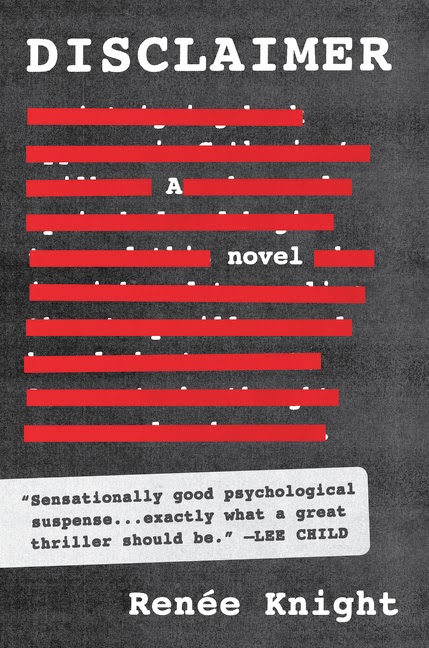
"Disclaimer"

Renée Knight worked for the BBC directing arts documentaries and has had TV and film scripts commissioned by the BBC, Channel Four, and Capital Films. In April 2013, she graduated from the Faber Academy "Writing a Novel" course, whose alumni include S. J. Watson. She lives in London with her husband and two children.

Knight applied the Page 69 Test to her new psychological thriller, Disclaimer, and reported the following:
Page sixty-nine is only half a page, the opening of Chapter Thirteen. It describes the moment when Catherine Ravenscroft recognises for the first time, that her life might be in danger. She is standing on an underground train platform on her way to work: 'Buried beneath the earth, deep underground, at least thirty feet between her and natural light'. She has done this a million times before but this time it is different. This time the words she has read from the book that found its way into her home - the book in which she discovered she is a central character - fill her head. She hears them as she is crushed by the rush hour crowd who are pushing around her to get on to the train. She hears them as she sees her feet slipping across the yellow safety line. She hears them as she looks up at the train arrivals screen which tells her the train will be arriving in three minutes.
...what she didn't know was that it was also telling her how long she had left to live...
Buried in this half page too, is an echo from the secret which Catherine has tried so hard to keep hidden.
Learn more about Disclaimer at the publisher's website.

Writers Read: Renée Knight.

--Marshal Zeringue

Monday, June 1, 2015

"Dear Carolina"

Kristy Woodson Harvey holds a degree in journalism and mass communications from the University of North Carolina at Chapel Hill and a master’s in English from East Carolina University.

She applied the Page 69 Test to her new novel, Dear Carolina, and reported the following:
I was a little nervous about this “Page 69” test. It’s a lot of pressure, isn’t it? I, obviously, didn’t know what page 69 of Dear Carolina held off the top of my head, so I worried that page 69 wouldn’t be a good page or that it wouldn’t be representative of the rest of the book. So, imagine my relief, when I found that page 69 is sort of a microcosm of the rest of the novel!

When page 69 opens, Jodi, the birth mother in the story, is fighting her very hardest not to start drinking again, which is one of her main struggles in Dear Carolina. She goes to her cousin Graham and his wife Khaki’s house, where Khaki immediately takes baby Carolina. Jodi says, Khaki “winked at me and patted my back real sweet like. She didn’t have to say nothing at all for me to know that she knew right where I was. Not long ago, she’d been knowing that same tired that brings you to your knees and frustration over not being able to do nothing to stop the cryin’ and being so scared you like to faint from remembering that this little baby—all she’s got in the whole wide world is you. But she didn’t know near nothing ’bout addiction. And that was the difference.”

That paragraph, I’d dare to say, is the crux of the story. Khaki and Jodi, despite their clear differences in socioeconomic background, education, upbringing… They understand each other in a very poignant way that goes even deeper than the bond of the shared understanding of motherhood.

And, despite her remembering of the difficulties new motherhood can bring, Khaki longs for another child anyway. But, as Jodi says, the thing that separates them, the thing that makes them different is that, when Khaki is feeling down and upset and exhausted, she turns to her husband Graham. And Jodi turns to alcohol.

As Jodi sits in her cousin’s kitchen, in the home that she compares to “a summer day at the beach,” she realizes: “I couldn’t think straight I were so busy looking around figuring on where they keep the booze. I’d like to tell you I wouldn’t never steal from somebody I love. But I wrote more than a few ‘sorry’ letters to people I loved during them twelve steps.”
Jodi feels about as low as she ever has on page 69. She is scared and exhausted and depleted and she has nowhere to turn. On the one hand, she is excited to tell Graham about the new job that she has been offered, but, on the other, she is racked with worry because she has no idea how she can take the job, pay for childcare and possibly make ends meet.

In his strong, Southern, cowboy kind of way, Graham, as always, makes Jodi feel better with one sentence, with the last line of page 69 that, again, is one of the most important messages of the entirety of Dear Carolina: “You don’t need to give up, and you aren’t all alone.”

That is, to me, the most important theme in Dear Carolina. And, happily, page 69 embodies it quite well!
Visit Kristy Woodson Harvey's website.

My Book, The Movie: Dear Carolina.

Writers Read: Kristy Woodson Harvey.

--Marshal Zeringue