Thursday, March 31, 2022

"Fencing with the King"

Diana Abu-Jaber is the award-winning author of several books of fiction and nonfiction, including Crescent and The Language of Baklava.

She applied the Page 69 Test to her new novel, Fencing With the King, and reported the following:
Page 69 of Fencing With the King contains a moment from Amani, the main character’s childhood, when she told a nun that her grandmother was her guardian angel. The nun, who’s an uptight sort, is scandalized by this. She complains to Francesca, the child’s mother, that her daughter is breaking the rules of Catholicism and that people can’t be guardian angels.
Francesca didn’t stop tapping her pen until the nun had finished explaining about how wayward and recalcitrant Aman often seemed, her strange ideas, the time she told class that the communion host was made of paper, and how sorry Sister was for her loss, but angels were divine intermediaries, untainted by the physical world: Francesca’s mother could not strictly be considered a guardian angel.
This page is a flashback, so while it does reveal important information about Amani’s upbringing and her relationship to her grandmother, it’s also somewhat anecdotal, a kind of break from the main narrative, meant to quickly and concisely insert information to help readers better understand Amani’s motives. This particular page 69 gives you a fair sense of the flavor of the book – its rhythms, tone, and dialog, as well as providing a little window into one of the central relationships, but strictly speaking, it might also be considered a bit digressive from the main plot line because it’s removed from it in terms of place and time.

It’s interesting to look at this page in part because one of the main underlying questions of Fencing With the King is whether it’s possible to have a relationship with someone you’ve never actually met. Amani’s grandmother died before she was born, yet Amani returns to Jordan in search of her grandmother’s story and to hunt down certain mysterious clues she left behind about her life. In many ways, this page 69 might be seen as another one of those secret clues.
Learn more about the writer and her work at Diana Abu-Jaber's website.

The Page 99 Test: Origin.

--Marshal Zeringue

Tuesday, March 29, 2022

"The Echoes"

Jess Montgomery is the author of the Kinship Historical Mysteries. Under her given name, she is a newspaper columnist, focusing on the literary life, authors and events of her native Dayton, Ohio for the Dayton Daily News. Her first novel in the Kinship Historical Mystery series garnered awards even before publication: Montgomery County (Ohio) Arts & Cultural District (MCAD) Artist Opportunity Grant (2018); Individual Excellence Award (2016) in Literary Arts from Ohio Arts Council; John E. Nance Writer in Residence at Thurber House (Columbus, Ohio) in 2014.

Montgomery applied the Page 69 Test to The Echoes, the fourth novel in the Kinship series, and reported the following:
On page 69, Lily Ross, Sheriff of Bronwyn County in the Appalachian area of Ohio, is at the grand opening on July 4 of an amusement park dedicated to veterans, particularly to her brother Roger, who died in the Great War. The park—which features a shooting range, fishing pond, archery, dance floor, and similar activities—was built by Chalmer, a veteran and owner of the local lumber mill. His cousin Hiram, also a veteran, has helped build the park. In this scene Hiram has just had a strong reaction to the sound of gunfire—triggered by PTSD, though it would not have been called by that name in 1928. Lily is attempting to calm him:
But Hiram has always, Lily reflects, looked scared, about to jump out of his skin at the least provocation. Lily digs back in her memory. Roger and Hiram had been friends, but then Roger was popular with everyone. Still, Lily finds a few hazy memories of Hiram coming over to their house after school and Mama always setting an extra spot for him. Daddy always offered to take Hiram back to his house after dinner, but Hiram would always walk, his insistence almost panicky. And Lily hadn’t thought much about it then, how hard it must have been for Hiram to come into town for school each day—well, most days, and as he got older, he missed more days than he attended. He’d dropped out after tenth grade.

Lily says so softly that her voice is a near whisper, “Too bad we didn’t bring our fishing poles, huh, Hiram?”

He does not look at her.

She puts a hand on his arm, ever so gently, but he still jumps. Then, he does look at her, a bit wild-eyed, but he is finally focused on the moment, on her.

“Hiram, can you tell me what happened? Before you . . .” She pauses, wanting to phrase this accurately, but not accusatorily. “Before you came up onstage?”

“There was gunfire. I thought—I thought—”

“It startled me, too,” Lily says. “Someone should have told the boys down at the shooting range to stop during that time.”

Hiram looks at her at last, his eyes wide. “It was—just from the shooting range?”

“Yes. Part of the park.”

He hangs his head again.

“Hiram,” Lily says. “Please look at me.”

Slowly, he looks up. “It is all right,” she says. “It would be easy to be startled by that sound. To not be sure where it was coming from....”
This page captures the driving force of the plot, Lily’s personality, Hiram’s character, and the theme of The Echoes. Plot: much of the plot is driven by contention over the land on which the park is built. Lily’s personality: Lily is a strong woman and a hard-working sheriff. She is not afraid of physical confrontation, but where possible, she prefers de-escalation and discussion to diffuse difficult situations. Hiram’s character: Hiram is a gentle soul wracked by PTSD from his experiences in the Great War, which contributes to his uncertainty about how to navigate the world around him. Theme: secrets from the past, and how much we share or don’t share with our loved ones, and how we can move forward once these secrets are revealed, is the thematic core of The Echoes, and it turns out that there are secrets aplenty in Hiram’s and Lily’s families.
Visit Jess Montgomery's website.

The Page 69 Test: The Hollows.

The Page 69 Test: The Stills.

--Marshal Zeringue

Sunday, March 27, 2022

"On a Night of a Thousand Stars"

Andrea Yaryura Clark grew up in Argentina amid the political turmoil of the 1970s until her family relocated to North America. After graduating from Georgetown University's School of Foreign Service — including a year of study at the Universidad del Salvador in Buenos Aires —and completing her MBA at York University (Toronto, Canada), she returned to Buenos Aires to reconnect with her roots. By the mid-1990s, many sons and daughters of the "Disappeared"—the youngest victims of Argentina’s military dictatorship in the 1970s —were coming of age and grappling with the fates of their families. She interviewed several of these children, and their experiences, not widely known outside Argentina, inspired her debut novel. She lives in Brooklyn with her husband, two sons and a spirited terrier.

Clark applied the Page 69 Test to her new novel, On a Night of a Thousand Stars, and reported the following:
On page 69 of On a Night of a Thousand Stars, there is a three-sentence paragraph that provides a good glimpse of what the book is about:
I thought about Sanchez’s and Professor Torres’s accounts. Dad had built the safe house for a woman. A missing woman. If that was the case, it might explain why he kept the safe house a secret from my mother.
I hadn’t heard of this test before and I think my novel passed with flying colors! Those three sentences, in my view, capture the two narrative threads. The first one revolves around the dad (Santiago) and his time as a university student in 1970s Buenos Aires. The second story is narrated by Paloma, whose passage I quote. She’s the daughter of Argentinians Santiago and Lila Larrea and has grown up in New York. After an unexpected appearance of an old friend of her father’s at the family’s summer home, Paloma becomes curious about him as a young man. On page 69, she’s trying to figure out what his involvement might have been during the tumultuous years leading up to the military coup of 1976.

When I moved to New York in the early 2000s, after having lived for almost a decade in Buenos Aires (I also spent a part of my childhood there), I realized there wasn’t enough fiction about this tragic period, especially for readers not from Argentina. My hope is that the reader will follow Paloma along on her journey as she slowly uncovers her family’s secret history and her country of origin’s troubling past.
Visit Andrea Yaryura Clark's website.

My Book, The Movie: On a Night of a Thousand Stars.

--Marshal Zeringue

Friday, March 25, 2022

"The Bone Orchard"

A seamstress and horsewoman, Sara A. Mueller writes speculative fiction in the green and rainy Pacific Northwest, where she lives with her family, numerous recipe books, and a forest of fountain pens.

In a nomadic youth, she trod the earth of every state but Alaska and lived in six of them.

She’s an amateur historical costumer, gamer, and cook.

Mueller applied the Page 69 Test to her debut novel, The Bone Orchard, and reported the following:
On page 69 of The Bone Orchard, Pain is witnessing the aftermath of the Boren's Imperial Army confronted by Captain Oram, who heads the Firedrinkers - Borenguard's psychically gifted Imperial police. The Firedrinkers have prevented a riot by enforcing calm on a crowd who are watching their loved ones being pressed into service by Boren's Imperial Army.
Oram turned on his heel, and he and the two columns of Firedrinkers moved off up the Imperial Way. Slowly, as if waking from a dream, the crowd around started to drift into motion.

"I don't see Jim," said Maude, hope quavering in her throat. "I need to get home, Miss Pain. Thankee for waiting with me." The laundress went to her cart, heaved against the handles, and got it moving toward the gate.

Pain didn't move, turning what she had seen over in her mind while the crowd flowed around her and gradually melted back into normal morning traffic. It was clever of Aerleas to send his men to remind people of him; clever again, to send those who were most like him. Colonel Fletcher and his men would inspire Strephon, and Boren, to fear him. And to force the Firedrinkers to act again so soon after the near riot in Cathedral Square.

Clever, also, to force Captain Oram to stand between the anxious crowd and the army taking away their loved ones. Had it been enough for the crowd that he'd made the demonstration with the colonel's horse? Perhaps the people would see the distinction between the Firedrinkers and the greater evil. Aerleas was not done with Borenguard. He was making sure that everyone knew it. The thought prickled along Pain's arms, and she rubbed her hands up and down them to try to lay the hair back down inside her sleeves.

Mechanically, Pain fell back into her routine. It was soothing, easy to simply do what she always did and not to think about things too much. She went to the bakery, but had to wait.

"Sorry, Miss Pain, but the army came in this morning on their way to Lowtown and took every blessed dainty they wanted on vouchers. All I have left is from yesterday. You know I don't do this to my regular customers, Miss Pain, but..."
On one hand, page 69 doesn't work very well in isolation, because there's a lot of assumed knowledge by this point. That's no less true here than it would be in most SFF books. Strephon is the newly-elected Emperor of Boren, and the youngest brother of mad Prince Aerleas who has been heading up the army holding Inshil, a country conquered by Boren. There's no context on this page to tell a reader that if it's read in isolation. They couldn't know that Pain is an artificially created boneghost, and one of five; nor that the Firedrinkers are all controlled by mindlocks. It wouldn't warn the reader about any of the dark themes of trauma and recovery in this book. I don't believe page 69 would make a reader buy the book if read by itself, but if the reader skipped this page, they'd lose information that's vital to understanding the dance of power between the Firedrinkers and the army of Prince Aerleas. It's a glimpse at the political situation. It's a glimpse of how as insane general and his army might still come home to roost. It's also a good look at the aftermath of telepathic emotional manipulation. Even Pain, who is virtually immune to the suppression, still has some hangover from it. In all, I'd've picked a different page for a single-page challenge; but the book would've been poorer if I'd left this page out.
Visit Sara A. Mueller's website.

--Marshal Zeringue

Wednesday, March 23, 2022

"Beat the Devils"

Josh Weiss is an author from South Jersey. Raised in a proud Jewish home, he was instilled with an appreciation for his cultural heritage from a very young age. Today, Weiss is utterly fascinated with the convergence of Judaism and popular culture in film, television, comics, literature, and other media. After college, he became a freelance entertainment journalist, writing stories for SYFY WIRE, The Hollywood Reporter, Forbes, and Marvel Entertainment. He currently resides in Philadelphia with his fiancée, as well as an extensive collection of graphic T-shirts, movie posters, vinyl records, and a few books, of course.

Weiss applied the Page 69 Test to his new novel, Beat the Devils, and reported the following:
As fate would have it, the 69th page in Beat the Devils is a blank filler page. I could just take the easy way out and say that this was an intentional nod to the moral bankruptcy of this dystopian timeline, but instead, let’s take a look at Page 65, which closes out the first part of the narrative (the book is broken up into several different days).

In the final paragraph of Part I, Baker lies awake in the middle of the night after spending an evening with his on-again-off-again girlfriend, Elizabeth Short (aka the infamous “Black Dahlia” victim in our reality). He muses on how it’s becoming harder and harder to stave off the traumatic memories of the war. Our protagonist is “slowly building up a tolerance to the comfort Liz once brought him.”

Memory and guilt are two of the book’s central thematic pillars. The overarching mystery exposes the horrors of Baker’s past until he’s got nowhere else to hide. He must face the past head-on if he is to move forward with his life — emotionally, socially, psychologically, and yes, even romantically.
Follow Josh Weiss on Twitter.

Writers Read: Josh Weiss.

My Book, The Movie: Beat the Devils.

--Marshal Zeringue

Monday, March 21, 2022

"Mickey7"

Edward Ashton is the author of the novels Mickey7, Three Days in April, and The End of Ordinary. His short fiction has appeared in venues ranging from the newsletter of an Italian sausage company to Escape Pod, Analog, and Fireside Fiction. He lives in upstate New York in a cabin in the woods (not that Cabin in the Woods) with his wife, a variable number of daughters, and an adorably mopey dog named Max, where he writes—mostly fiction, occasionally fact—under the watchful eyes of a giant woodpecker and a rotating cast of barred owls. In his free time, he enjoys cancer research, teaching quantum physics to sullen graduate students, and whittling.

Ashton applied the Page 69 Test to Mickey7 and reported the following:
The question of whether the Page 69 Test works for Mickey7 is slightly complicated by the fact that there are two different English language editions of the book. In the US edition, page 69 finds my protagonist, Mickey Barnes, learning just exactly how screwed he is. He’s signed on to a one-way expedition to colonize a barely-inhabitable planet and, as he learns here, his commanding officer for the remainder of his natural life is someone who has a visceral hatred of what he is, if not yet of him personally. Moreover, his fellow colonists are pretty clearly not going to be much help, since they assume he must have done something awful back on Midgard to wind up with the job he’s got.

In the UK edition, on the other hand, Mickey has just survived an excruciatingly close brush with death on page 69, and he and his double, Mickey8, are trying to figure out how in the hell they’re going to keep their dual existence a secret in the middle of an overcrowded community of only 175 people, knowing that if they’re discovered it almost certainly means the end of both of them.

In isolation, I’m not sure either one of these really gives a fair representation of the book. The US version lays out the mess that Mickey has gotten himself into pretty well, but it’s not clear to either him or the reader at that point just how bad things are going to get. In the UK version Mickey’s gotten a much better idea on that front. He’s already died six times by then, and he’s just come within a hair’s breadth of being broken down into slurry. You’d probably get a bit of a feel for the gallows humor that gets Mickey through his days from this passage, anyway.

I guess the bottom line for me is that tone and voice are always a big part of my writing, and that’s especially so for Mickey7. Mickey has quite literally the worst job in the universe, and it’s one he knows he’s never going to be able to leave. It would be easy for him to be bitter or to fall into despair, but he doesn’t, and I think that comes through pretty clearly in both these passages. I’m not willing to say page 69 holds any special place in either case, but sure, these pages would probably give a casual browser a fair idea of what they were in for.
Visit Edward Ashton's website.

--Marshal Zeringue

Saturday, March 19, 2022

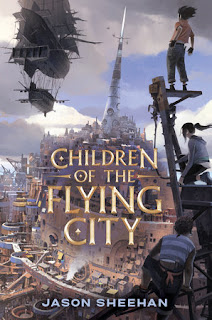
"Children of the Flying City"

Jason Sheehan is an award-winning freelance journalist and author. In addition to being a book and video game critic for NPR, he has published three books for adults.

He applied the Page 69 Test to Children of the Flying City, his first book for young readers, and reported the following:
From page 69:
When the wall curved in a direction she didn't want to go, Dagda ducked her head, pulled her arms in tight to her sides, and slipped into the maze of crowded streets and alleys that bordered the market. She wanted so badly to feel the sun on her skin, but instead balled her hands into fists and held her sleeves over her knuckles to hide her scars. She pulled up the back of her shawl like a hood and buried her face up to her nose in the part wrapped around her neck, smelling smoke and breath and dust like memory in the loose fabric. She made herself small. Just another forgettable girl, making her way a little too quickly, a little too nimbly, out to the bright and wind-beaten blocks at the very edge of the Flying City.

Dagda didn't see the old man watching her. Maybe because she had her head down or maybe because her mind was on other things. He had a white mustache, wore a shirt made of a twisted white sheet, and had a long, bloody scratch down one arm. He stood casually, smiling, smoking a short, stumpy pipe and talking with a short, stumpy man.

The old man is Semyon Beli, of course. The man who boxed the carrier bird. We've met him before. The other one, though? Him, we haven't seen yet.

His name is Reyn Farrago and he's a ship's engineer. He's solid as a packed box, lumpy with muscle, dressed in a stained and patched boiler suit with his sleeves rolled to the elbows and a dirty string around his neck hung with compression screws. The skin of his arms is loud with tattoos.

Still, Dagda slid right past without noticing anything more than the sweet, sticky smell of Semyon's pipe smoke. The two men, though, took very careful stock of her.

'The girl?' asked Semyon Beli.

The engineer nodded, scratching the side of his face with nails showing black half-moons of grease. 'If that's what you want to call her, then sure. That's the girl.'
In this scene, Dagda--one of the books three young protagonists--is doing nothing more than walking down a street. Just going from one place to another. But I think The Page 69 Test works here because it catches her in a rare moment of quiet, lost in her own thoughts while, all around her, larger and more complicated stories are revolving.

Why must she make herself small?

What's with the scars?

Who are these men and why are they paying such close attention to her?

And what does the engineer, with his dirty nails and tattoos, mean when he says, "If that's what you want to call her"?

Memory, closely-held secrets and the idea of a larger, more complicated adult world slowly intruding into the bubble of a child's personal narrative are all themes in Children Of The Flying City, and all of those elements are present here. In its thumping heart, this is an adventure story--full of small heists and huge risks, daring escapes, airships and war. It's about the lengths that friends will go to in order to protect each other when the world falls apart. So one page in which one girl walks alone couldn't possibly contain the essence of the entire book.

But this particular page tries hard. It captures a mood, a sense of looming threat, and asks questions that will echo through the entire story. There are bad things coming--for Dagda, for her friends Milo and Jules, and for everyone else in the Flying City. They're not here yet. Not on page 69.

But they're close. And getting closer every minute.
Follow Jason Sheehan on Twitter.

My Book, The Movie: Children of the Flying City.

Q&A with Jason Sheehan.

--Marshal Zeringue

Thursday, March 17, 2022

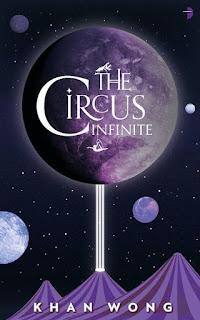
"The Circus Infinite"

In past chapters of life, Khan Wong has published poetry and played cello in an earnest folk-rock duo. As an internationally known hula hoop teacher and performer, he’s toured with a circus, taught workshops all over the world, and produced circus arts shows in San Francisco. He’s worked in the nonprofit arts for many years, most recently as an arts funder for a public sector grantmaking agency.

Wong applied the Page 69 Test to his new novel, The Circus Infinite, and reported the following:
On page 69 of The Circus Infinite, the protagonist, Jes, is in the middle of getting a make-over by the star juggler, a character named Moxo Thron. Jes has been tapped by the circus manager to attend a meeting with the crime boss that "sponsors" the show, and the manager wants him to look less like a street rat. On this page, Moxo has just finished giving Jes a haircut, and the two enter the room in Moxo's home where he stores old gear and costumes from past productions. They are looking for something presentable for Jes to wear to the meeting.

A reader opening to this page will find a good example of the "peek behind the curtain" aspect of the book, but there is no clue as to the darker themes that come up - the experimentation and the criminal underworld elements and their associated violence. The test works well as a glimpse of the character dynamics and the slice-of-circus-life parts that inspired the writing of the book, but not of the main storyline. In other words, it gives a good sense of milieu and setting, but not plot or theme. How well or poorly this test serves this book is entirely reliant on if the reader in question is a plot-focused reader or a world-focused reader. The test works well for one element and poorly for another.

This scene is also the introduction to a character who will eventually catalyze an important development for our protagonist. I’ll say no more on that.

One of the things I set out to do with this book was to explore the bohemian underbelly of a spacefaring civilization. Away from the political leaders and warriors and starship crews that more typically populate space operas - what are the lives of this universe’s artists like? This page does give a taste of that aspect of the book.
Visit Khan Wong's website.

Q&A with Khan Wong.

--Marshal Zeringue

Tuesday, March 15, 2022

"Under Lock & Skeleton Key"

Gigi Pandian is a USA Today bestselling and award-winning mystery author, breast cancer survivor, and accidental almost-vegan. The child of cultural anthropologists from New Mexico and the southern tip of India, she spent her childhood being dragged around the world on their research trips and now lives outside San Francisco. She’s been awarded Agatha, Anthony, Lefty, and Derringer awards, and is a co-founder of Crime Writers of Color. Pandian writes the Jaya Jones Treasure Hunt mysteries, Accidental Alchemist mysteries, and Secret Staircase mysteries—beginning with Under Lock & Skeleton Key.

Pandian applied the Page 69 Test to Under Lock & Skeleton Key, and reported the following:
Turning to page 69, we find Tempest Raj in a quiet moment in the aftermath of a big discovery about the supposed family curse that’s plagued her family for generations. (Abra, short for Abracadabra, is Tempest’s large lop-eared rabbit.)
Tempest picked up Abra. “I’ll take Abra back to his hutch. Don’t worry, I won’t leave Fiddler’s Folly.”

Along the highest slope of the hillside, a partially constructed stone turret sat abandoned. Christened Secret Fort by Tempest’s mom, the structure was one of Secret Staircase Construction’s “lesson-learned experiments”—a term Emma and Darius preferred over “failed experiment.”

The idea was to build a freestanding stone structure in the style of a medieval castle. Emma had spent quite a bit of time on it the year before she vanished.

It wasn’t a practical project, and Darius hadn’t had time to help her with it while he was managing the crew on several large jobs, but Emma had a story in mind to tell about a magical castle turret, so she spent her extra time giving it a go.
That’s from the middle of the page, because I didn’t want to reveal a spoiler at the top of the page!

It’s a representative moment, because the book is filled with whimsical architectural details, plus it shows the magical sentiment of the Secret Staircase Construction business Tempest’s family owns. The premise of this unique construction company: What happens when a carpenter and a stage magician fall in love? They form a Secret Staircase Construction business to bring magic to people through their homes.
Visit Gigi Pandian's website, Facebook page, and Twitter perch.

--Marshal Zeringue

Sunday, March 13, 2022

"Nowhere to Hide"

After studying English at university, Nell Pattison became a teacher and specialized in Deaf education. She has been teaching in the Deaf community for 14 years in both England and Scotland, working with students who use BSL (British Sign Language), and began losing her hearing in her twenties. She lives in North Lincolnshire with her husband and son. Pattison is the author of novels The Silent House, which was a USA Today bestseller, Silent Night, and The Silent Suspect, featuring British Sign Language interpreter Paige Northwood.

Pattison applied the Page 69 Test to her latest novel, Nowhere to Hide, and reported the following:
On page 69 of Nowhere to Hide, we find a group of people preparing to go out for a hike on 26th December. They’re discussing whether it might snow, and it’s obvious there’s tension between several members of the group for different reasons. The chapter is narrated by Lauren, and on this page we see some of her simmering annoyance at her sister, Emily. We also get a brief suggestion that something has happened recently to set them on edge, something involving Alec, one of their group.

This test works in part for Nowhere to Hide: page 69 would give the idle browser an insight into some of the characters, and a clear indication that this isn’t a group of people who all get on well, with some foreshadowing that the weather might cause them some problems along the way. It gives an air of tension and possibly foreboding that, if the characters had noticed it, might have saved someone’s life. However, this page doesn’t fully illustrate the extent of the fast-paced action that comes slightly later in the plot, or the terror of being in an isolated setting with a killer on the loose.

One thing this page might do is raise a lot of questions about the characters, that would hopefully make the person who picked it up want to read more. Why is Emily there if she clearly doesn’t like outdoor pursuits? Why is Lauren trying to hide her dislike of her sister? Why is Dan so secretive, and what trauma is he processing? And what did Alec say in the pub a few nights ago that has led everyone to distrust him? All of the characters are hiding something, and these secrets will gradually be revealed throughout the course of the action.

The idea for this book came as I was walking around a nature reserve in the north of England with my husband, and I realised how somewhere so beautiful could easily be turned into a frightening setting given the right circumstances. The action in the novel takes place over just a few hours, beginning with the characters meeting up at the nature reserve, then following them on their hike until disaster strikes, and they end up separated. Each character is involved in narrating the story, meaning the reader gets to see the plot unfold from different perspectives, but who can we believe?
Follow Nell Pattison on Twitter.

--Marshal Zeringue

Friday, March 11, 2022

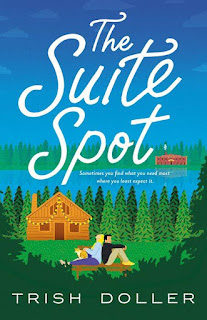
"The Suite Spot"

Trish Doller is a writer, traveler, and dog rescuer, but not necessarily in that order. She is the international bestselling author of Float Plan, The Suite Spot, and Off the Map. She has also written several YA novels, including the critically acclaimed Something Like Normal. When she's not writing, Doller loves sailing, camping, and avoiding housework. She lives in southwest Florida with an opinionated herding dog and an ex-pirate.

Doller applied the Page 69 Test to The Suite Spot and reported the following:
Page 69 of The Suite Spot is a scene that follows a tense moment between main character, Rachel, and her employer, Mason, as they stop for lunch at a waterfront park while on a supply run to the mainland.
The return trip to Kelleys Island is excruciating. Mason gives off a boiling kettle vibe the whole way and even Maisie must sense it, because she plays with her new pack of little plastic dinosaurs without the usual narration, which typically involves mermaids and at least one Disney princess. Without having to focus on driving--or talking--I notice things I didn't see before. Pizza places. The local farm stand still closed for the season. And a giant fiberglass waiter standing on the side of the road. he's wearing a black jacket and red bow tie, with metal framework where his hands should be--like there was once a sign or he was holding something. It's probably some retro roadside attraction with a fun backstory and I'm desperately curious, but the quiet, devastating way Mason said no when I asked if he'd lost custody of his child in the divorce still haunts my heart.

Back at the house, I give Mason a wide berth as we stash away our groceries. Afterward I unload the plants and other purchases, and put Maisie down for a nap. Yōkai slips into the room as I shut the door. Downstairs, Mason isn't in the kitchen or living room. And when I check his bedroom--which turns out to be a converted sunroom with French doors--I discover a desk drowning in paperwork and a futon made up for sleeping. It doesn't make sense to me that he owns this big, beautiful old house and relegates himself to the tiniest space. What the hell has he been through?
I think this passage definitely passes the Page 69 Test because it gives the reader a sense that Rachel's boss is going through some things that he's not willing or able to share with Rachel. It also gives a taste of midwestern setting and the hint that Rachel's daughter, Maisie is a personality in her own right.
Visit Trish Doller's website.

Coffee with a Canine: Trish Doller & Cobi.

My Book, The Movie: Float Plan.

Q&A with Trish Doller.

--Marshal Zeringue

Wednesday, March 9, 2022

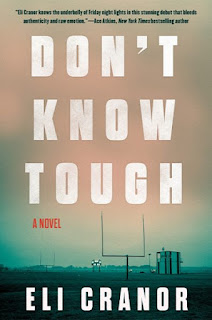
"Don't Know Tough"

Eli Cranor played quarterback at every level: peewee to professional, and then coached high school football for five years. These days, he’s traded in the pigskin for a laptop, writing from Arkansas where he lives with his wife and kids. His fiction has won The Greensboro Review’s Robert Watson Literary Prize and been a runner-up for The Missouri Review’s Miller Prize. Cranor also writes a nationally syndicated sports column, “Athletic Support,” and his craft column, “Shop Talk,” appears monthly over at CrimeReads. His debut novel, Don’t Know Tough, won the Peter Lovesey First Crime Novel Contest.

Cranor applied the Page 69 Test to Don't Know Tough and reported the following:
From page 69:
There’s red on my Jordans. Got red all over them. It ain’t syrup, though. I see that now. Coach do too, but he turn away, like all that blood don’t scare him one bit.
On page 69 of Don't Know Tough readers come in at the very end of Chapter 7. The scene is told in the voice of Billy Lowe, a high school running back suspected of murder. At the end of the chapter, Billy is asked to apologize for fighting with a teammate, which he does, albeit begrudgingly. The lines quoted above are the last lines of the chapter.

The test works perfectly for Don't Know Tough, namely because it introduces the reader to Billy and his unique voice. The whole novel is told in alternating perspectives, with every other chapter coming back to Billy. This scene in particular carries weight because Billy is forced to do something he's not comfortable with, which is apologize to a peer. His discomfort in the situation is apparent, but he really doesn't have a choice given the situation. He's suspected of murder, and there's literally blood on his sneakers. For the first time in his young life, Billy Lowe is forced to toe the line.

Previous to this exercise, I'd never heard of "The Page 69 Test." For this specific experience, I think it works, and I could see it working on a broader spectrum as well. Most books I read have the "inciting event" hit somewhere on or before page fifty. It follows, then, that nineteen pages later, the story should be good and going, the heat of the narrative pulling the reader along.
Visit Eli Cranor's website.

--Marshal Zeringue