Thursday, September 30, 2010

"Dark Moon of Avalon"

Anna Elliott is the author of the Twilight of Avalon Trilogy from Simon & Schuster's Touchstone imprint. The trilogy comprises Twilight of Avalon, Dark Moon of Avalon, and the upcoming Sunrise of Avalon.

She applied the Page 69 Test to Dark Moon of Avalon and reported the following:
In Dark Moon of Avalon, a retelling of the Trystan and Isolde legend, the young former High Queen Isolde and her friend and protector Trystan are reunited in a new and dangerous quest to keep the usurper Lorde Marche and his Saxon allies from the throne of Britain. To save Britain's throne, Isolde must navigate a political landscape torn by infighting and civil war and turn bitter enemies into allies. Yet her own greatest challenge lies in saving the life of the man she loves and mending her own wounded heart.

Page 69 of Dark Moon of Avalon finds Isolde in the midst of a meeting of Britain's High Council of Kings. Born a royal princess, Isolde is barely twenty years old but already has been forced into marriage twice by the political maneuverings of the petty kings on the council. Now, as former High Queen, she is the only woman grudgingly permitted a voice in the council's meetings. And as she listens to the quarreling and political jockeying amongst Britain's petty kings--kings who must be forced to unite if they are to survive the coming war with invading Saxon forces--Isolde feels "an almost physical revulsion for ... men who, Briton or Irish or Saxon, knew only one thing, so it seemed. How to fight, to kill, to hurt--how to carve one another up into bloody, aching pieces--and then send the fragments home to be either buried or stitched together as best their women could."

This scene encapsulates both Isolde's position in the political landscape of Dark Age Britain and one of the central challenges she must overcome in Dark Moon of Avalon. As a high-born woman, she has throughout her life had little control over her own destiny. Her Britain is a dark and often brutal place, where might truly does make right, laws are made by the men who conquer in battle, and women are little more than chattel to be given in marriage wherever their male guardians deem most advantageous. In Dark Moon of Avalon, Isolde must prove to Britain's High Council that a woman can be as valued and courageous a fighter as any warrior, and serve her country through more than just political marriage. And through her journey, she must fight for the right to control her own destiny and follow her own heart.
Read the prologue to Dark Moon of Avalon, and watch the video trailer.

Learn more about the book and author at Anna Elliott's website and blog.

Visit the complete list of books in the Page 69 Test Series.

--Marshal Zeringue

Wednesday, September 29, 2010

"Blind Man’s Alley"

Justin Peacock is the author of the novels A Cure for Night and the recently released Blind Man's Alley. He received an MFA from Columbia and a law degree from Yale.

He applied the Page 69 Test to Blind Man's Alley and reported the following:
Although Blind Man’s Alley is set in the recent past – the summer of 2008 – in some ways the book is intended as a work of historical fiction, capturing a recent moment that already feels long distant. Page 69 illustrates this.

The scene that is unfolding on that page takes place at a private event being thrown by an elite law firm for summer associates (law students who are spending the summer with the firm before deciding whether to join it upon graduation) at the Rainbow Room, at the time an exclusive and expensive Manhattan restaurant, more famous for its views (a classic of art deco design, the restaurant opened back in 1934 and occupied the sixty-fifth floor of a Midtown skyscraper) than its food. Such fancy events were a ubiquitous part of law firm recruiting before the financial crises hit; now, after waves of layoffs, young lawyers cling to whatever job they can get. Similarly, the Rainbow Room, the sort of ornate establishment whose success was predicated on tourists and corporate events, has recently closed its doors, another victim of the Great Recession. I chose it as the location of this scene precisely because it crystallized the gilded aspects of New York City that have recently taken a severe battering.

The novel’s protagonist, Duncan Riley, is a senior associate at the law firm in question, obligated to attend such events because his upcoming partnership vote requires establishing his bona fides as a team player. Duncan, to his great surprise, has just found himself taking on a murder case pro bono, and on page 69 he is buttonholed by a junior associate who would love to escape the tedious grind of corporate litigation and is intrigued by the murder. Duncan, who is not quite as cynical as he thinks he is, has more than put in his own dues in the corporate trenches and is therefore possessive of the murder case, which he hopes will provide him with the opportunity to actually help someone.

In terms of the main plot of the book, page 69 reveals little, if anything. In turns of the themes of the book and the world it depicts – high-end Manhattan, just before the long fall – page 69 is a perfect example.
Read an excerpt from Blind Man’s Alley, and learn more about the book and author at Justin Peacock's website.

The Page 69 Test: A Cure for Night.

Check out the complete list of books in the Page 69 Test Series.

--Marshal Zeringue

Tuesday, September 28, 2010

"Antiphon"

Ken Scholes is a winner of the Writers of the Future contest whose short stories have appeared in various magazines and anthologies since 2000. His first novel, Lamentation, debuted from Tor in February 2009. Canticle was the second and Antiphon is the third of the five-book series, The Psalms of Isaak.

He applied the Page 69 Test to Antiphon and reported the following:
Antiphon, Page 69:

"And I have saved your son's life," she reminded him. "What does that merit with you?"

Rudolfo nodded slowly but found no words to accompany it.

Her voice became even more muffled, heavy with emotion. "Your son will be the salvation of our world," she said. "We have pledged blade and heart to his well-being and to the well-being of his parents." Her voice was at the door now. "I will ask you to reconsider my offer of aid. You have many enemies in the Named Lands and your borders are not secure. Allow me to assist you or, if you can not abide a Machtvolk presence on your soil, send your wife and child to me and I will watch over them until this threat has passed." Her voice was near the door now. "It will pass, Rudolfo, and when the Crimson Empress arrives, she will make all things right."

He squinted but could not even make out the ghost of her. She will make all things right. That would be quite a trick. He considered his next words carefully, tasting them like iron shavings in his mouth before he spoke them. "Ria," he said in a quiet voice, "do not come to me in this way again and do not broach my borders without announcing yourself."

The door handle moved beneath a hand he could not see. "I will do what I must to preserve the life of this child of promise," she said, and her next words stung him though he knew she meant them to. "The question remains, Lord Rudolfo, as to whether or not you will do the same."

Rudolfo heard Jin's swallowed gasp and looked over to see her face red in wrath she could no longer conceal. Still, Jakob slept on.

As the door swung open slowly, Aedric looked in. "Was there someone -- "

When Ria moved past him, the First Captain leaped back and reached for his knives, his lips puckering to whistle third alarm.

"Let her go," Rudolfo said, hearing the weariness in his own voice. Even as he said it, his fingers were moving. Do you believe her message?

Jin Li Tam sighed. She had not spoken through the entire exchange and he could see that her lips were a tight, pale line. I believe her but I do not trust her.

Yes. "I concur," he said.

Then, he reached for his glass of chilled peach wine but found that his interest in it had passed. Instead, Rudolfo fixed his eyes upon his sleeping son and pondered the darkening paths that lay before them both.
Above is the pre-copyedited manuscript for what is now page 69 in Antiphon, volume three of the Psalms of Isaak. For those of you who haven't read the series, you may want to avoid any potential spoilers.

I would have to say that this page is indeed indicative of the novel as a whole -- a novel that is largely about trust and making the best bad decisions when no good decisions really are left. Here, we see Ria -- the Machtvolk Queen first introduced in Canticle -- having snuck magicked into Rudolfo's Seventh Forest Manor with a warning and an offer of aid for the Gypsy King and his family. Jakob, the son born to him and Jin Li Tam in the second volume, features heavily in the Machtvolk gospel as The Child of Promise and though Ria is their enemy, Rudolfo is discovering that those who once held kin-clave with the Forest Gypsies now see he and his family as allied with the dark forces -- including Ria's Machtvolk -- that are pressing upon the Named Lands.

As the book progresses, Rudolfo watches loss and fear of loss reduce his effectiveness as a leader even as he learns that trying to hold to tradition and past ways of coping is not serving him well. Jin Li Tam and Winters find themselves slowly figuring out that the levels of mistrust created by recent events in the Named Lands are interfering with their own ability to work together and trust each other as they, too, grapple with making the best of a bad situation. Petronus, the life-long humanist and former Androfrancine Pope, finds himself dreaming dreams and hearing voices leading him deeper into his place of exile in the Churning Wastes. Vlad Li Tam, the spymaster and Machiavellian manipulator, finds himself inexplicably falling in love and pulled by that love onto an unexpected journey with the remnants of his family to discover yet more secrets of the ancient world. And Neb...well, he learns a lot more about himself and his role in the Home-Seeking dream.

I do hope that if the page above and my brief words about it resonate with you, you'll pick up the books and give them a try.
Learn more about the author and his work at Ken Scholes's website and blog.

The Page 69 Test: Lamentation.

Check out the complete list of books in the Page 69 Test Series.

--Marshal Zeringue

Monday, September 27, 2010

"Dust"

Joan Frances Turner was born in Rhode Island and grew up in the Calumet Region of northwest Indiana. A graduate of Brown University and Harvard Law School, she lives near the Indiana Dunes with her family and a garden full of spring onions and tiger lilies, weather permitting.

She applied the Page 69 Test to Dust, her first novel, and reported the following:
From page 69 of Dust:
Renee's grave was already pristine, the birthing hole filled in and covered with grass too even and green to be real. There's no gate guards, the alarm systems are defunct, the barbed wire's busted full of holes, weeds everywhere, but by God they still get those gravesites looking swank and undisturbed as soon as they humanly can. Maybe it's all people really care about, the handful that still come to visit. I hope the pay's good, if you've got that job. I bet it is. Nearly as good as a thano lab guard's. We crouched in a patch of woods above Calumet Memorial, waiting.
Dust is a story of the undead ("zombie" they consider derogatory) from their own point of view, as they exist hand-to-mouth in abandoned rural areas and try to avoid any contact with the living families they've left behind, lest terrible things happen on both sides. The undead, in this world, aren't virally created Johnny-come-latelies; an uneasy living/dead détente has existed for centuries, with nobody understanding why or how some of the dead return. The thanatological ("thano") labs are working on it, though, with potentially disastrous consequences all around.

This excerpt pleases me because it sets the book's background swiftly, via Jessie's asides: Our lead characters are dead, the living know this and avoid them even as they try to mask the traces, the ordinary task of gravekeeping is a dangerous job and the dead can end up attending their own funerals. Her casual relation of these facts, none of them odd to her or her friend Renee even though fantastical to the reader, establish straight off this isn't the reader's reality, and our usual cultural assumptions about what death means are not just inapplicable, but irrelevant. For a random page-turn, my page 69 is quite a good and instructive introduction.
Read an excerpt from Dust, and learn more about the book and author at Joan Frances Turner's website and blog.

Writers Read: Joan Frances Turner.

Visit the complete list of books in the Page 69 Test Series.

--Marshal Zeringue

Saturday, September 25, 2010

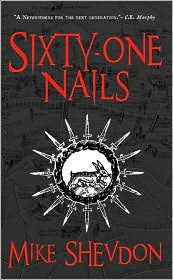
"Sixty-One Nails"

Mike Shevdon draws his inspiration from the richness of English folklore and from the history and rituals of the UK. His Courts of the Feyre series follows the adventures of Niall and Blackbird as Niall discovers a world of dark magic and strange creatures hidden in plain sight.

The first book in the series, Sixty-One Nails, is now available everywhere. It will be followed by a sequel, The Road to Bedlam, available now in the UK and Australasia, and in North America on 26th October 2010.

Shevdon applied the Page 69 Test to Sixty-One Nails and reported the following:
Page 69 of Sixty-One Nails finds Niall in the tunnels below Covent Garden Underground Station, about to be introduced to Kareesh, who may be able to help him survive. Having already met the troll, Gramawl, he has little idea of what to expect, but then this is turning into the strangest of days…
Gramawl materialised from the darkness without a sound. It wasn’t just that he moved quietly. In the silence of the passage you could have heard a feather fall but Gramawl made no sound until he reappeared from tunnel. Blackbird was unsurprised by this and took in the rapid gestures that accompanied his return.

“She’ll see us now, Rabbit. You are privileged. She must be curious about you.”

“Why would she be curious about me?”

“Because I brought you to her, I expect.”
The way that Blackbird calls him 'Rabbit' and his exclusion from the conversation through the use of sign language between Blackbird and Gramawl adds to Niall's unease. Blackbird has brought Niall to someone she believes can help him, but at this stage only she knows just how desperately he needs that help. There's a hint, though, that their request might have been refused: You are privileged. Even so, when Niall asks her why Kareesh would be curious about him, Blackbird's answer is typically evasive.
Gramawl stepped back into the darkness and Blackbird followed him. I wasn’t sure what to expect now that we were going to meet Kareesh. What would a female troll look like? Were they bigger or smaller than the males? Was she likely to decide I was a self-delivering takeaway?

The darkness eased in behind me and we were climbing slightly. The passage angled left and right and came to a stairway at one side while the passage continued onward into darkness. The metal treads of the steps gleamed dully in the darkness and I noticed a faint glimmer of light coming from above.
There was some unseen exchange between Gramawl and Blackbird and she took the steps upwards. I followed, nodding a blind acknowledgement to the hulking shape in the dimness, guessing that with his huge gold-rimmed eyes he could probably see me perfectly well.

There are hints here that Niall still isn't sure whether to trust Blackbird; she's leading, but should he follow? Reading this back to myself, it's also the moment where Niall crosses from the concrete and steel world of humanity into a place altogether more strange.
The steps doubled back at the first level and climbed up to an area that opened out, whether into another corridor or a room it was hard to tell, for every surface was hanging with rugs and heavy curtains patterned in muted gold and red. In contrast to the space below, the echoes died immediately, leaving a sensation of muffled closeness.

As we walked forward we stepped onto rugs with curving geometric patterns that led the eye to wander. Delicate filigree lamps in beaten copper hung from the ceiling…
This is not a page I would have immediately chosen to introduce a stranger to the book, but I think it touches on some important themes - the precarious balance of trust between Blackbird and Niall, and the human world concealing the hidden world of the Feyre. There's a sense that Niall is lost, that he doesn't know what's expected of him or how to behave. The rules have changed and his guide is uncertain, and now he's heading into unknown territory.

Everyone keeps looking at him strangely, even though he's normal and they're the ones who are strange, but that's because they're all looking at someone they don't expect to survive to see the dawn.
Read an excerpt from Sixty-One Nails, and learn more about the book and author at Mike Shevdon's website.

Check out the complete list of books in the Page 69 Test Series.

--Marshal Zeringue

Thursday, September 23, 2010

"City of Veils"

Zoë Ferraris moved to Saudi Arabia in the aftermath of the first Gulf War to live with her then husband and his extended family of Saudi-Palestinian Bedouins, who had never welcomed an American into their lives before. She has an MFA from Columbia University and is the author of the novel, Finding Nouf.

She applied the Page 69 Test to her new novel, City of Veils, and reported the following:
City of Veils is a follow-up to Finding Nouf. Both are mysteries set in Saudi Arabia, and both follow Nayir, a devout Muslim who is looking for a wife, but having trouble finding one in a society where he is not allowed to interact with strange women. Through his investigations, he meets Katya, an independent and liberal-minded woman who puts him into an agitated state of desire, admiration and disdain.

Page 69 contains a gem: Katya, a forensic tech at the Jeddah medical examiner’s office, is waiting to talk to someone at work. She isn’t wearing a veil. When a man walks by, pointedly avoiding looking at her face, she feels strangely empowered by it.
Her previous boss had taught her not to wear her burqa unless she absolutely had to, so Katya kept it resting on the top of her head, ready to drape down when the next pious bureaucrat chastised her with sharp works or a withering look.

“Do you think you are so ugly,” the last one had said, “that no man will find your face appealing? Is that why you expose it?”

No, she wanted to retort, I just mistakenly thought that when it came to sexuality, you had some self-control.
This is the big argument in Saudi Arabia for why women should be covered: they are beautiful, tempting, and distracting. Covering them up solves the problem. But as most women will tell you, not being thought of as a sex object would be a far better solution.
Read an excerpt from City of Veils, and learn more about the book and author at Zoë Ferraris' website and blog.

The Page 69 Test: Finding Nouf.

Visit the complete list of books in the Page 69 Test Series.

--Marshal Zeringue
Wednesday, September 22, 2010

"Rag and Bone"

James R. Benn is the author of the Billy Boyle World War II series, historical mysteries set within the Allied High Command during the Second World War. The series began with Billy Boyle, which takes place in England and Norway in 1942. The second, The First Wave, carries on a few months later during the Allied invasion of French Northwest Africa. The third, Blood Alone, continues the story through the Allied invasion of Sicily; and Evil for Evil, the fourth volume, follows Billy Boyle to Northern Ireland where he is sent at the request of the British government to investigate links between the Irish Republican Army and the Germans.

Benn applied the Page 69 Test to Rag and Bone, the latest novel in the series, and reported the following:
In Rag and Bone, Lieutenant Billy Boyle is sent to London in the midst of a Luftwaffe bombing offensive to investigate the murder of a Soviet embassy official. There's reason to believe that the crime could be connected to the recent discovery of mass graves in the Katyn Forest, where thousands of Polish officers were executed. Is there a killer targeting Soviet officials in revenge for the Katyn Massacre? If so, the diplomatic stakes couldn't be higher as the uneasy relationship between the Soviets and the other allied powers hangs in the balance. Further complicating matters, Scotland Yard names Billy's friend Kaz, now working for the Polish government in exile, as the prime suspect. Billy must track the killer through London's criminal underworld and the higher strata of Allied diplomatic circles to save his friend.

The Page 69 Test finds Billy paying a visit to the Soviet Embassy, where he gets his first lesson in Marxist diplomacy, and it is not what he expects. In this passage, he is introduced to Captain Kiril Sidorov, likely an NKVD agent, who tells him Soviet officials are not allowed to meet foreigners alone.
“Do not mind Sergei. We do not meet alone with westerners. Sergei was available, although he speaks English poorly. Still, it allows us to follow the rules laid down by our security people.”

“To protect you against provocateurs,” I said.

“I see you have been lectured by our reception committee. They are sometimes over-enthusiastic, but these precautions are necessary, believe me. The Revolution has enemies beyond the Nazis. Czarists and other émigré groups are based here in London, and none of them wish us well. But never mind about our security procedures. Tell me how I can help you.”

“General Eisenhower asked me to look into the death of Captain Egorov,” I said, avoiding the distinction between murder and assassination. “He’s also concerned about security, and wanted to be certain there was no further trouble.”

“You work for General Eisenhower?”

“Yes, I’m on his staff.”

“Please excuse me, Lieutenant Boyle, if I fail to be impressed by a mere lieutenant detailed to this investigation. It does not signal true concern on the part of our American allies.” Sidorov smiled, almost apologetically. He looked half serious and half amused at the lines he had to speak. He wasn’t what I expected. He was stern, but not harsh. He spoke the jargon of Communism naturally, but lightly, as if we were all in on the joke. It occurred to me that the Soviets picked their personnel for foreign posts very carefully, and that his casual veneer of nonchalance was well practiced. Possibly dangerous.
Billy is right in his assessment, and the mysterious and definitely dangerous Kiril Sidorov has a major role to play in Rag and Bone, once again validating the Page 69 test!
Learn more about the Billy Boyle WWII Mystery Series at James R. Benn's website.

The Page 99 Test: The First Wave.

The Page 69 Test: Evil for Evil.

Check out the complete list of books in the Page 69 Test Series.

--Marshal Zeringue

Tuesday, September 21, 2010

"The Blessings of the Animals"

Katrina Kittle is the author of Traveling Light, Two Truths and a Lie, and The Kindness of Strangers. The Kindness of Strangers was a BookSense pick and the winner of the 2006 Great Lakes Book Award for Fiction. Early chapters from that novel earned her grants from both the Ohio Arts Council and Culture Works. Kittle earned an MFA in Creative Writing from Spalding University in Louisville.

She applied the Page 69 Test to her new novel, The Blessings of the Animals, and reported the following:
Page 69 of The Blessings of the Animals is not at all a page I would have picked to represent the rest of the book…at first. But the more I thought about it, the more I think it does reveal something of what I was going for. Page 69 puts you smack in the middle of a complicated, fast-paced scene with a large cast of characters. Not an easy place to "drop in." The main character, Cami, was left abruptly by her husband the day before. She and her daughter, Gabby, have been asked to help with the surprise marriage-proposal for Olive, Cami's best friend (and the sister of Cami's soon-to-be-ex-husband). Olive and her boyfriend Nick do not know that Cami's husband left. Cami's brother Davy (who does know) has come along to help. Cami, Davy, and Gabby are "breaking in" to Olive's apartment while Nick takes Olive down the block for a coffee. Cami is to pack an overnight bag for Olive, who believes she and Nick are going to a beer garden, not to a fancy, formal restaurant and bed-and-breakfast. In the middle of the hurried packing, Cami gets a call from her best friend, Vijay. She emailed Vijay yesterday when her husband left and told him to get back to her asap because it was an "emergency." At the same time, Zayna—a girl who works both in Cami's vet clinic and in Cami's husband's restaurant—arrives at Olive's apartment, seemingly confused by why Cami and her crew are there. Zayna will become intertwined in Cami's life in ways Cami does not realize yet.

An excerpt of this chaos:
Clutching the phone between my ear and shoulder, I dug around on the closet floor and found the cream T-strap heels Olive always wore with the pink dress.

I stood up and turned around, barreling into Davy. "Here, Gabby, run these down!"

"ME? I'm gonna get caught now!" but she snatched them and ran.

"Cami, talk to me." Vijay sounded panicked.

I took a deep breath. I had, after all, left a melodramatic message. "Bobby left."

There was a pause. "Left?"

"Yes. Left. As in emptied his closet, packed up his car, and left me."

Zayna put her hands over her mouth. I turned away from her.

"Oh, Cam. Cam." The tenderness in Vijay's voice prompted my eyes to sting.

"I should go—" Zayna said.

But Gabriella ran back into the apartment, blocking Zayna's exit. "They're coming!" she said.

"They'll just get in the car and leave now," I said. "We can hide up here until they go."

"HIDE?" Vijay asked. "Why are you hiding? Who are you talking to?"

"I'm talking to Gabby. Don't worry. This is a GOOD thing. It has nothing to do with Bobby—"

Suddenly Nick's voice boomed in the stairwell. Way too loud he announced, "Okay, just hit the bathroom and we'll be on our way."

I reached out to quietly close and lock the door.
This page illustrates a reality of life Cami learns to embrace in the wake of her divorce: life isn't either/or...life is and & and & and. Life doesn't ever say, "Okay, she's been dealt a bad blow. Let's give her a pass." Life piles it on, both with the good and the bad. Here is Cami, the day after her husband leaves her, helping to make someone else's engagement spectacular. Just as the animal characters will teach her later, this is Cami's first mini-lesson in moving on and moving forward. Although it seems chaotic, the tribe of family and friends surrounding her are her salvation (and later, she will be the salvation for some of them).
Learn more about the book and author at Katrina Kittle's website.

Writers Read: Katrina Kittle.

Visit the complete list of books in the Page 69 Test Series.

--Marshal Zeringue

Monday, September 20, 2010

"Sick City"

Tony O'Neill played keyboards for bands and artists as diverse as Kenickie, Marc Almond and The Brian Jonestown Massacre. His autobiographical novel Digging the Vein was published in 2006. Seizure Wet Dreams, a collection of short stories and poems was also released in 2006, followed in 2007 by a volume of poetry, Songs from the Shooting Gallery. Down and Out on Murder Mile, his second novel, was released in 2008 by Harper Perennial. O'Neill also is the co-author of Hero of the Underground, the memoir of Jason Peter.

His latest books are Neon Angel (co-written with Cherie Currie) and his new novel, Sick City (both 2010).

O'Neill applied the Page 69 Test to Sick City and reported the following:
Sick City is a novel about 2 drug addicts (ex-prostitute Jeffrey, and wayward son of a Hollywood tycoon Randal) and their attempts to get rich by selling a legendary sex tape on the black market. The tape itself was stolen from the Tate house by a crooked LAPD cop the night of the Manson murders, and shows a sex and drug orgy starring Sharon Tate, Yul Brynner, Steve McQueen and Mama Cass.

Other characters include:

• Dr Mike, the media whoring “addictologist” who runs the rehab our heroes meet in. Dr Mike has a nice sideline in self help books and reality television.

• Ex-child actor and now meth-addled gay porn performer Spider.

• Phil Collins obsessive Pat, a psychotic speed dealer who is hot on the heels of the tape.

But what you really want to know is what is happening on page 69, right?

Well, page 69 amounts to paragraph of writing, as it falls at the end of a chapter. In this scene Dr Mike is at home with a beautiful transsexual called Champagne. We find them mid way through an act of… uh… lets call it “oral copulation.” However, before she will continue pleasuring the Doctor, she insists that he bring her some painkillers, to “help her concentrate.”

Does this snippet sum up the book in any way? Well, no, not really. But it does speak to one of the threads of the book: the fact that the “normal” characters (like Dr Mike) are easily more corrupt and repulsive than our drug-addicted anti-heroes, Jeffrey and Randal. In this exchange we see the duplicity of the sanctimonious “addicologist” who is willing to trade prescription narcotics for sex, while preaching abstinence to his drug dependent patients.

However, you’ll really have to pick up a copy of the book if you want to know why James Frey called Sick City “one of the best books written about LA in a long time.”
Learn more about the book and author at Tony O'Neill's website.

Check out the complete list of books in the Page 69 Test Series.

--Marshal Zeringue

Sunday, September 19, 2010

"Noise"

Darin Bradley holds an M.A. in Literature and Literary Criticism and a Ph.D. in Literature and Theory. He has taught courses on writing and literature at the University of North Texas, Furman University, and East Tennessee State University. His short fiction, poetry, and critical nonfiction have appeared in a variety of journals, and he served as founding fiction editor of the experimental e-zine, Farrago's Wainscot.

He applied the Page 69 Test to Noise, his first novel, and reported the following:
Page 69 of my novel, Noise, is both representative and not. See, what occurs on page 69 is a segment of "The Book"--a fictional manifesto that appears in the larger novel. This manifesto was penned piecemeal by the various members of an international counter-culture movement that calls itself Salvage. Salvagers are convinced that the collapse of society is coming, long before it does, so they broadcast, email, vandalize, hack, and otherwise do whatever they have to in order to communicate bits of advice to themselves about how best to build a new nation-state after a collapse. The resulting document, which prioritizes the survival of the reader's "Group" at the expense of others, is a horrifying, somewhat-fascist guide to civilization. Page 69 is Part Two, Section I, Sub-section "c," "Event Exit Strategy" of this manifesto: "The Book."

While the majority of the novel deals with the plotline of how the main characters survive the collapse and make use of The Book, the tone of delivery (and the ideas motivating the characters' actions) of the material on page 69 is very representative, while not being part of the story at all.

The entire "Book," for those who are curious, appears at the promotional companion site to Noise.
Read an excerpt from Noise, and learn more about the book and author at Darin Bradley's website.

Visit the complete list of books in the Page 69 Test Series.

--Marshal Zeringue

Friday, September 17, 2010

"The Pindar Diamond"

Katie Hickman is the author of two best-selling history books, Courtesans and Daughters of Britannia, and two travel books, Travels with a Circus, which was shortlisted for the 1993 Thomas Cook Travel Book Award, and Dreams of the Peaceful Dragon.

Her novels include The Quetzal Summer, for which she was listed for the Sunday Times Young British Writer of the Year award, The Aviary Gate, and The Pindar Diamond.

She applied the Page 69 Test to The Pindar Diamond and reported the following:
Once again the Page 69 Test has proved uncannily representative!

Page 69 of The Pindar Diamond describes the first meeting of my two principal characters: a young nun, Annetta; and the maverick John Carew, servant to a rich English merchant.

The setting is in Venice, 1604. At the beginning of the novel we are introduced to Annetta, a woman with a disquieting past. As a novice she was captured by corsairs in the Adriatic, taken into captivity, and sold as a high-caste slave to the mother of the Ottoman Sultan in Constantinople. On the death of the Queen, Annetta regains her freedom (as was the custom of the day), but instead of marrying an Ottoman lord, she chooses instead to return to her convent on the Venetian lagoon, enriched by a large dowry. With her ambiguous past and her sharp wits, Annetta is seen as a disruptive and transgressive figure by the nuns of the island convent.

John Carew has also returned to Venice after several years living in Constantinople, where he had accompanied his master, the Levant company merchant Paul Pindar, who travelled there as part of an English trade mission sent by Queen Elizabeth I to the Ottoman Sultan.

Although they do not yet know it, Annetta and John Carew are intimately linked by a third character, an Englishwoman named Celia Lamprey. Celia was once engaged to be married to Paul Pindar, but she too was taken into captivity and sold into the Sultan’s palace. Annetta and Celia had become like sisters in the brutal world of the harem – but then tragedy stuck. Everyone believes that Celia has been killed, her punishment for trying to be re-united with her former lover. (This story is told in full in my previous novel, The Aviary Gate.)

But what really happened to Celia Lamprey? Is she dead or alive? Many years later these thoughts still torment Paul Pindar, but he is galvinised by the appearance in Venice of a priceless diamond, the Sultan’s Blue. Could the diamond be linked to the mysterious nun, and through her to Celia Lamprey?

Pindar sends Carew to the Convent to investigate, not realising that his servant’s nocturnal wanderings – as a monachino, or seducer of nuns - have already brought him into contact with that establishment.

It is under these circumstances that Annetta and John Carew are fated to first meet, with explosive results.
*
There was a pause, as though he were considering something. ‘All right, then, this time I’ll let you off,’ he said, still holding her fast against him, ‘but in return I want you to promise me something.’

‘Promise what?’

‘Promise you won’t tell anyone what you saw last night.’

Annetta considered her options; she felt she would rather have her head boiled in oil than promise anything to this man, but pragmatism soon got the better of her. Of course she would promise him anything he liked, the stupid fool. And as soon as she got safely away from him she would tell everyone, but everyone, what she had seen, scream it from the convent rooftops if necessary.

‘All right, I won’t,’ she answered him meekly, ‘I promise I won’t tell anyone what I saw – ‘ but immediately the words were out of her mouth she knew that she had fallen into his trap.

‘Ah! So you did see something!’

Stronzo! She detected a change in his tone of voice: could it be that he was smiling, or worse, actually laughing at her?

‘You’re wrong, I didn’t see anything, not really!’ Annetta was floundering now, but she knew it was no good.

‘Oh, yes you did. Describe to me what you saw.’

What?’

‘It’s not hard to understand. I said, describe to me what you saw.’

‘No!’

‘Oh go on. Which bit did you like the best? Was it just a bit of kissing, or.... something a bit more exciting? She’s very eager to please, that little nun, but then you usually are you know.’

Stronzo, stronzo, stronzo!’

‘Language, please!’ Carew was really laughing now. ‘Well, I’d wager that you haven’t been a nun all your life.’
Learn more about the author and her work at Katie Hickman's website and blog.

The Page 69 Test: The Aviary Gate.

Visit the complete list of books in the Page 69 Test Series.

--Marshal Zeringue

Thursday, September 16, 2010

"Trail of Blood"

Lisa Black spent the five happiest years of her life in a morgue, working as a forensic scientist in the trace evidence lab until her husband dragged her to southwest Florida. Now she toils as a certified latent print analyst and CSI at the local police department by day and writes forensic suspense by night. Her books have also been published in the United Kingdom, the Netherlands, Germany, France, Spain and Japan.

She applied the Page 69 Test to her latest novel, Trail of Blood, and reported the following:
Page 69 of Trail of Blood may not be a microcosm of the book but it does give a quick essence of the plot, the setting (Cleveland, Ohio) and my main character, forensic scientist Theresa MacLean. She is responding to a call at the annual Cleveland Air Show, a Labor Day weekend extravaganza of power and grace on the shores of Lake Erie. In a few sentences we learn that the city, with its battered self-esteem, isn’t too concerned about security on an everyday basis but it has been ramped up due to the large amount of military aircraft at the show.
And so the Port Authority officer had been policing the perimeter on foot when he discovered the girl’s body. Or rather, part of it. He stared at it for a long time, that completely obvious yet somehow indecipherable object. Then the officer took out his radio, called his supervisor, and said a silent prayer of thanks that the piled stones sloped downward to the water and therefore the body or part of a body lay just below the line of sight from the bleachers. There were a hundred thousand spectators on the south side of the tarmac. At least half of them carried binoculars.

Theresa had attended the show in exactly two of her (almost) forty years. She wondered if this visit counted as number three, though they didn’t enter the show, only skirted around it down a small access road between the runways and the water.
Through this and the rest of the page, we see that Theresa is approaching the big 4-0 and that she is not at all concerned about approaching this mangled corpse which has so unsettled the officer. It turns out she is more concerned about moving around active runways. Theresa has been in forensics too long to be freaked out by dead bodies, but long enough to have learned to put safety first. There are too many ways to die and she’s not looking to try any out.

Unfortunately we don’t meet any other characters on this page and we will not see the unnamed Port Authority officer again. Theresa’s cousin, homicide detective Frank Patrick, will arrive shortly.

What even Theresa does not immediately realize is that this dismembered body is only the first volley fired across their bow by a psychotic who wishes to see history repeat itself. The dead woman is a replica of the first victim attributed to the Torso Killer—an unknown, never-caught, true-life murderer who terrorized Depression-era Cleveland over seventy-five years ago. Theresa had just found an apparent victim of his walled up in an abandoned building, and for a few chapters we travel back to see an earlier version of Cleveland through his eyes.

To sum up: on page 69, the battle between Theresa and this new killer begins in earnest. And that battle will get personal.
View the video trailer for Trail of Blood, learn more about the book and author at Lisa Black's website.

My Book, The Movie: Trail of Blood.

Visit the complete list of books in the Page 69 Test Series.

--Marshal Zeringue