Wednesday, May 19, 2010

"The Tulip Virus"

Daniƫlle Hermans works as a freelance communication consultant and lives in Bilthoven, the Netherlands.

She applied the Page 69 Test to her debut mystery, the recently published The Tulip Virus, and reported the following:
Is my page 69 characteristic of The Tulip Virus? Is it representative for the rest of my book?

Partly, and I’ll explain why. In The Tulip Virus, I take the reader back and forth to the seventeenth century and the present. Page 69 is a seventeenth century chapter, and takes place in the Dutch town of Alkmaar on July 21, 1636, to be exact. On page 69, my character Wouter Winkel, an inn-keeper and tulip merchant who actually worked and lived in Alkmaar during this time, is mistreated.
The fingers dug deep into his armpits. He felt the heels of his shoes sliding along the floor, catching slightly on the edge of each tile. Through half-closed eyes, he looked down. His hands were tied together over his stomach, rising and falling with each tug as he was dragged across the floor. He could see the fingertips of the person dragging him, the thick, irregular nails caked with blood. His blood.
On page 69, Wouter Winkel is begging for his life, and begging to be understood in his fight for freedom of thought and freedom of speech. In seventeenth century Holland, known as the Golden Ages, these were important topics as our country boarded mutual different religions and was the only country in the world at that time where people were free to write and print anything they wanted. But for some people in the Low Countries, even freedom had its boundaries. And in the eyes of some people, Wouter Winkel crossed these boundaries and had to pay for it.
Learn more about The Tulip Virus at the publisher's website and visit Daniƫlle Hermans' website.

--Marshal Zeringue

Tuesday, May 18, 2010

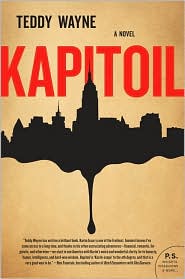
"Kapitoil"

Teddy Wayne is a graduate of Harvard and Washington University in St. Louis, where he taught fiction and creative nonfiction writing. The recipient of a 2010 NEA Creative Writing Fellowship, his work has appeared in The New Yorker, the New York Times, Vanity Fair, Time,Esquire, McSweeney's, USA Today, and elsewhere. He lives in New York.

He applied the Page 69 Test to his new novel, Kapitoil, and reported the following:
Here is page 69 of Kapitoil. Karim Issar, the protagonist and narrator, has recently begun using his computer program, Kapitoil, to predict oil futures and, after some tweaks, it’s been performing well for his company, Schrub Equities:
JOURNAL DATE RECORDED: OCTOBER 25

On Monday morning Kapitoil continues generating hourly profits. By noon, out of a possible 2.1% profit based on how much the oil futures have vacillated per hour, we have made a 1.7% profit, which is not full efficiency but is still robust.

Mr. Ray emails me:

Meet me in the conference room on 89 at 1:30.

Possibly he has reconsidered that Kapitoil might still be too risky. There are rumors that layoffs will soon occur, and maybe they do not have the money to continue high-risk programs like mine.

Or possibly they do not even have the money to retain me as an employee.

I omit lunch because my stomach is turbulent, as it frequently becomes when I am anxious, and do not run Kapitoil at noon, because I do not want it to lose money suddenly and give Mr. Ray more reason to kill it.

At 1:30 I knock on the door of the conference room. Mr. Ray says “Come in” from inside, and I open the door.

He is sitting, and at the head of the table is an older man.

He has tan skin and black and white hair, and his nose slightly curves down like a vertical asymptote. His suit is gray and blue and his tie is dark red like blood that has dried.

It is Mr. Schrub.

“Karim,” he says. He stands and extends to a few inches taller than I am. “Glad to meet you.”

I am afraid to look into his eyes as we shake hands, so I look at his red tie. “It is my honor to meet you, Mr. Schrub.”
This feels like a representative page, largely because I strove for consistency in Karim’s business and tech jargon-inflected voice (which evolves slightly through the novel, turning later to past tense, using contractions, and incorporating new words and idioms he learns). It also encapsulates some essential components of his character: he’s nervous about being evaluated by his superiors at work even though his program is doing well; despite his rigorously logical mind, he focuses on tangential and often morbid details (the tie that is “dark red like blood that has dried”); he is humble and polite and earnest with everyone he meets. Finally, the scene accomplishes what I hope the book achieves as a whole—a combination of character development with some narrative propulsion.

There isn’t, however, any humor here or anything too melancholy, two other staples (I hope) of the book. As the first page of a chapter, its function is more to lead the reader gracefully into the development of the scene rather than come out with guns blazing.

Mostly, I’m glad I was able to work in the word “asymptote.”
Read an excerpt from Kapitoil, and learn more about the book and author at Teddy Wayne's website.

Visit the complete list of books in the Page 69 Test Series.

--Marshal Zeringue

Monday, May 17, 2010

"Mississippi Vivian"

Bill Crider is the author of more than fifty novels, including the Sheriff Dan Rhodes series. He is the winner of the Anthony Award and has been nominated for both the Shamus and Edgar Awards. The late Clyde Wilson was a legendary Texas private eye. He worked with the famous and the infamous. One of his cases was the basis for two true-crime books and a made-for-TV movie.

Crider applied the Page 69 Test to Mississippi Vivian, their second collaborative novel, and reported the following:
Okay, I’m going to have to cheat because the first paragraph on page 69 begins on page 68. I think it’s worth quoting, however, so here it is:
I nodded. I understood how things were done in small towns and backwoods counties. It worked all right as long as the sheriff was honest, but there were times when the power went to a man’s head and turned him into something worse than the lowest criminal. I’d dealt with someone like that once, and I hoped I wouldn’t have to again.
Those are the thoughts of Ted Stephens, an insurance investigator from Houston, Texas. He’s been sent to the small town of Losgrove, Mississippi, to find out why so many people there have gone to work on the Houston Ship Channel and sustained mysterious injuries that have allowed them to file claims with the insurance company that’s hired Stephens. The case has turned out to be considerably more complicated than anybody thought it would, and now there’s a murder involved. In fact, more than one murder, Stephens suspects, and he isn’t sure if anyone in town can be trusted, even the members of the sheriff’s department.

I’d hope that this paragraph would make the reader wonder just what kind of law there was in Losgrove and just how much more trouble Stephens was going to get into. Plenty, of course. Trust me.
Read more about Mississippi Vivian at the publisher's website, and visit Bill Crider's website and blog.

My Book, The Movie: Mississippi Vivian.

Check out the complete list of books in the Page 69 Test Series.

--Marshal Zeringue

Sunday, May 16, 2010

"Sima's Undergarments for Women"

Ilana Stanger-Ross grew up in Brooklyn. She holds an undergraduate degree from Barnard College and an MFA from Temple University. She is currently a student midwife on the University of British Columbia faculty of medicine. She has received several prizes for her fiction, including a Timothy Findley Fellowship, and her work has been published in Bellevue Literary Review, Lilith magazine, The Globe and Mail, and The Walrus magazine, among others.

She applied the Page 69 Test to Sima’s Undergarments for Women, her first novel, and reported the following:
This page 69 business is brilliant. I opened Sima's Undergarments for Women to the assigned spot and read:
… father at the kitchen table while she opened drawers and overturned sofa pillows, searching for her mother’s treasures. Her father wrung his hands, agitated, as he lamented that he’d never thought to ask where she hid her jewelry—the cheap gold, imitation diamond trinkets he’d bought her during their decades together. Sima found them finally in a tallis bag at the back of her mother’s closet, hidden behind a pair of violet heels.

Curled against the costume jewelry was a worn envelope containing two thousand dollars cash.

“I knew she put away what she could, now and then,” her father said, “but I never knew she’d saved much.” He lifted the bills, his hands as gentle as if it were his wife’s own weight he held, and, cradling them, looked at Sima.

….. Her father took her hand, placed the money in her palm. “This money belonged to her; she’d want it to be yours.”

Sima closed her hand around the soft bills.
It's the writer's job to ensure that every page is essential, but this one seems especially important. When Sima takes that money – for the first time, she feels that her mother, who she has just buried, really did love her.

Later in the novel, she's not so sure. But that money helps her to start her business: the Sima's Undergarments for Women of the title.

Page 69. Who knew?
Read an excerpt from Sima's Undergarments for Women, and learn more about the book and author at Ilana Stanger-Ross' website.

Visit the complete list of books in the Page 69 Test Series.

--Marshal Zeringue

Friday, May 14, 2010

"The Third Rail"

Michael Harvey is the creator, writer, and executive producer of the television series Cold Case Files, as well as an Academy Award-nominee for his documentary Eyewitness, and is a former investigative reporter for CBS.

He applied the Page 69 Test to his new novel, The Third Rail, and reported the following:
Page 69:
Outside, the night offered an inky canvas on which to replay the day’s events: a woman dropping to the hard boards of the Southport L, surprise scratched all over her face; an alley, tunneling through the black and filling up with snow; a tangle of footprints and the fat hole of a .40 cal. pressed to my head. Slipping underneath was the electric silk of the voice on my cell phone, one that called me by name, one I couldn’t place. I closed my eyes and let the images play. Pretty soon I started to drift, the pup close by, readily following my lead.
Page 69 of The Third Rail marks the end of a chapter, and thus consists of just a few lines of text and a lot of white space. I have included the text above, picking up a fragment of an extra sentence from the previous page so the excerpt makes sense. Now, what does it mean? How is it representative of the novel? Or not? Hmmm...

At first, I thought this little slice of text was representative of nothing worth writing about. I was wrong. In many ways, it sums up what the first half of the book is all about. In the opening pages of The Third Rail, a spree killer has committed a series of murders on Chicago’s L. Kelly is drawn into the crimes and taunted by the killer who somehow seems to know him. For Kelly, this turn of events is unsettling. Kelly is used to being the hunter. Used to controlling the action and orchestrating events. Here, he is confused, defensive, and cast into a purely reactive role.

I wanted the first half of The Third Rail to replicate that feeling for readers. I tried to accomplish that by dropping readers into the action from page 1. No preamble. No messing around. I also decided to move away from an exclusive “first-person Kelly” point of view and into, at times, a “third-person killer” point of view. This allowed me to develop multiple crime scenes simultaneously, ramp up the action and further bounce the story around a little. My hope was to both draw the reader in and disorient her just a little bit. In real life, that’s how cops feel during these types of investigations ... especially in the early days ... and that’s what Kelly feels on page 69. He is processing information, trying to “get ahead of the curve” and get a handle on what’s happening and why. Kelly’s not there... yet. Page 69 is a microcosm of that initial period of confusion and immersion in the rush of events.
Read an excerpt from The Third Rail, and learn more about the book and author at Michael Harvey's website.

Check out the complete list of books in the Page 69 Test Series.

--Marshal Zeringue

Thursday, May 13, 2010

"Call It What You Want"

Keith Lee Morris is an associate professor of English and creative writing at Clemson University. His short stories have been published in Tin House, A Public Space, Southern Review, Ninth Letter, StoryQuarterly, New England Review, The Sun, and the Georgia Review, among other publications. The University of Nevada published his first two books, The Greyhound God (2003) and The Best Seats in the House (2004), and Tin House Books published his novel The Dart League King.

He applied the Page 69 Test to his new story collection, Call It What You Want, and reported the following:
First let me say that I refuse to back down from the challenge as some others (who shall remain nameless) have done before me—“Well, page 69 isn’t really a very good example, so let me refer you to page 27 instead,” blah blah. No, it’s the “page 69” test, dammit, and based on the merits of page 69 I will let my book sink or swim, I will let my star rise or fall.

Problem, though—uh, the book is a short story collection, and page 69 is the final page of a story called “Camel Light,” and, well, it’s actually you might say half a page. So, in that sense, I fail miserably. I mean, hey, the vast majority of pages in the book are in fact pages of full text.

Plus, the concluding page of a story is always different from the beginning page, or the middle pages, because you have this deal where you’re required to wrap up stuff like plot and theme and then, you know, lots of times there’s revelations or twists or epiphanies. For instance, the main character in “Camel Light,” Rick Steuben, is in the middle of an existential meltdown, all because of a frigging cigarette he finds on the floor in his kitchen while he’s home alone one morning. Nobody in his family smokes, so he starts imagining whose cigarette this is, and he eventually gets around (as husbands do) to deciding that his wife must be having an affair. Then after that he really goes off the deep end, imagining that we’ve reached the end of civilization as we know it and whatnot:
Global warming, shrinking ice caps, expanding oceans, extensive flooding, widespread drought, mass starvation, a whole species on its way to becoming fertilizer or fish food. It was right there in front of him. You could read the signs in the daily paper.
Whoa, that’s some depressing shit, and I promise that this sort of thing doesn’t happen to my characters on every page. Besides, Rick is actually having what we in the biz might call a false epiphany—i.e., he thinks he’s having this massive, life-changing moment, but as soon as his wife gets home, he forgets all about it:
... he sat crying quietly when Maggie’s car turned into the drive. How nice it looked out there in the sunshine, the gleaming black Volvo wagon he had just washed yesterday. Maggie emerged, carrying a new beaded handbag. She’d worn her glasses today. He remembered that now, could see them in the moment she’d walked out the door an hour ago. She was approaching the house. He didn’t want her to see him crying. He wiped his eyes with his hand and the hem of his T-shirt.
Etcetera. So, wait—page 69 is like the rest of the book, because the stories are mostly about illusions, or delusions, or self-delusion—the stories are about the stories we keep trying to tell ourselves when the real ones are ugly or frightening. They’re about the shaky line between dreaming (in this case daydreaming) and reality, about how we so rarely see things clearly, and not for very long.

Therefore, my book passes the page 69 test!
Read an excerpt from Call it What You Want.

Visit the complete list of books in the Page 69 Test Series.

--Marshal Zeringue

Tuesday, May 11, 2010

"Strip"

Thomas Perry is the author of the Jane Whitefield series as well as the bestselling novels Nightlife, Death Benefits, and Pursuit. He is the first recipient of the Gumshoe Award for Best Novel, and he won an Edgar Award for The Butcher’s Boy.

He applied the Page 69 Test to his new novel, Strip, and reported the following:
In Strip, page 69 is a cozy domestic scene in which we learn what LAPD Lieutenant Nick Slosser is all about. He lives at home in Woodland Hills, an L.A. suburb, with his wife, Mary, and their two teenaged children. He only sleeps there three or four nights a week because of his schedule, but now he's come home and he and Mary talk over dinner about the three days each has had. What we notice is that Slosser speaks only vaguely about his time away, while Mary is quite specific. What Slosser is thinking about is his almost religious commitment to self-discipline and an orderly life, including his personal life, which has brought him great joy and satisfaction. Self-discipline is what separates him from the petty criminals he struggles against each day, most of them middle-aged men who live by impulse, like teenagers. What we're working up to is this statement at the top of p. 70: "Nick had been so happy with his wife and family that he had married again right away." He has not one happy family, but two, and the primary use of his self-discipline is keeping the two families separate and unaware of each other's existence.

Page 69 does give a pretty good taste of the tone of Strip, as well as the complexity and ambiguity of the interactions between characters. It's a heavily populated book, with about eight major players. Slosser, in addition to being a bigamist who is comically afraid he's about to be caught because his two eldest kids are ready for college and he won't be able to explain the huge expense, is also a brave, honest, and competent police Lieutenant, who is busy keeping the other characters from killing each other. I had a lot of fun writing this book, and I think other people will enjoy it too.
Read an excerpt from Strip, and learn more about the book and author at Thomas Perry's website.

Check out the complete list of books in the Page 69 Test Series.

--Marshal Zeringue

Monday, May 10, 2010

"One Man's Paradise"

Douglas Corleone is the winner of the 2009 Minotaur Books/Mystery Writers of America First Crime Novel Award. A former New York City criminal defense attorney, he now lives in the Hawaiian Islands with his wife and son.

He applied the Page 69 Test to his new novel, One Man’s Paradise, and reported the following:
On page 69 of One Man’s Paradise, defense lawyer Kevin Corvelli catches a sensational journalist casting Kevin’s client, who is charged with murder, in a negative light on a national cable news show. The mother of the victim is being interviewed by cable news clown Gretchen Hurst.

Hurst asks:
“Are you satisfied with the police investigation into your daughter’s death?”
The victim’s mother Carlie Douglas responds:
“I am satisfied, Gretchen. They have the killer behind bars and they tell me they have all the evidence they need to obtain a conviction.”
These lines are very much representative of One Man’s Paradise as a whole. Throughout this case, attorney Kevin Corvelli has his back up against the wall. Corvelli fled his successful law practice in New York City because of the media, and now that he’s arrived in Paradise, the media are picking up right where they left off: criticizing Corvelli and poisoning potential jurors.

Kevin Corvelli used to delight in trying cases in the press, until an innocent client of his was murdered in jail because Kevin was too busy playing for the cameras. Now the media are yet another adversary Kevin Corvelli must go up against, and in the pages that follow, Kevin makes a bold decision concerning his investigation - a decision that may have devastating consequences for both Kevin and his new client.
Learn more about the book and author at Douglas Corleone's website.

Check out the complete list of books in the Page 69 Test Series.

--Marshal Zeringue

Saturday, May 8, 2010

"Seeing Stars"

Diane Hammond, the author of Going to Bend and Homesick Creek, is the recipient of an Oregon Arts Commission literary fellowship and served as a spokesperson for the Free Willy Keiko Foundation and the Oregon Coast Aquarium. In 2008 she applied the Page 69 Test to her novel Hannah’s Dream.

She applied the Page 69 Test to her new novel, Seeing Stars, and reported the following:
Page 69 begins a new chapter, in which stage-mom-in-training Ruth Rabinowitz has just shelled out a cool $995 to buy her daughter Bethy’s way into the production of a short movie about surviving middle school. The project has been put together by talent manager Mimi Roberts, and is a scam, a shortcut that will make the young cast eligible to join the Screen Actors Guild. SAG membership will enable Bethy, a thirteen-year-old, to audition for much higher-paying and prestigious TV shows, movies and commercials.

This is a fitting moment for Ruth, who has done nothing but shell out huge sums of money since arriving in Hollywood just over a month earlier. She is appalled by the cost of everything to do with ramping up Bethy’s professional acting career: the costs of haircuts, waxings, straightenings, headshots, acting lessons, acting showcases and coaching for auditions—to say nothing of the cost of rent, food and other miscellaneous services. Still, Ruth doesn’t even consider denying her daughter these things and more. After all, stardom is at stake. And Ruth, like all stage mothers, is utterly convinced of her daughter’s qualifications for joining the Hollywood pantheon of young stars. But she is also at the crest of a steep slope towards the self-doubt and disillusionment that will soon set in.
Read an excerpt from Seeing Stars, and learn more about the book and author at Diane Hammond's website.

Visit the complete list of books in the Page 69 Test Series.

--Marshal Zeringue

Thursday, May 6, 2010

"The Edge of Ruin"

Irene Fleming lives in Lambertville, New Jersey, with her musician husband and their cat. Writing as Kate Gallison, she has three private eye novels and five traditional mysteries to her credit. Her Mother Lavinia Grey stories were the talk of the Episcopal Church.

She applied the Page 69 Test to her new novel, The Edge of Ruin, and reported the following:
The page 69 Test! This is intriguing. I had a look at page 69 of The Edge of Ruin and was startled to see that it contains material that's central to the book: the chaos of early movie-making, a hint of the sinister backstory, our last sight of the murder victim alive. Whether a casual reader who picks the book up and reads nothing but that page would get an idea of this, I couldn't say.

But the book would be much weaker without this page. Everything mentioned here becomes an important clue later on in the book, except for the lace collar, which is there to draw attention to Mary Grace and pull her into the scene, so that when she steps forward as a witness several chapters down the road, we remember where she was at the time of the murder.

Page 69 of The Edge of Ruin:
"However," Adam said, "if you'd like to work as an extra in this picture, I can probably accommodate you. Emily, see about this man's wardrobe."

"An extra? Me? No, I've come here to give you this," he said, and he thrust the manila package into Adam's hand. "It's the story of my life, sir. I believe you'll find it fascinating, and I think you'll want to make it into a moving picture. After you read it we'll talk about money. And now I'll go and have a look at your movie camera, if you don't mind. Cameras interest me."

"Not a chance," Adam said. "Emily, our friend here is an extra. He is not to go near the camera. Have you got a flannel shirt for him?"

"I've got a humdinger," Emily said. She held out the very gaudiest of the shirts she was carrying over her arm.

"Oh, no, no. No, I couldn't," Duffy said. He took a step backward, bumping into Big Ed Strawfield, who was standing right behind him now, cracking his knuckles. "No." He cast his eyes here and there, but there was no avenue of escape.

"Mr. Weiss says you're an extra," Mr. Strawfield said. "Take off your coat and put on the shirt." And so he put on the shirt, handing his checkered topcoat to Emily.

"Come this way," Adam said. He took him by one arm while Big Ed took him by the other. Between the two of them they dragged Duffy up to the front of the crowd of extras and planted him between Chalmers and Chief Watson. Emily felt a tug on her sleeve.

Mary Grace. "Oh, good, here you are. Mr. Weiss wants me to put your lace collar back. Just stand still for a moment." Emily began to pin the collar. Adam put the megaphone to his lips and called for quiet.

"But where am I supposed to be?" Mary Grace said. "Ouch."
View the trailer for The Edge of Ruin, and learn more about the book and author at Irene Fleming's website.

Visit the complete list of books in the Page 69 Test Series.

--Marshal Zeringue

Tuesday, May 4, 2010

"The November Criminals"

Sam Munson's writing has appeared in the New York Times and the Times Literary Supplement, among other venues. He is the former online editor of Commentary magazine. Munson graduated from the University of Chicago in 2003, and he lives in New York City.

He applied the Page 69 Test to The November Criminals, his first novel--released last month, and reported the following:
Is page 69 characteristic of The November Criminals as a larger work? Luckily enough, yes! Which makes writing this easier, certainly, than having to stammer and bluff my way through an explanation of how well, maybe this page isn't exactly characteristic, but it certainly has its importance, you know, and like that's not such a bad thing in itself. But page 69, yes, is characteristic, as far as I can determine. It features the protagonist, high school senior Addison Schacht, dressed in a stolen tie and ill-fitting suit, talking his way into a police station under false pretenses in order to further his own investigation of a classmate's murder:
I'd put on my holiday suit, lawyer-black, for the occasion, and a tie I'd swiped from my father's closet. Also, for some reason, I was carrying a briefcase with nothing in it, this old narrow-gauge black attaché my father discarded when I was eleven and which seemed to me the height of aesthetic magnificence then. Scars of use dented all its edges, and its vertices had been blunted by handling. I know now that I looked like a gawky, underfed idiot, someone über-insignificant. But I managed to convince myself then that I looked pretty goddam impressive.
He fails, of course, his plan goes stupidly awry, as should be obvious from the above, he humiliates himself utterly and desecrates the memory of the dead in doing so. Which is indeed characteristic of Addison: he manages to fuck up (almost) everything he touches. Let me say in his favor only that the police are even worse fuckups than he is, what with it being their job to solve crimes and all. That's a fairly juvenile argument, I know—they started it—but there it is, as the British say.
Read an excerpt from The November Criminals, and learn more about the book and author at Sam Munson's website.

Visit the complete list of books in the Page 69 Test Series.

--Marshal Zeringue

Sunday, May 2, 2010

"31 Bond Street"

A photo editor for books and magazines, Ellen Horan has worked on staff and in a freelance capacity for many publications, including Vanity Fair, Vogue, House & Garden, Forbes, and ARTnews, as well as for a number of book publishers.

She applied the Page 69 Test to 31 Bond Street, her first novel, and reported the following:
Page 69 of 31 Bond Street falls on the opening of Chapter Nine, and the heading says September 1856, New York City. I'd say it was a seminal page in that each chapter shift is important in driving the narrative forward. From the very beginning, when I decided to write about the factual murder case of Dr. Burdell in 1857, (which I turned into a novel), I had the idea to structure the book around two narrative threads: one is from the point of view of the lawyer Henry Clinton, who takes on the defense of a woman accused of murdering a wealthy dentist, Harvey Burdell, in his townhouse. The other narrative thread is from the point of view of the accused, Emma Cunningham, and her story backs up to the previous summer, when she first meets the murdered man. This particular chapter opens with such a switch -- in Chapter Eight we have left the lawyer, Henry Clinton who has just announced to his wife, that against his partner's wishes, he is taking on this high stakes murder case. Chapter Nine opens the previous fall, with the flirtatious widow, Emma Cunningham, sitting in a tea parlor on Broadway, waiting for the eligible bachelor, Dr. Burdell, to pick her up and take her to the theatre. She has met him on her summer trip to Saratoga, and he has expressed an interest in seeing more of her upon their return to New York. We enter inside her thoughts as she waits for him to arrive, and she calculates his qualities, one of which is a beautiful townhouse at 31 Bond Street. It is through her inner voice, that we learn of her past husband, and her humble origins in Brooklyn. If the reader were to read only p.69, (and the rest of the paragraph on the following page,) you would get a very good sense of this woman's character and her background. The relationship between Emma and Dr. Burdell develops into a series of precise calculations and increasingly sinister manipulations.

As each chapter switches from the present context of Henry Clinton's court case, to the background of his client, the reader is propelled closer to the heart of the mystery: Who killed Dr. Burdell? The sentence for murder is hanging, so Emma Cunningham's life is at stake, as all of New York is watching to see if a jury will find her guilty or innocent of murder.
Read an excerpt from 31 Bond Street and view the trailer; learn more about the book at author at the official 31 Bond Street website.

See "The Story Behind the Story: '31 Bond Street,' by Ellen Horan," at The Rap Sheet.

Visit the complete list of books in the Page 69 Test Series.

--Marshal Zeringue