Friday, March 30, 2012

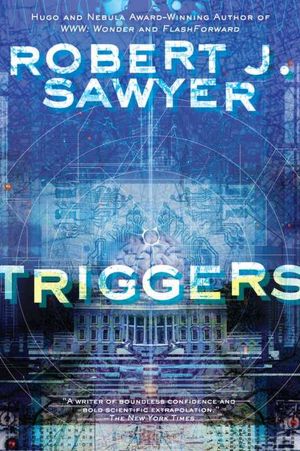
"Triggers"

Robert J. Sawyer is one of only eight writers in history — and the only Canadian — to win all three of the world's top Science Fiction awards for best novel of the year: the Hugo, the Nebula, and the John W. Campbell Memorial Award.

He applied the Page 69 Test to his latest novel, Triggers, and reported the following:
From page 69:
the president, it was the FBI that investigated attacks on him. But the two FBI agents dispatched to Danbury's home had asked Cheung to join them, since he'd been familiar with the deceased. Gordo lived an hour's drive southwest of DC, in Fredericksburg, Virginia -- far enough away that his place hadn't been affected by the electromagnetic pulse.

It didn't take long to find what they were looking for. Danbury had an old Gateway desktop computer, with a squarish matte-finish LCD monitor, an aspect ratio that was hard to get these days; both were connected to a UPS box. He'd left them on, with a Microsoft Word document open on the screen. The document said:
Mom,

You'll never understand why I did this, I know, but it was the right thing. They won't let me get away, but that doesn't matter. I'm in heaven now, receiving my reward.

Praise be to God.
Cheung glanced around; there was no sign of a printer. "He expected to die today," he said. "And he knew we'd find this."

The FBI agents were both white, but one was stocky and the other thin. The stocky one said, "But he ran."

"If he hadn't, he'd have been gunned down," said Cheung. "Sure, Gordo was a sharpshooter, but he'd have been facing a swarm of armed Secret Service agents; they'd have had no trouble taking him out, and he had to know that. Once he shot the president, he knew he'd be neutralized."

"Did you know he was religious?" asked the thin FBI man, whose name was Smith, as he pointed at the glowing words.

"No," said Cheung. "Never heard him mention it."

"`Praise be to God,'" Smith said. "Odd way to phrase it."

Cheung frowned, then gestured at the computer. "May I?"

"Just a minute," said the heavier agent, Kranz. He took a series of photos of the computer as they'd found it, and dusted the keyboard for
Triggers is my 21st novel, and the first new one I've written since FlashForward, the ABC TV series based on my novel of the same name, went off the air. That series brought me more new readers than anything else in my career. My original FlashForward novel was a philosophical exploration of fate and free will, but ABC made it into a slam-bang conspiracy-theory thriller (with my blessing and participation -- I wrote one of the episodes and consulted on all of them).

Because of the big new influx of readers who associate me more with thriller than science fiction, I decided to make Triggers a novel that might please both audiences: the readers who have been with me for years, and the new ones. Page 69 gives a good sense of some of the thriller elements in Triggers: an attempted assassination of the president, a conspiracy in the Secret Service, and more.

What's missing from it is anything science fictional, but, trust me, that's in there, too (indeed, the novel was serialized prior to book publication in Analog, the world's #1 bestselling English-language science-fiction magazine), although the whole thing should be readily accessible to people who don't normally read science fiction.
Learn more about the book and author at Robert J. Sawyer's website and blog.

--Marshal Zeringue

Thursday, March 29, 2012

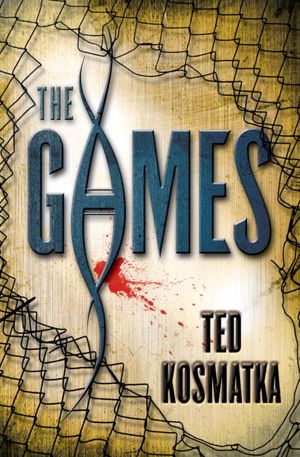
"The Games"

Ted Kosmatka was born and raised in northwest Indiana and spent more than a decade working in various laboratories there before moving to the Pacific Northwest. His short fiction has been nominated for both the Nebula Award and the Theodore Sturgeon Memorial Award. He now works in the videogame industry where he’s a full-time writer at Valve, home of Half-Life, Portal and Dota 2.

He applied the Page 69 Test to The Games, his first novel, and reported the following:
The scene isn't necessarily representative of the novel as a whole, but it is a nice snapshot of Evan, the savant responsible for the creation of the Brannin computer. The scene describes the last moments before Evan disappears into virtual space to commune with Pea, the secret splintered personality hidden within the computer. Dangerous authority figures look on, but they will be powerless to interfere with what they don't understand. Just as Evan was responsible for the creation of the computer, the computer is responsible for the design of the U.S. gladiator. Both the computer and the gladiator are flawed creations and yet at the same time are far more than what they seem to be on the surface.

From page 69:
It didn't take long to attach the probes and strap him into the booth. The cloth pinched a little at his crotch, but by shifting his weight, it was tolerable. The nice-teeth woman in the jumper lowered the faceplate, and his vision lost its reds. He caught Baskov's critical eye in the crowd just before his vision opaqued. Well, to hell with him; he wasn't going to ruin Evan's day. The old gimp could glare all he wanted, but Evan would have his two minutes and fifty-nine seconds. Almost an eternity.
Learn more about the book and author at Ted Kosmatka's website and blog.

Writers Read: Ted Kosmatka.

--Marshal Zeringue

Wednesday, March 28, 2012

"Rizzo’s Daughter"

Lou Manfredo, author of Rizzo’s Fire and Rizzo’s War, worked in the Brooklyn criminal justice system for twenty-five years. His short fiction has appeared in Best American Mystery Stories, Ellery Queen Mystery Magazine, and Brooklyn Noir.

He applied the Page 69 Test to Rizzo’s Daughter, his third novel, and reported the following:
The Page 69 Test for Rizzo’s Daughter catches Sgt. Joe Rizzo in the midst of a tense, high pressure investigation into the car-jacking of a young mother and child. Although the case is secondary to the broader theme of the book, the page manages to prove reflective of the novel’s essence.

In this, the third of my Rizzo trilogy, the narrative tension and general pace of the over-riding story line has been considerably increased from the earlier two books. The ancillary investigation captured on page 69 serves as a good barometer for the novel itself: Quicker, crisper and more power punched than its precedents, the book represents a gear shift which I had long planned. One example, Rizzo no longer has a rookie partner to mentor. Instead, he is teamed up with the savvy, seasoned Sixty-second Precinct veteran, Detective First Grade Mark Ginsberg. Sadly, we don’t see too much of Mark on page 69, but trust me on this: He’s a guy to watch, an extremely entertaining character. I had a great amount of fun playing Mark against Joe Rizzo, and I hope my readers will have a similar experience.

On a personal note, as much as I’ve loved watching Joe work over the course of the first two novels, Rizzo’s Daughter has become my favorite. The ultimate verdict, of course, as always, lies with my readers. I’ll await their feedback and hopefully they’ll agree that Rizzo’s Daughter is a solid, fast read with a stark and darker tone.
Learn more about the book and author at Lou Manfredo's website.

The Page 69 Test: Rizzo's War.

Writers Read: Lou Manfredo (April 2011).

My Book, The Movie: Rizzo's Fire.

--Marshal Zeringue

Tuesday, March 27, 2012

"The Reeducation of Cherry Truong"

Aimee Phan grew up in Orange County, California, and now teaches in the MFA Writing Program and Writing and Literature Program at California College of the Arts. A 2010 National Endowment of the Arts Creative Writing Fellow, Aimee received her MFA from the Iowa Writer's Workshop, where she won a Maytag Fellowship. Her first book, We Should Never Meet, was named a Notable Book by the Kiryama Prize in fiction and a finalist for the 2005 Asian American Literary Awards. Her writing has appeared in the New York Times, USA Today, and The Oregonian among others.

She applied the Page 69 Test to her new novel, The Reeducation of Cherry Truong, and reported the following:
I was so happy to discover what scene I landed on for this test, because it fortuitously foreshadows the central conflict of the novel: how my main protagonist Cherry grapples with the unfair expectations her Vietnamese immigrant family thrusts upon her, her brother, and cousins to succeed in America.

On page 69, we join Cherry, age 8, and her older brother Lum, 13, at their grandmother’s birthday party, where they are promptly confronted with a surprise palm reading by their grandmother’s closest psychic friend Ba Liem. While Cherry’s horoscope is rather uninspiring and sexist (she can be a nurse to her doctor husband!), Lum’s prediction sadly confirms the boy’s worst fears of inadequacy:
“This one is murky,” she pronounced. “I can’t get a clear reading on him. He is too impressionable, easily influenced by his peers. He must be watched very carefully...his eyes are good now, but he may require reading spectacles when he is forty-two.”

Both Grandmother Vo and Ba Nhanh leaned forward, as if to examine Lum with a new perspective.

“I suspected this one may be more troublesome,” Ba Nhanh said.

“He doesn’t do as well in school as his sister,” Grandmother Vo said to the twins. “His parents say he has poor reading skills, but perhaps it’s more than that.”

Lum withdrew his hand. “I’m doing fine in school.”

The old ladies stared at him with oval mouths.

“Impudent child!” Grandmother Vo said. “Ba Liem is honoring you with a reading and you disrespect her like this?”

“We shouldn’t be surprised,” Ba Liem said, nodding in satisfaction. “I will speak with his mother later. We will stop it, Ba Kim, before he gets too unruly.”
And of course, readers know at this point that he will be very unruly! But I love how this scene not only shows the significance of superstition in this family’s biases against each other, but it also reveals the children’s resistance of these preordained fates. Yet, this silly fortuneteller’s words will cast a large shadow over these children, no matter how much they try to deny it.
Learn more about the book and author at Aimee Phan's website and blog.

--Marshal Zeringue

Monday, March 26, 2012

"The Towman's Daughters"

David J. Walker is the author of eleven mystery/suspense novels.

He applied the Page 69 Test to The Towman’s Daughters, the sixth book in his “Wild Onion, Ltd.” series, and reported the following:
Most people (including the editors of Microsoft Word’s dictionary) don’t even know “towman” is a word. But ask the folks at American Towman magazine, and then check out the prestigious Order of Towman award given each year to operators (some of them female, by the way) of vehicle towing operations for outstanding service to their communities. I’m not kidding; you can Google it.

The Towman’s Daughters stars Chicago private eye Kirsten and opens with her lawyer husband Dugan, who’s not totally wasted at the time, going to Wancho’s Towing at one a.m. to ransom his towed car. At Wancho’s he stumbles across an obvious crime in progress. His Sir Galahad instincts kick in and he rescues the beautiful young Isobel Cho from an armed abductor. This being a crime novel, though, the obvious isn’t what it seems. The rescued Isobel, a recent graduate of a prestigious east coast university, is handed over to her father, Mr. Juan Cho, the decidedly low-life owner of Wancho’s. Two days later she goes missing, and it’s up to Kirsten and Dugan to find her.

What about page 69? Well, by then Kirsten has tracked down Isobel and has her stashed away with a bodyguard named Cuffs Radovich, hopefully safe from whoever it is who’s stalking her. And on page 69 we find Kirsten accusing Cho of being less than forthright—well, OK, lying through his teeth—not just about Isobel, but also about the threat to his other daughter, nine-year-old Luisa.
“What the hell are you talking about?” Cho sat upright again, and put his palms flat on the table and leaned toward her. “It’s time for me to leave. I don’t know you, and I don’t know that you’re really working for Isobel.”

“Ask her yourself. Does she know your cell number?”

“Yeah.”

Kirsten took out her cell phone and called Cuffs. “I’m with Isobel’s father. Have her call him. Right now.”

Cho already had his cell in his hand. It rang almost at once and he answered.

“Yeah, it’s me. Hold on a minute.” Then he stood up and walked outside. She watched through the window as he paced back and forth and spoke into the phone.

It was pretty clear, both from his body language and his expression, when she could see his face, that Isobel had quickly verified that Kirsten was on her side, but the conversation didn’t end there. Cho was arguing with her. In a few minutes he gave up, and came back inside and sat down across from her again.

“Did she tell you where she was?” Kirsten asked.

“No.”
Of course she didn’t. She’s following Kirsten’s orders, and Kirsten believes the thuggish Juan Cho, though he clearly loves his daughters, may be the real source of their troubles.

So what does page 69 give us? A glimpse of a smart, resourceful, female private eye, faced with an archetypal private eye problem: a witness who ought to be on her side, but who obviously isn’t telling her what he knows. The question is…why?

And the answer to that…hidden beneath layers of greed and betrayal, politics and murder… may reveal just how far a father’s love for his daughters will take him.
Learn more about the book and author at David J. Walker's website.

--Marshal Zeringue

Sunday, March 25, 2012

"Throne of The Crescent Moon"

Saladin Ahmed was born in Detroit and raised in a working-class, Arab American enclave in Dearborn, Michigan.

He holds a BA in American Culture from the University of Michigan, an MFA in Creative Writing from Brooklyn College, and an MA in English from Rutgers. His poetry has received several fellowships, and he has taught writing at universities and colleges for over ten years.

His short stories have been nominated for the Nebula and Campbell awards, and have appeared in Year’s Best Fantasy and numerous other magazines, anthologies, and podcasts, as well as being translated into five foreign languages.

Ahmed applied the Page 69 Test to Throne of the Crescent Moon, his first novel, and reported the following:
Well, huh. As it turns out, page 69 of Throne of The Crescent Moon is both a representative and atypical moment in the novel.

It's representative because it's dedicated to depicting the city of Dhamsawaat, my sort of Lankhmar/medieval Baghdad hybrid, and the setting for the great bulk of the action in Throne. A number of reviewers and readers have described Dhamsawaat as being one of the main characters of the novel. and I'm inclined to agree.

The atypical part here is that the King of Cities is being seen through the eyes of a desert tribeswoman, the teen werelioness Zamia, who has just entered Dhamsawaat for the first time. Before we get to this scene we spend a good forty pages in the head of the old Dhamsawaat native Adoulla watching, smelling, and listening to the Jewel of Abassen's festivals, traffic jams, and executions.

And yet, even in this, perhaps there's something representative: Allowing the reader to see the same scene and setting through different sets of eyes - allowing them to walk the same streets in different shoes - is a technique I use a fair amount...

From page 69:
...it was terrifying. Men’s and women’s scents bled together with a thousand others, and countless people darted in and out of her peripheral vision.

How could she scent out enemies in a crowd like this?

“There are so many people here!” she said without meaning to.

“You should have seen it on our way out of here!” the old man bellowed. He turned to Raseed. “We’ll get home twice as quick, I think.”

Zamia had trouble imagining the streets being any more crowded. Veiled Rughali women lined the street, grinding sweet-smelling spice with pestles the size of war clubs. Girls in gemthread half-robes walked arm-in-arm with soft, wealthy-looking men. Two boys led small goats along the edge of the crowd. She even saw two men wearing the camel calf suede of Badawi tribesmen. She avoided their eyes, but they seemed more interested in the city itself than in the odd sight of a young tribeswoman alone in the Jewel of Abassen. Zamia tried to ignore all of the beast- and people-scents as best she could—the sights were confusing enough.

A hard-faced man jumped in her path. Zamia tensed for a fight, weighing the risks of taking the shape in this unfamiliar place. The man, smelling of deceit, shook a leather cup and screamed about triangle dice. Before Zamia could do anything, the Doctor elbowed the man away, spitting something about rigged games of chance. The man bowed mockingly and turned to his next potential player.

Again she resisted the urge to turn on her heel and run at lion-speed back into the desert. But she thought of her father, who had been to Dhamsawaat once in his youth. This gave her strength—If Nadir Banu Laith Badawi had visited this monstrous place and lived to tell the tale, surely his daughter could honor his memory by doing the same. Thoughts of her father and of his fate filled her with increasing resolution. She reminded herself that the path to vengeance— the only thing she lived for now—moved through this sandstorm of a city and its colorful carpet of…hundreds of people? Thousands? She did not have
words for the number of people who must live in such a place.

They continued down the street slowly, the press of the crowd preventing them from moving any faster...
Learn more about the book and author at Saladin Ahmed's website and blog.

--Marshal Zeringue

Friday, March 23, 2012

"The Reconstructionist"

Nick Arvin is the award-winning author of the novel Articles of War, named one of the Best Books of the Year by Esquire, and the story collection In the Electric Eden. A graduate of the Iowa Writers' Workshop, he also holds degrees in mechanical engineering from the University of Michigan and Stanford, and has worked in both automotive and forensic engineering.

Arvin applied the Page 69 Test to his new novel, The Reconstructionist, and reported the following:
It turns out that page 69 of The Reconstructionist is a great introduction to the book's themes and two of the principal characters, Ellis Barstow and his boss John Boggs. Here is the complete page 69 text:
“I don’t really know what an accident is.”

This -- or a version of this -- was one of Boggs'’s themes.

“Everything,” Boggs would say, “depends on the contingent and the adventitious” -- Boggs, liking that word, drew it out -- “and if some people make some decisions that result in the physical interference of one vehicle with another in an intersection, and that can be called an accident, then what can'’t be called an accident? Where my footsteps fall, where I place my hands, where I sit, where I stand, how I appear in the world, who I speak to, the kind of work I do, who I befriend, who I fall in love with?” Boggs pouted. “Accident?”

It had taken Ellis a long time to realize that Boggs didn'’t generally keep friends. He could be too overbearing, too blunt, too indifferent, too chatty, too silent. But somehow, because Ellis worked for him and because Boggs loved the work, Ellis was shielded from the worst of these traits. Moreover, by the nature of the work they were often seated side-by-side for long periods -- in airports, airplanes, rental cars, and hotel bars as they traveled to inspect accident scenes and vehicles -- and the demands of the work curtailed other relationships even as the two of them were pushed together. They talked about books, and they joked easily, and they could be silent easily.
The title of the novel comes from the type of work that Ellis and Boggs do: they reconstruct how and why car crashes occurred, using forensic engineering techniques. I'm an engineer myself, and I worked in accident reconstruction for a while. It's very interesting work but discomforting in the way that it applies cold, analytical techniques to examining situations that are full of coincidence and human drama.

The Reconstructionist represents my effort to explore this conflict inherent in the work. The problems of accident and fate that Boggs describes on page 69 run through the novel, as do the problems of the uneasy friendship between Ellis and Boggs. The only big things that are missing on page 69 are the two other principal characters: Ellis' half-brother, Christopher, who died in his youth and haunts everyone, and Heather, a young woman who comes to a difficult position at the center of the knot that ties all the characters together in their tragedies and struggles.

The story also involves an illicit love affair, Legos, a zombie pig, and of course a couple of car crashes. I hope you'll check it out.
Learn more about the book and author at Nick Arvin's website and blog.

--Marshal Zeringue

Wednesday, March 21, 2012

"Arcadia"

Lauren Groff is the author of the New York Times bestselling novel The Monsters of Templeton and the critically acclaimed short story collection Delicate Edible Birds. She has won Pushcart and PEN/O. Henry prizes, and has been shortlisted for the Orange Prize for New Writers. Her stories have appeared in publications including The New Yorker, The Atlantic, One Story, and Ploughshares, and have been anthologized in Best American Short Stories 2007 and 2010, and Best New American Voices 2008.

She applied the Page 69 Test to her new novel, Arcadia, and reported the following:
Possibly apropos for a post called "Page 69," Arcadia's page 69 is a climax (of sorts). The first half of the novel takes place in a utopianist community in upstate New York called Arcadia. My main character, Bit Stone, is five at the time and has just been lost in the terrifying winter woods all afternoon. He is cold and it's dark and he was frightened enough to pee his pants, and now he feels as if he's being chased, and he sees glowing across the pond that the ancient building that his community is restoring, open for dinner for the first time. He runs toward its warmth and light and his mother, Hannah, who is helping to cook the community meal.

From page 69:
He bursts inside, into the overwhelming warmth. Here, too, is a thicket of legs like birch trunks, and he almost runs into one. Hey, there, man, someone says. Whoa, where's the emergency, someone else says. What the hey was that? someone asks, and someone else says, Oh, just your average forest elf, and there is laughter and he screws his fists and pushes harder.

The kitchen blasts with heat, hurts him. It smells so good he wants to cry. It is something fried, vegetable stew. He finds Hannah stirring vinegar into the roasted beets in a huge steel bowl, and clutches her knees. She smiles down at him. She lifts him and washes his face with warm water at one of the sinks. She says Brr, when she touches his hands, and picks the leaves and twigs out of his hair and lifts him to sniff at his rear end, and makes a little face, shrugging. We all have accidents, she whispers. It's okay once in a while to piss yourself, I'd say.

He puts his face close to his mother's warm mouth, and like that, the chasing thing in the woods draws away and dissolves back into the night.
Learn more about the book and author at Lauren Groff's website and blog.

The Page 99 Test: The Monsters of Templeton.

--Marshal Zeringue

Tuesday, March 20, 2012

"The Devil's Bones"

Larry D. Sweazy's first western, The Rattlesnake Season, a Josiah Wolfe, Texas Ranger novel, was released in 2009. Book #2 in the Josiah Wolfe series, The Scorpion Trail, followed in 2010. Book #3, The Badger's Revenge, was released on April, 2011, and Book #4, The Cougar's Prey, followed in October, 2011.

He applied the Page 69 Test to The Devil's Bones, his first mystery novel, and reported the following:
Interestingly, this page definitely reflects the book. It captures the environment, the overgrown, unkemptness of the pond where a severe drought has exposed a skeleton—the event that drew the marshal and Jordan McManus, the main character, to the pond in the first place. It also introduces the sheriff, who is suspicious of Jordan, and the story he tells about the unfolding events. And it is the first up close viewing Jordan actually gets of the skeleton. Like everybody else, he think the skeleton belongs to Tito Cordova, a half-white, half-Mexican boy who disappeared nineteen years earlier.
Jordan walked away from Hogue, restraining himself from striking out, and took his first close-up look at the skeleton. The butterscotch brown bones were covered with dried mud, but everything looked intact; the rib cage poked out of the ground perfectly, even the fingers were still attached. Flies had lost the opportunity to lay their eggs in the flesh long ago; there were no signs of insects anywhere, except the ever-present cloud of mosquitoes that swarmed over the pond. It looked like the bones…
I hope a reader would want to know more, since this section of the book is pretty much the catalyst for everything that follows. Who is the skeleton? Is it really Tito Cordova? Who lured the marshal to the pond and shot him? And why? All of the questions that Jordan has about what’s going on, are reflected on this page. This is more than a revenge novel, and it could be confused to be a child-in-peril novel, but it’s not, though it does have that feel to it in the beginning. I hope in the end, page 69 reflects the mystery, and the heart of the story. Honestly, I didn’t plan it that way, but I think it does.
Learn more about the book and author at Larry D. Sweazy's website and blog.

Read--Coffee with a Canine: Larry D. Sweazy and Brodi and Sunny.

Writers Read: Larry D. Sweazy.

--Marshal Zeringue

Monday, March 19, 2012

"Murder at the Lanterne Rouge"

Cara Black is the author of the best-selling Aimée Leduc series. She lives in San Francisco with her husband and son and visits Paris frequently.

She applied the Page 69 Test to Murder at the Lanterne Rouge, the 12th book in the Aimee Leduc Series, and reported the following:
Is page 69 representative of the rest of the book? Would a reader skimming that page be inclined to read on?

Sure. A character has a Glock bulging in their pocket and a clue is revealed. You're compelled to turn the next page and find out what it is.
Learn more about the book and author at Cara Black's website.

--Marshal Zeringue

Sunday, March 18, 2012

"Poison Flower"

Thomas Perry is the author of 20 novels including the Jane Whitefield series (Vanishing Act, Dance for the Dead, Shadow Woman, The Face Changers, Blood Money, Runner, and Poison Flower), Death Benefits, and Pursuit, the first recipient of the Gumshoe Award for best novel.

He won the Edgar for The Butcher’s Boy, and Metzger’s Dog was a New York Times Notable Book.

A repeat contributor to this site, Perry applied the Page 69 Test to Poison Flower and reported the following:
Back to the page 69 test. Yes, I'm satisfied that page 69 is representative of Poison Flower, and that most readers would be intrigued enough by it to read on.

At the start of the book, Jane saves an innocent man named James Shelby by sneaking him out of the Clara Shortridge Foltz Criminal Court Building in Los Angeles. She is immediately captured by men who want Shelby to stay in custody so they can get him murdered in prison. When Jane escapes from their car, one of them shoots her in the leg. After they torture her, trying to make her reveal where Shelby will be hiding, she succeeds in escaping.

The problem on page 69 after her escape is that Jane is now wounded, burned, cut, and bruised. She's alone on foot in Las Vegas, has no money, no identification. She's wearing ill-fitting men's clothing she stole from her captors. She's exhausted, hungry, and dirty. She's being hunted by the men who hurt her and by every law-enforcement agency in the western United States. In other words, she is in a position much like her most unfortunate runners, only a bit worse.

On page 69 we see her at this low point, and watch her begin to work her way out of it. She decides to present herself as a terribly abused victim who has been abandoned after a weekend in Las Vegas, and ask for help at a battered women's center. She knows they'll help her and also preserve her anonymity. At the end of this page the door opens and she steps in out of the searing heat and glaring sunlight and becomes invisible again.

It's a fair representation of the book as a whole--Jane can be hurt, she can be surrounded by obstacles, but she's always thinking, always working to get past them, and she's the smartest person in the room.
Learn more about the book and author at Thomas Perry's website and Facebook page.

--Marshal Zeringue

Friday, March 16, 2012

"Heft"

Liz Moore is a writer and musician. Her debut novel, The Words of Every Song, was published in 2007, and she subsequently released her album Backyards. She is a professor at Holy Family University in Philadelphia, where she lives.

Moore applied the Page 69 Test to her new novel, Heft, and reported the following:
Magically, page 69 of Heft is the shortest page in the book. This is the whole of it:
I wrote out a transcript. It went, "Charlene, this is Arthur. I know it's you, Charlene, and I'm worried. I want to help you. Can I help you?" I waited a week & called Charlene again & there was no answer. Then I waited another week & called Charlene & there was no answer.
Here's the context: what sets the novel into motion is that Arthur Opp, a reclusive, 550-pound former academic who hasn't left his house in a decade, receives a phone call from a former student of his--Charlene, of the passage above. She wants to introduce him to her son, Kel, who she says needs help with school. But after making her initial request, Charlene disappears once more, and Arthur spends a large part of the rest of the book trying to figure out what happened to her.

Page 69 represents a low point for Arthur Opp. He's started to get his life in order in preparation for his meeting with Charlene, and he feels hopeful for the first time in years; so it is particularly devastating to him realize that his hopes might once again be dashed. Furthermore, he genuinely cares about Charlene, and feels both concerned for her welfare and trapped by his own immobility--he can't go rushing off to Yonkers (where she lives) to investigate, because he simply cannot act.

A lot of the characteristics of Arthur's voice and personality are contained in this brief excerpt, so I'll talk about those too. First, that he would write out a transcript before a telephone call seems very right for Arthur--he is incredibly self-conscious, perhaps self-loathing. He's certainly not the type to jauntily pick up the telephone and phone an old friend. Second, he understates things--he cannot bring himself to admit when he's been hurt or disappointed, but rather tries to convince himself that he's unscathed by stating just the facts, and letting the feelings go unsaid. Finally, his use of ampersands--which many readers have asked about--comes out of my idea that Arthur's is a written voice, somehow. He's been so isolated, for so long, that I can't even imagine him speaking aloud--which is how I imagine most characters' first-person voices (including Kel's). Rather, I had this idea in mind of Arthur writing in a sort of diary, jotting down his thoughts, abbreviating words here and there, and--yes--using ampersands.
Learn more about the book and author at Liz Moore's website.

--Marshal Zeringue