Monday, May 31, 2010

"A Curtain Falls"

Stefanie Pintoff is the author of a historical mystery series where early criminal science meets the dark side of old New York. Her debut novel, In the Shadow of Gotham, won the Edgar® Award for Best First Novel and the St. Martin’s Press / Mystery Writers of America Best First Crime Novel Award, while also earning nominations for the Agatha and RT Reviewer’s Choice Awards. Her second in the series, A Curtain Falls, released in May 2010. Pintoff is currently at work on her third novel, which will appear in 2011. A former lawyer and academic, Pintoff lives in Manhattan’s Upper West Side with her husband, daughter, and their family dog.

She applied the Page 69 Test to A Curtain Falls and reported the following:
The scenario: 1906 New York City. The situation: a killer is targeting actresses of the Great White Way, leaving poems and letters by their corpses.

I’ve long been fascinated by the type of murderer who is compelled not only to kill, but also to write about it. These men – for so far, they have been male – have been theatrical and fame-seeking in their own, unique ways. From Jack the Ripper to BTK, Albert Fish to the Austrian killer Jack Unterweger, we’ve seen very different examples in real life history. I drew upon each of them in some way in creating the “series killer” who stalks the chorus girls and bit players of A Curtain Falls. When he kills, he gives them a starring role for just one night.

On page 69, we find the text of a letter he has delivered to Adolph Ochs, owner of The New York Times. (Full disclosure: I had to cheat and pull a few lines from page 68, since 69 actually begins mid-letter).
Dear Mr. Ochs,

Here’s your chance to cover the biggest story of the day. Your job? Well, you’ve got to recognize the opportunity I’m giving you.

I’ve readied a new production for the stage. I auditioned the leading lady last week, and she’s perfect for the part.

Her debut will be Friday at the Garrick

Ever gentle in my methods, she’ll suffer no stage fright.

Like God, I create life in death.

Like sculptors, I forge beauty

And exquisite loveliness

Where there is none.

At last, you will behold my work of art!

In honor and

Tribute to

Sublime form.

It was signed “yours truly.” The letter was not what I had expected, and I had dozens of questions – though of course I could mention none of them in front of Ira Salzburg. I would have to wait until we were clear of him.

“You noticed the acrostic – ‘hell awaits’?” Alistair seemed unaware that he had spoken aloud.

“I’d say it’s an allusion to Jack the Ripper, who also wrote to the papers. A couple of his letters were signed ‘From Hell.’” I answered him automatically, to my immediate regret.

Ira’s eyes glinted and his mouth turned up into a satisfied smirk. “So you may well be dealing with a series murderer, gentlemen.”

Alistair’s reproof was icy. “That’s a leap of logic I wouldn’t care to make.”
This page contains the seeds of several central conflicts in the novel.

The killer, present by means of his letter, offers a warning and suggests something of what motivates him to kill.

Together with those helping him, Detective Simon Ziele begins the process of tracking this depraved murderer through the clues left at each crime scene.

And this excerpt marks the beginnings of Ziele’s uncomfortable relationship with the newspaper reporters from the Times. He’s furious with them – for in their delay to tell him about the letter, he has missed an opportunity to identify the killer’s next target and save a woman’s life. And yet, they demand access to the case – since in exchange for not publishing the letter now, they want material for an exclusive later on.

Conflict abounds – and I’d like to think most people would choose to read on.
Learn more about the book and author at Stefanie Pintoff's website.

The Page 69 Test: In the Shadow of Gotham.

Visit the complete list of books in the Page 69 Test Series.

--Marshal Zeringue

Sunday, May 30, 2010

"City of Dreams"

The New York Times bestselling author William Martin is best known for his historical fiction, which has chronicled the lives of the great and the anonymous in American history while bringing to life legendary American locations. His first novel, Back Bay, introduced Boston treasure hunter Peter Fallon, who is still tracking artifacts across the landscape of our national imagination. Martin's subsequent novels, including Harvard Yard, Citizen Washington, and The Lost Constitution have established him, as a “storyteller whose smoothness matches his ambition” (Publishers Weekly).

He applied the Page 69 Test to his new novel, City of Dreams, and reported the following:
A two-part question: is page 69 representative of the rest of the book and would a reader skimming that page be inclined to read on?

A one-word answer: yes.

On page 69, you’ll encounter characters who have just made a momentous decision that has complicated their lives. It has also brought them into the presence of an important – if little known – figure from American history.

So, if you read my books for their storytelling, you’re getting it on that page. And if you read my books for a chance to look history in the eye, you’re getting that, too.

All good storytelling is about people who make decisions and face the consequences. Gil Walker and his sidekick have just decided to desert the Continental Army at Harlem Heights and return to the city at the southern tip of the island. They are the protagonists – the good guys – so they decide that the first thing they will do when they get back to the city is tell the mother of a friend that he has died in battle.

The mother keeps house for Haym Salomon, a little-known figure from American history who will draw one of them into his scheme. Salomon, part of the small Jewish community in Revolutionary America, will become broker for the Continental Congress. Before that, he will enlist Gil Walker in his scheme to smuggle American prisoners of war out of brutal British jails. He is the kind of figure who flies under the radar of most American historians but who made the kind of difference worth reading about.

Much of Page 69 is dialogue between the deserters and Salomon, and it does what storytelling should: it sustains the larger story through a series of a smaller conflicts. I call them the conflicts within the conflict.

Salomon has discovered the pair in his back yard. Now he realizes they are friendly.
Salomon put the pistol back into his belt. “The British are arresting some of us and watching the rest.”

“Why don’t you leave?” asked Gil.

“I should. I’m a Son of Liberty, but” – Salomon shrugged – “I have a business here… and a girl.”

Gil nodded. Business and Women. Those were things that a man could understand more easily than windy ideas like liberty.
Windy ideas like liberty will blow ever harder for Gil as the story advances. So will his involvement with business and women.

What page 69 can’t do is suggest the dimensions of City of Dreams.

It’s not only a historical novel. It’s also a modern suspense thriller, in which a Boston treasure hunter named Peter Fallon searches for a series of 1780 bonds that Gil Walker may once have owned. But as I sweep you through two hundred years of Manhattan history, Peter Fallon learns something that the drama of page 69 suggests: we are all products of the past, of the big history made by men like Haym Salomon, and of the decisions made by the anonymous Gil Walkers.

I like to think that in the best novels, each sentence, paragraph, and page in some way carry the DNA of the bigger story that’s being told. And it’s there on Page 69.
View the City of Dreams trailer, and learn more about the book and author William Martin's website.

Check out the complete list of books in the Page 69 Test Series.

--Marshal Zeringue

Friday, May 28, 2010

"Falling Is Like This"

Kate Rockland is a frequent contributor to the New York Times style section and has also written for Playboy, Rolling Stone, Spin, and others.

She applied the Page 69 Test to her new novel, Falling Is Like This, and reported the following:
I wasn’t sure how I would feel about page 69 of Falling Is Like This. Turns out, it’s fabulous! My two characters, Harper Rostov and Nick Cavallaro, are walking around the East Village, which they will do throughout the book. I wanted to paint a vivid portrait of Alphabet City, and page 69 helps this along. I also like the conversation between Nick and Harper:
“You know what, I hate roses.” And Nick answers, “Right. You strike me as the kind of girl who pretends she doesn’t like roses, when really, you’d like, go apeshit if I gave you them.”
This jocular, bold conversation between the two lovers, so early on in their relationship, strikes just the right tone that I wanted to strike. Their whole attraction exists on their banter, their light flirting that is helping Harper get over the recent breakup she had with another boyfriend. Nick and Harper enter the bar Coyote Ugly on page 69 and they will continue to frequent several Village bars until Harper one day realizes she’s been drinking a little too much, and that Nick might be a catalyst for change, and that’s good, but that he also might be a bad influence on her. You’ll have to read the book to find out everything that happens after page 69!
Learn more about the book and author at Kate Rockland's website.

Visit the complete list of books in the Page 69 Test Series.

--Marshal Zeringue

Thursday, May 27, 2010

"Play Dead"

Ryan Brown is an actor who has starred on the daytime dramas Guiding Light and The Young and The Restless, and has appeared on Law & Order as well as in feature films for Lifetime Television.

He applied the Page 69 Test to Play Dead, his debut novel, and reported the following:
Play Dead is part sports satire, part horror-comedy, and tells the story of a Texas high school football team that dies tragically and returns from the dead as zombies to play a game in which the stakes are even higher than life or death. Of course, the demise of the team wasn't necessarily accidental, and might have had something to do with their vicious district rivals. And in this story, the zombies are the good guys - the team to pull for.

Page 69 of the book is actually part of a pivotal scene in the story. It depicts the beginning of a face-off between the story's hero, quarterback Cole Logan, and his head coach. The scene takes place in the coach's cramped office, only hours after Cole has suffered a brutal attack from an unknown assailant, which resulted in the loss of two of his fingers. The big game is only hours away. Cole, playing for much more than just victory, is adamant to play despite his injuries. His coach, who has a tragic history with regards to the safety and well being of his players, is reluctant to allow Cole to take the field. On page 69, the reader senses that both men are about to come to a head, and rather explosively!
Read an excerpt from Play Dead, and learn more about the book and author at Ryan Brown's website.

Check out the complete list of books in the Page 69 Test Series.

--Marshal Zeringue

Wednesday, May 26, 2010

"The Unincorporated War"

Dani Kollin is co-author (with his brother Eytan) of The Unincorporated Man and the recently released The Unincorporated War.

He reported what anyone who applied the Page 69 Test to the new novel would discover:
This is what they'd get: One guy dumping another guy [who happens to be drunk] from a hover disc into a frigid lake. They'd also get the reason guy #1 (Justin Cord) chose to drop guy #2 (Omad Hassan) into said lake. The reader would get a sense of these two guys special relationship. If they like the repartee than yes, I'd like to think they would be intrigued but then again, I'm not quite objective.
Learn more about the book and authors at Dani Kollin's blog and The Unincorporated Man website.

Writer's Read: Dani Kollin.

Check out the complete list of books in the Page 69 Test Series.

--Marshal Zeringue

Tuesday, May 25, 2010

"House of Secrets"

Richard Hawke is the author of Speak of the Devil and Cold Day in Hell. He lives and writes in New York City.

He applied the Page 69 Test to his new novel, House of Secrets, and reported the following:
On Page 69 of House of Secrets, New York State Senator Andy Foster is haranguing a member of the insurance industry who is testifying in Congress. Andy is showing his biting wit and his outrage at the practices of the industry as he systematically sets up the witness for public humiliation. The scene then cuts to Andy’s Senate office and his acerbic aide-de-camp ribbing him about his Frank Capra-esque performance. You will also note Andy futzing with a bandage on his head. Bandage from what? Oh ... nothing much, except the wound he received from an attacker who burst in on the Senator during a tryst with a beautiful political adviser, beaned Andy with a pipe and murdered the woman. Oh. That.

So...page 69. It does attest to Andy’s authentic instinct to fight for the little guy ... but one might also deduce that the good Senator is the quintessence of a flawed hero ... one might even conclude, hypocritical. This, I can say, is Andy’s internal battle in this book. He is a man of hubris and privilege and in House of Secrets, both of them are nailing him big time. Plot-wise, Andy is in a race against time ... he is being called on to replace the retiring Vice-President. And if he can somehow manage to get this irritating little illicit sex-and-murder thing out of the way ... he’ll be fine!

Page 69:
“Mr. Sprague. I stand ready to apologize to the fortunate Miss Hammond for my characterization of her as a killer. I’m sure she is a lovely person, and she’s just doing her job. It was a harsh thing to say.” His eyes drifted to the gallery, then lowered again to the man at the table. “Perhaps, Mr. Sprague, you can show me how it’s done.”

The witness was confused. “I’m sorry, Senator. How what is done?”

“Apologizing, Mr. Sprague. Ross Foley’s widow and two of her three children are seated in the front row of the gallery. If you turn around, you can see them. Go ahead, sir. Have a look. They’re right there.”

Sprague knew he had no choice. Reluctantly, he twisted in his chair and peered up into the gallery.

Andy pulled the microphone closer. “Mrs. Foley. I don’t believe Mr. Sprague has any idea what you look like. Could you please help him out?”

A frail-looking black woman in a checked dress seated in the front of the gallery lifted her hand. She spoke some words, but they failed to travel down to the floor. A pair of preteens sat sullenly on either side of her.

Sprague turned back to the committee and waited for the senator from New York to complete the disemboweling. Andy Foster was only too happy to comply.

“If you’ll apologize to Mrs. Foley and her children for the unnecessary death of the late Mr. Foley, I will beg the forgiveness of your … your Benchmark Achiever of the Year, Miss Hammond. Do we have a deal, Mr. Sprague?”

The tomato looked perfectly ready to burst.

* * *
Back in his office, Andy hung up his jacket and loosened his tie. Jim Fergus, Andy’s aide-de-camp, was already seated in his usual chair, fidgeting with a pencil. Grabbing a tissue from the box on his desk, Andy dabbed gingerly at the wound on his head. The stitches had come out that morning, and he had been warned of the possibility of slight oozing. The tissue came away dry.

Fergus asked, “Did you enjoy that? Beating up on the good Mr. Sprague?”

Andy moved behind his desk and dropped into his chair. “Did you?”

“If Frank Capra were alive, I’m sure he would have enjoyed it. Either that or started making plans to sue your ass.”

Andy laughed. “The man is holding a one-way ticket to hell, Jim. He is literally in the business of killing sick people. Under the guise of providing insurance. It’s seriously nuts.
Read an excerpt from House of Secrets, and learn more about the book and author at Richard Hawke's website.

Check out the complete list of books in the Page 69 Test Series.

--Marshal Zeringue

Monday, May 24, 2010

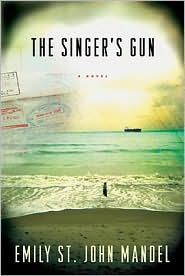
"The Singer’s Gun"

Emily St. John Mandel was born on the west coast of British Columbia, Canada. She studied dance at The School of Toronto Dance Theatre and lived briefly in Montreal before relocating to New York.

Her first novel, Last Night in Montreal, was a June 2009 Indie Next pick and is a finalist for ForeWord Magazine's 2009 Book of the Year.

She applied the Page 69 Test to her new novel, The Singer's Gun, and reported the following:
The Singer’s Gun concerns a man named Anton Waker, who’s trying to lead a more honorable life. Everyone he grew up with is corrupt—his parents are dealers in stolen goods, and his first career was a partnership venture with his cousin Aria, selling social security cards and forged passports to illegal aliens in New York.

As the novel opens, the tenuous life he’s built for himself in the legitimate world is beginning to come undone. The process begins on the day his secretary Elena disappears. Elena is Canadian by birth, but has lived and worked in the United States for a number of years; she has secrets of her own, and she’s being pressed into service by a State Department agent named Alexandra Broden. Page 69 marks the beginning of Elena’s entrapment. On that page, Broden is interviewing Elena for the first time.

Page 69:
Broden looked at her for a moment, and then smiled. Elena shivered.

“Cold?”

“A little. The air conditioning in this building …”

“It is a little cool in here,” Broden said. “I’d just like to go through your background one more time. Just to clarify a few points, and I believe that will bring us naturally back to the question at hand. After you graduated high school, you moved to the United States to go to college.”

“Exactly. Yes.”

“You were eighteen?”

“Yes.”

“You had a scholarship to Columbia?”

“And an offer of one at MIT. But I wanted to live in New York.”

“Quite an accomplishment,” Broden said. “Did you work while you were in school?”

“No. I worked after I left school,” Elena said.

“Tell me about that time,” said Broden. “After you left school.”

“Well, there’s not much to tell. I was washing dishes at a restaurant. Then I was a photographer’s model, and then I came here.”

“Uh- huh. Let’s go back a step. The time when you were posing for the photographer. What made you start doing that?”

“The posing? I don’t know, it’s hard to find a decent job without a bachelor’s degree. I didn’t make a lot of money at the restaurant. It was just extra income.”

“I understand,” Broden said. “It was something you could do without being legal in the United States.”
Learn more about the author and her work at Emily St. John Mandel's website.

The Page 69 Test: Last Night in Montreal.

Visit the complete list of books in the Page 69 Test Series.

--Marshal Zeringue

Sunday, May 23, 2010

"Instinct"

Jeremy Robinson is a bestselling novelist whose books include The Didymus Contingency, Raising the Past, and Antarktos Rising.

He applied the Page 69 Test to Instinct, his second Chess Team novel, and reported the following:
Page 69 in Instinct is the end of a chapter and not even half the page. In some ways I was hoping page 69 would be a dud so I could be different from all the other authors saying their page 69 was awesome, but I can’t say that! What Instinct’s page 69 reveals about the books is its quick tension. Each and every chapter ends with a cliffhanger and this is one of the biggest because the enemy force the Chess Team previously encountered and will continue to encounter is revealed. And their name alone says so much. Read the text of Instinct’s page 69 and find out who it is!
She nodded. “The next lesson you get won’t be from me, and it won’t be an object lesson.”

She said it with such confidence, King realized she knew more than she’d revealed. “Pawn, stay with the others. We’ll bring up the rear.”

Sara nodded slowly. Her muscles, tight with tension, fought against her as she moved. The introduction to Somi had been so unnerving that it exhausted her. The caffeine seemed to be wearing off already. She remembered King’s reprimand and pushed against the pain in her legs. The mission would be completed, no matter the cost to their bodies or psyches. They just had to succeed and survive. She left with Rook, moving fast to catch up with the others.

When the group was out of earshot, King turned to Somi. “Who are they? Who is following us?”

“I wasn’t sure at first, but after last night’s battle ended I had a chance to inspect the dead men’s uniforms. VPLA. The Death Volunteers,” Somi said with a frown. “Vietnamese special forces.”
Watch the Instinct trailer, and learn more about the book and author at Jeremy Robinson's website.

My Book, the Movie: Instinct.

Check out the complete list of books in the Page 69 Test Series.

--Marshal Zeringue
Saturday, May 22, 2010

"The Language of Trees"

Ilie Ruby lives near Boston with her husband and three children from Africa.

She applied the Page 69 Test to her debut novel, The Language of Trees, and reported the following:
The Language of Trees takes place on Canandaigua Lake, the birthplace of the Seneca Nation of Indians. Woven with magical realism and folklore, the story centers on the mysterious disappearances of two children in the Ellis family—little Luke Ellis, and then over a decade later, his sister, Melanie, now a teenage mother and ex-addict. As townspeople isolated by years of secrets are drawn into the frantic search for Melanie, they discover a world where nature and the spiritual realm intertwine and the past refuses to stay where it belongs. It is only when a Seneca healer who has turned his back on his legacy confronts his past and his own lost love, that the mystery of the Ellis children can be put to rest. With the aid of a restless spirit, help comes for Melanie through unexpected circumstances as her life hangs in the balance.

I approached the page 69 test with a healthy dose of enthusiasm and a hint of trepidation, unsure as to whether it would be indicative of the book. Thank God for small favors--it is: the magical realism vernacular that is delicately woven throughout everyday occurrences; one of the main characters, the late Luke Ellis, and how memories of him still haunt his neighbors and are a driving force in the book; our last glimpse of the relationship Luke and his sisters had before tragedy struck. And the effect he still has on the people who knew him.

The element of magical realism is something that I’m asked about a lot. I think this page is a good illustration of how extraordinary occurrences can infiltrate ordinary experiences, and how this creates a certain atmosphere in the book. Their presence must deepen our understanding of the events in the story. This page is a nice snapshot of several reoccurring elements throughout the book. More specifically, you’ll see things like paper airplanes and stacks of dimes in the story, even though you may not see little Luke Ellis.

Page 69 of The Language of Trees:
As she stands at her kitchen window, she tries not to look, but her eyes fix on the frosted gray tombstone. The smell of the flowers is so sweet it sometimes gives Clarisse a headache. It trickles in even though her windows are kept tightly shut. There are no boundaries when it comes to that family. All those years ago, little Luke’s paper airplanes would soar right through her kitchen window. Once they had landed on the belly of her oldest and most patient ginger tabby that had rolled over, just moments before, stomach up like a landing strip. Clarisse could hardly keep from laughing, even after she had marched outside with the intention of reprimanding Luke Ellis.

A black bra dangled over one side of Luke’s head as he sat on a milk crate, dressed in an adult’s robe, in front of a handmade sign that read, "Paper airplanes for a dime!" He was intense and focused, folding the yellow legal paper, which he handed over to his sisters, Melanie and Maya, who sent them spiraling out into the air. Passengers waved from car windows. People on bikes slowed to watch him. Luke had always been obsessed with collecting dimes. He had just seen a movie about airplanes on television, Leila later told Clarisse, and now he’d become completely obsessed with flying.

When a strong wind kicked up, the paper airplanes took off in a million different directions, and the girls chased them down driveways four neighbors deep. What could Clarisse do when Luke asked her for eighty cents, pointing to four airplanes on her roof? It didn’t matter that he had added wrong, or that he spilled purple juice all over her shoes when he hugged her after she had given him his money. Back then, she loved having the children next door. She loved the sight of him flying down the driveway later that afternoon with a large black plastic bag for a cape, his long blond curls making him look wild, a purple scarf flapping around his neck. That evening Clarisse had gone
Visit Ilie Ruby's website, blog, and Facebook page.

Check out the complete list of books in the Page 69 Test Series.

--Marshal Zeringue

Thursday, May 20, 2010

"Injustice for All"

Scott Pratt is the author of An Innocent Client and In Good Faith.

He applied the Page 69 Test to his new novel, Injustice for All, and reported the following:
Page 69 of my third novel, Injustice for All, is actually quite interesting. It involves one of the lead characters, Katie Dean, and is the second time in the book in which she eats a meal. During the first meal, which is the first chapter in the book, her father kills her mother and her brothers and sister with a shotgun. He shoots Katie, too, but after a long stay in the hospital, she survives. She winds up being taken in by her mother's sister, who lives on the border of the Great Smoky Mountains National Park in East Tennessee. The second meal, which occurs on page 69, is symbolic of a communion between Katie and her new life. The food has all been produced on the farm where she now lives. She feels a connection between the food and the place, which leads to a sense of renewal in her life.

I could write much more about the scene and the novel, but I'd rather you read it and draw your own conclusions. Thanks for the opportunity to share my thoughts and my work.
Learn more about the book and author at Scott Pratt's website.

The Page 69 Test: An Innocent Client.

Visit the complete list of books in the Page 69 Test Series.

--Marshal Zeringue

Wednesday, May 19, 2010

"The Tulip Virus"

Daniëlle Hermans works as a freelance communication consultant and lives in Bilthoven, the Netherlands.

She applied the Page 69 Test to her debut mystery, the recently published The Tulip Virus, and reported the following:
Is my page 69 characteristic of The Tulip Virus? Is it representative for the rest of my book?

Partly, and I’ll explain why. In The Tulip Virus, I take the reader back and forth to the seventeenth century and the present. Page 69 is a seventeenth century chapter, and takes place in the Dutch town of Alkmaar on July 21, 1636, to be exact. On page 69, my character Wouter Winkel, an inn-keeper and tulip merchant who actually worked and lived in Alkmaar during this time, is mistreated.
The fingers dug deep into his armpits. He felt the heels of his shoes sliding along the floor, catching slightly on the edge of each tile. Through half-closed eyes, he looked down. His hands were tied together over his stomach, rising and falling with each tug as he was dragged across the floor. He could see the fingertips of the person dragging him, the thick, irregular nails caked with blood. His blood.
On page 69, Wouter Winkel is begging for his life, and begging to be understood in his fight for freedom of thought and freedom of speech. In seventeenth century Holland, known as the Golden Ages, these were important topics as our country boarded mutual different religions and was the only country in the world at that time where people were free to write and print anything they wanted. But for some people in the Low Countries, even freedom had its boundaries. And in the eyes of some people, Wouter Winkel crossed these boundaries and had to pay for it.
Learn more about The Tulip Virus at the publisher's website and visit Daniëlle Hermans' website.

--Marshal Zeringue

Tuesday, May 18, 2010

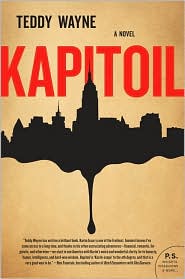
"Kapitoil"

Teddy Wayne is a graduate of Harvard and Washington University in St. Louis, where he taught fiction and creative nonfiction writing. The recipient of a 2010 NEA Creative Writing Fellowship, his work has appeared in The New Yorker, the New York Times, Vanity Fair, Time,Esquire, McSweeney's, USA Today, and elsewhere. He lives in New York.

He applied the Page 69 Test to his new novel, Kapitoil, and reported the following:
Here is page 69 of Kapitoil. Karim Issar, the protagonist and narrator, has recently begun using his computer program, Kapitoil, to predict oil futures and, after some tweaks, it’s been performing well for his company, Schrub Equities:
JOURNAL DATE RECORDED: OCTOBER 25

On Monday morning Kapitoil continues generating hourly profits. By noon, out of a possible 2.1% profit based on how much the oil futures have vacillated per hour, we have made a 1.7% profit, which is not full efficiency but is still robust.

Mr. Ray emails me:

Meet me in the conference room on 89 at 1:30.

Possibly he has reconsidered that Kapitoil might still be too risky. There are rumors that layoffs will soon occur, and maybe they do not have the money to continue high-risk programs like mine.

Or possibly they do not even have the money to retain me as an employee.

I omit lunch because my stomach is turbulent, as it frequently becomes when I am anxious, and do not run Kapitoil at noon, because I do not want it to lose money suddenly and give Mr. Ray more reason to kill it.

At 1:30 I knock on the door of the conference room. Mr. Ray says “Come in” from inside, and I open the door.

He is sitting, and at the head of the table is an older man.

He has tan skin and black and white hair, and his nose slightly curves down like a vertical asymptote. His suit is gray and blue and his tie is dark red like blood that has dried.

It is Mr. Schrub.

“Karim,” he says. He stands and extends to a few inches taller than I am. “Glad to meet you.”

I am afraid to look into his eyes as we shake hands, so I look at his red tie. “It is my honor to meet you, Mr. Schrub.”
This feels like a representative page, largely because I strove for consistency in Karim’s business and tech jargon-inflected voice (which evolves slightly through the novel, turning later to past tense, using contractions, and incorporating new words and idioms he learns). It also encapsulates some essential components of his character: he’s nervous about being evaluated by his superiors at work even though his program is doing well; despite his rigorously logical mind, he focuses on tangential and often morbid details (the tie that is “dark red like blood that has dried”); he is humble and polite and earnest with everyone he meets. Finally, the scene accomplishes what I hope the book achieves as a whole—a combination of character development with some narrative propulsion.

There isn’t, however, any humor here or anything too melancholy, two other staples (I hope) of the book. As the first page of a chapter, its function is more to lead the reader gracefully into the development of the scene rather than come out with guns blazing.

Mostly, I’m glad I was able to work in the word “asymptote.”
Read an excerpt from Kapitoil, and learn more about the book and author at Teddy Wayne's website.

Visit the complete list of books in the Page 69 Test Series.

--Marshal Zeringue