Thursday, December 10, 2020

"My Name is Anton"

Catherine Ryan Hyde is the author of more than 40 published and forthcoming books.

She applied the Page 69 Test to her new novel, My Name is Anton, and reported the following:
From page 69:
He stepped into her warm foyer and found himself at eye level with the hat. Somehow it looked more fine and valuable and perfect even than he had remembered. If he was wrong to think it could solve all of his problems, he was incapable of seeing the error in that moment. It was in perfect condition, too. A little softer and more broken-in than the ones he’d tried on in the hat shop, but not noticeably more worn looking.

“You miss your grandfather, don’t you?”

“Of course I do.”

“I see you staring at his old fedora. He loved that hat.”

“It looks nearly new.”

“It does, and he had it since… oh, I’m not sure now. Sometime in the 40s. Definitely before 1950. But he took such meticulous care of it. He had it cleaned and blocked every year like clockwork. It was something of a signature piece of apparel for him.”

He unbuttoned his jacket as she spoke, because he was too warm.

“Would it be all right if I tried it on?”

“Of course.”

He took it off its rack almost reverently, and settled it on his head. It didn’t fit perfectly. It was maybe a quarter of an inch too big. But it didn’t literally fall onto his eyebrows. It just felt a little insecure there. He wouldn’t dare wear it outside in a blustery wind.

He stepped over to the decorative mirror, and sucked in his breath when he saw himself. He looked like a new person. Like a fully grown man. Like an adult man named Anton. It was too perfect. He knew he couldn’t let it go now—not now that he’d seen who he was in it.

Grandma Marion sucked in her breath, too. Audibly.

“What?” he asked her, when he’d torn his eyes away from his own reflection. “Is something wrong?”

“You look so much like him when I first met him. It took my breath away for a second.”
The “Page 69 Test” seems to work unusually well for this book, at least in terms of the symbolic heart of the work.

I should begin by noting that the working title of this novel was Anton's Hat. As I got deeper into the book, I realized that it was not the right symbol for the work as a whole, but Part 1 of the book still bears the heading “Anton’s Fedora.”

In this scene he not only takes on the hat as his own, but at the end of the scene it strikes him, with the help of his Grandma Marion’s words, that he must never use a nickname again. He is growing up as the namesake of his Grandpa Anton. Growing up in the older man’s image. Hence his embrace of the name, and the ultimate title, My Name is Anton.

What you don’t see on this Page 69 Test is that Anton is in love. There is a woman in his life. She’s too old for him, and in an abusive marriage, and it certainly seems at that point to be a love with no space to exist. Before she asks him searching and difficult questions, she always says, “Hold on to your hat, Anton.” It’s become something of a private joke between them. Just prior to page 69, he has overstepped with her, and driven her further away. Somehow he is allowing himself to believe that showing her he has a hat to hold on to will smooth everything over.

The book takes place over a period of many decades, but I think the text on page 69 speaks well to the first and longest part of the book, which is set in the winter of 1965.
Visit Catherine Ryan Hyde's website.

Q&A with Catherine Ryan Hyde.

The Page 69 Test: Brave Girl, Quiet Girl.

--Marshal Zeringue

Tuesday, December 8, 2020

"The Butterfly Effect"

Rachel Mans McKenny is a writer and humorist from the Midwest, recently published in McSweeney’s Internet Tendency, Electric Lit, The Rumpus, and The New York Times.

She applied the Page 69 Test to The Butterfly Effect, her first novel, and reported the following:
From page 69:
If only she could still be collecting data in the cloud forest. Costa Rica and the resort could have been a sci-fi movie, or maybe her life now was. A parallel universe-- make one choice, and it all went a different way.

When Greta was a teen, there had been a surge of reinterest in the theory of the butterfly effect. Magazines covered it, and experts were interviewed on 60 Minutes. It was a dramatic time-- September 11 and natural disasters. As the theory stated, if a butterfly flaps its wings in Argentina, there's a monsoon in Singapore. She understood the attraction then, and she understood it now-- human beings like to think that everything they do matters.
I am shocked at how well this test works for my book, and honestly, it's funny that it does. This page is the first place that I mention "the butterfly effect" in the entire novel, and it was a part which was added during first round edits of the manuscript when we settled on the title as that name. While refining the novel with my editor, we talked about this sense of predestination or loss of control that Greta, the main character, feels. It's one of her major struggles in the novel to try to live with things as they are instead of wishing they had gone another way.

This struggle of hoping that our actions have an impact-- but not too much of one-- is a real human impulse that many of us identify with. We want to be remembered, but for the right things. We want to make a difference in someone's life, as long as it's a good one. But ultimately, we're not in control of how others see us-- and most of the characters in my novel (along with the readers of the novel) might think of Greta as "unlikeable" at first glance. Hopefully by the end of the book, readers (like the characters in the book), come to understand Greta's motives as she comes to understand herself better. She realizes the actions she can take to help, not hurt; to rebuild rather than tear down. The Butterfly Effect is an ultimately hopeful story that ultimately, I hope, will make a difference in people's lives.
Visit Rachel Mans McKenny's website.

--Marshal Zeringue

Sunday, December 6, 2020

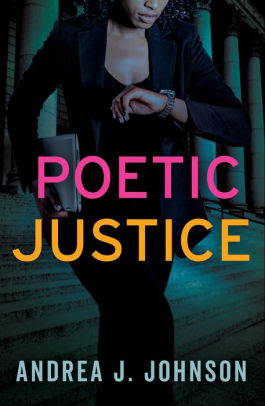
"Poetic Justice"

Andrea J. Johnson is a writer and editor whose expertise lies in traditional mysteries and romance. She holds an M.F.A. in Writing Popular Fiction from Seton Hill University and a copyediting certification from UC San Diego. Her craft essays have appeared on several websites such as DIY MFA, Submittable, and Funds for Writers. She also writes entertainment articles for the women’s lifestyle website Popsugar and is the author of the court reporter whodunit series the Victoria Justice Mysteries.

Johnson applied the Page 69 Test to the first book in the series, Poetic Justice, and reported the following:
From page 69:
“Someone we love died within the walls of our workplace. I think that’s worth us enduring any inconveniences that might come our way. You don’t see me complaining.”

“Oh, hush up.” Maggie groaned. “I know you’re used to walking on water around here, but you’d be well advised to keep that self-righteous attitude to yourself.”

Her comely features formed the same flirtatious smile she’d given James earlier, but the pleasantness didn’t reach her eyes—those clouded over with something wrathful.

“Ain’t nobody saying they don’t feel bad about what happened,” she cooed. “I was just trying to make a point about how my integrity is being called into question, but here you come, as usual, trying to steal the spotlight by flashing around your relationship with the judge.”

“Really, Maggs? You’re quibbling over friendships?” My voice grew taut to cover my frustration. If anything, I’d always downplayed my relationship with Ms. Freddie to avoid reactions like hers. “Judge Wannamaker loved all of us and treated everyone here as her equal. We should be willing to do whatever it takes, regardless of the consequences, to help the police figure out what happened and why.”

I swiveled my chair away from her in an attempt to end the conversation and resume binding pages, but her words stopped me.

“Easy for you to say, Little Miss First on the Scene.” She didn’t raise her voice, but the timbre carried enough bravado that James gasped.

“What’s that supposed to mean? How did you know I found—” I gaped at Maggie and James, who was sitting in a desk chair between us. Surely, he could see the storm brewing and would jump in to back me up. But no. He poked out his lips like a nervous duck and rolled himself out of the line of fire.

“Darling, I’m just saying maybe you should take a good hard look at yourself because you’re not the innocent lamb you claim to be. I wouldn’t try to play that pity card if I were you.”
Our heroine, Victoria Justice, finds herself in a losing argument with one of the story’s main villains (and eventually key suspects), Margaret Swinson. Maggs, as she best known, is a busty blonde busybody with a big ‘ol bouffant and syrupy Southern drawl. She works in the clerk’s office at the courthouse and breaches the sanctity of Victoria’s office on a daily basis. Maggs visits the court reporter’s sanctum under the pretense of flirting with one of Victoria’s young male coworkers, James Brandenkamp, but it quickly becomes clear Maggs motives are more sinister.

Maggs presents herself as a Southern sweetheart, but Victoria recognizes her as a gossipy maneater spreading lies about the judge who was murdered in the courthouse just one day earlier. Even though Victoria, has not yet made the decision to usurp the police and investigate the crime, this page shows her fierce loyalty to the victim, The Honorable Frederica Scott Wannamaker aka “Ms. Freddie.”

As with any good cozy mystery, our protagonist has a direct connection to all of the major characters in the story, specifically the victim who is Victoria’s mentor and her mother’s best friend. Therefore, this scene helps solidify that connection so that when it comes time for our sleuth to get involved with the murder, her decision to do so makes both logical and emotional sense. That is to say, Victoria becomes involved in solving the crime because she owes it the friend she feels she failed to protect and to help dispel the suspicion mounting around herself. We also get a glimpse at how Victoria’s keen power of observation and utter stubbornness will help her overcome the deadly obstacles that will surely obscure the truth.
Visit Andrea J. Johnson's website.

My Book, The Movie: Poetic Justice.

--Marshal Zeringue

Saturday, December 5, 2020

"The Ballad of Ami Miles"

Kristy Dallas Alley is a high school librarian in Memphis, Tennessee, where she lives with her husband, four kids, three cats, and an indeterminate number of fish. She studied creative writing at Rhodes College in another lifetime and holds a Master of Science in Instruction and Curriculum Leadership from the University of Memphis. In an ideal world, she would do nothing but sit on a beach and read every single day of her life, but in reality she's pretty happy reading on her front porch, neglecting the gardens she enthusiastically plants each spring, and cooking huge meals regardless of the number of people around to eat them.

Alley applied the Page 69 Test to The Ballad of Ami Miles, her debut novel, and reported the following:
From page 69:
I saw a couple of towels folded on a shelf above the toilet and thought I might be able to at least wrap a towel around myself before I looked, but they were too far to reach without stepping into the room. The mirror was old and cloudy around the edges, but I could still see better than I wanted to. Finally, curiosity got the best of me, and I locked eyes with my own self in the mirror. They were just about the only part of myself I was used to seeing in my little round pocket mirror, so that part was kind of comforting and familiar. I thought that maybe if I could just keep looking myself in the eye, I could find the courage to step out and look at the rest of me. And sure enough, I started to feel calmer. Keeping my eyes on their reflection, I slowly stepped into the bathroom.

When I was a few steps away from the mirror, I stopped. The towels were within reach now, but I was feeling braver. I let my eyes focus on my whole face and then outward just a little more to take in my hair. I had pulled it back into a thick braid at some point, but it was escaping in wisps and curls like it always did. Like it wanted to be free. So I pulled the long tail of the braid over my shoulder and untied the end, then worked my fingers through it until it was loose and wild around my shoulders and down my back. I pulled it all around me like a cape, and then I let my eyes drop so that I was looking, finally, at all of myself.

I saw a girl whose face and neck were freckled and brownish from the sun but whose body was pale and blank in comparison. Now, I know I didn’t need a mirror to look down at my undressed self, but I never really had. I was taught that vanity is a sin and the body is the devil’s trap. The only time I wasn’t covered from neck to ankle and wrist in a loose muslin dress was when I was bathing and changing clothes, and that was a quick, no-nonsense business. Even standing in that bathroom so far from Heavenly Shepherd, I felt like I was doing something shameful and wrong. I felt afraid. But another, newer feeling was also fighting its way out: I felt bold.
I had never heard of the Page 69 Test, but when I opened my book to page 69 I really had to laugh. As it turns out, this really is a fairly good test for my book, but also? It's about my protagonist seeing herself naked in a mirror for the first time ever!

Ami has been raised by her grandparents according to strict rules and a pretty harsh interpretation of religious values. In her world, pride is a sin, and for that reason mirrors are forbidden. Ami has secretly kept a small round mirror compact that she found as a child, so she has seen a tiny circle of her own face in the little mirror, and that's all. When she arrives at Lake Point in search of her mother, she's given a room in the repurposed guest lodge and gently encouraged to bathe after her long trek through the wilderness to get there. Her room has the kind of attached bath you would expect in the former guest lodge of a state park, and she's startled to find a large mirror above the sink. At first afraid, she decides to be bold and take a look at herself there in that strange place, far from home but also far from the overbearing adults who have always been right there watching,
Follow Kristy Dallas Alley on Facebook and Twitter.

My Book, The Movie: The Ballad of Ami Miles.

--Marshal Zeringue

Thursday, December 3, 2020

"The Art of Violence"

S. J. Rozan has won multiple awards for her fiction, including the Edgar, Shamus, Anthony, Nero, and Macavity, the Japanese Maltese Falcon, and the Private Eye Writers of America Lifetime Achievement Award. Rozan was born and raised in the Bronx and now lives in lower Manhattan.

She applied the Page 69 Test to her new novel, The Art of Violence, and reported the following:
Page 69 is largely dialogue, Bill Smith talking to two people who need to know what the case is about.

It's pretty spot on. Smith is clear on what he's doing; one of the other two is more confused than angry, the other more angry than confused, and they both find the situation -- that a client's hired Smith to prove he, the client, is a serial killer -- unbelievable.

Page 69 finds people arguing over the truth. Truth is at the heart of The Art of Violence. Everyone in the book has an agenda. If the truth will serve it, then the character's in favor of the truth. If it won't, the character chooses to deny the truth; or to shrug, ignore it, and move on. Not a lot of these characters are interested in the truth in the absolute sense: because it's true. That absolute truth is what Bill and Lydia have been hired to find.

The book's set in the art world. Keats said, "Beauty is truth, truth beauty." In the art world, though, that just kicks the can down the road. Beauty may be truth, but how do you know you've found beauty? Who defines it, who sanctifies it, what relation does it have to value, to money? Is art about beauty? About truth? Can they be at odds? If so, what triumphs?

These are the questions that animate The Art of Violence. They fascinate me. I hope readers find them absorbing, too.
Visit S.J. Rozan's website.

The Page 69 Test: Paper Son.

--Marshal Zeringue

Tuesday, December 1, 2020

"Eddie's Boy"

Thomas Perry is the bestselling author of over twenty-seven novels, including the critically acclaimed Jane Whitefield series, Forty Thieves, and The Butcher’s Boy, which won the Edgar Award. He lives in Southern California.

Perry applied the Page 69 Test to his new novel, Eddie's Boy, and reported the following:
Page 69 begins the scene with the words, "The men arrived around three in the morning, during the boy's turn to watch. A big sedan rolled into the lot with its lights off and stopped.The car doors all opened but the dome lights were turned off, so the car didn't emit light except for the faint glow of the dashboard dials. The driver stayed behind the wheel while four men got out and left the doors open so there would be no slamming sounds."

Michael Schaeffer is "the boy" in this scene, which happened many years ago when he was about fifteen. He's with his guardian and mentor, "Eddie the Butcher," who has been teaching him both of his two trades, butcher and occasional killer for hire. Eddie has agreed to do a killing in Chicago, but when he and the boy arrived, he was given a comped room in a particular south side motel. Eddie correctly realized that was suspicious, so he and the boy have secretly moved to a different room to await the killers who must be coming for them, and taken turns watching. The rest of the page is the ensuing battle, in which Eddie uses a shotgun to first kill the driver and then hide behind the car's engine block to shoot the men who have burst into the wrong room and become trapped. In the very last lines, the boy realizes that the man in the motel office must be part of the ambush, so the boy dashes toward the front desk with a pistol to kill him.

I think that page 69 is a fair taste of the book. The novel tells the story of a series of attacks on Michael Schaeffer in the present, when he is in his sixties and his guardian Eddie Mastrewski is long dead. These scenes from the past are Michael remembering the days half a century ago when he learned the lessons or acquired the skills that will keep him alive one more time today. Not all of the lessons are exclusively about killing. Some are about love, sacrifice,deception, responsibility, intelligence, competence--all the things we need to grow up.
Learn more about the book and author at Thomas Perry's website and Facebook page.

The Page 69 Test: Silence.

The Page 99 Test: Nightlife.

The Page 69/99 Test: Fidelity.

The Page 69/99 Test: Runner.

The Page 69 Test: Strip.

The Page 69 Test: The Informant.

The Page 69 Test: The Boyfriend.

The Page 69 Test: A String of Beads.

The Page 69 Test: Forty Thieves.

The Page 69 Test: The Old Man.

The Page 69 Test: The Bomb Maker.

The Page 69 Test: The Burglar.

The Page 69 Test: A Small Town.

Q&A with Thomas Perry.

--Marshal Zeringue

Monday, November 30, 2020

"Poppy Redfern and the Fatal Flyers"

Tessa Arlen is the author of the critically acclaimed Lady Montfort mystery series—Death of a Dishonorable Gentleman was a finalist for the 2016 Agatha Award Best First Novel. She is also the author of Poppy Redfern: A Woman of World War II mystery series. And the author of the historical fiction: In Royal Service to the Queen.

Arlen lives in the Southwest with her family and two corgis where she gardens in summer and writes in winter.

She applied the Page 69 Test to her new novel, Poppy Redfern and the Fatal Flyers, the second title of the A Woman of World War II series, and reported the following:
From page 69:
It was a forlorn group of women who were gathered around the long trestle table by the mess windows looking out on the airfield.

“Morning, Poppy. Breakfast? We usually have a large one because it might be the only chance we have to eat today.” June’s face was very pale, her eyes were red-rimmed with fatigue, but she was lacing into a plate of eggs, mushrooms, and what looked like some sort of tinned corned beef. It was a deadly-looking array of overcooked and greasy food. I shuddered. Even before the war, when an English cooked breakfast was the envy of the world, I never understood how people managed to eat platefuls of protein first thing in the morning.

“I would love a couple of slices of toast and a cup of coffee,” I said as Bess planted herself underneath June’s chair and looked up at her with a particularly yearning expression. She was rewarded with a corner of toast with scrambled eggs that looked like pale yellow rubber.

“No coffee for me; I’ll take tea,” Annie told the mess steward. “I want this war over soon, so we can have a good strong cup of real coffee with lots of sugar. What do they make this stuff with?” She had pushed away her coffee cup. “Parched acorns?”

Grable, after lifting her head briefly to say good morning, had gone back to staring bleakly out the window as she sipped coffee, and Annie became absorbed with making a toast sandwich with what looked like fried Spam, but her heart wasn’t in it. The Spam slithered out from between the toast, and she pushed it aside with an impatient exclamation. None of them looked like they had slept well; their faces were wan, their eyes clouded with exhaustion. If there was someone sitting at this table who had caused Edwina’s accident, her conscience had given her a rough going-over last night.
The Page 69 test worked quite well: it certainly gives us a good idea of what it would be like to eat breakfast in England during WWII!

But there is something else going on here too! The paragraphs from this page sum up the reactions and shock of a group of women pilots whose comrade, Edwina, was killed in an accident flying a Spitfire for a propaganda about the glamorous Air Transport Auxiliary pilots: The Attagirls.

A bit of background on the Air Transport Auxiliary (ATA): The women pilots of the ATA whose wartime job was to deliver planes from factories to military airfields were only glamorous Attagirls to the outsider. In reality their days were long, and often dangerous. Seasonal fog and ice storms contributed to the danger of flight particularly if you were delivering an open cockpit Tiger Moth to Scotland. The barrage balloons that protected the airway above military airfields were pulled down when friendly planes approached, but if there was an air raid warning were immediately released to provide a navigational nightmare. And not all air raid ground staff were adept at telling the difference between a German Heinkel or a British Hurricane from the ground and in their ignorance often opened fire on a British or American plane.

But it is the last sentence that gives us a clue that all is not well. “None of them looked like they had slept well; their faces were wan, their eyes clouded with exhaustion. If there was someone sitting at this table who had caused Edwina’s accident, her conscience had given her a rough going-over last night.”

This observation is made by the protagonist, Poppy Redfern, who is a script writer for the Crown Film Unit which made short films about civilians who do brave things in wartime. When Edwina appeared to crash her Spitfire Poppy was standing on the edge of the airfield as the film crew shot Edwina’s demonstration of skill at piloting a Spitfire. And to Poppy’s observant mind there was something about the dead pilot’s demeanor before she flew that day and her relationship with some of her ATA friends that caused her concern. It is these perceived signals that prompts Poppy to eat breakfast with this group of close friends before they leave to deliver planes, to see how they are faring after the accident. But little does she realize that her premonitions of danger are justified. Within hours of the Attagirls departure another of them falls to her death in what will also be termed as an “accident.”
Visit Tessa Arlen's website.

See Tessa Arlen’s top five historical novels.

Coffee with a Canine: Tessa Arlen & Daphne.

The Page 69 Test: Death of a Dishonorable Gentleman.

My Book, The Movie: Death of a Dishonorable Gentleman.

The Page 69 Test: Death Sits Down to Dinner.

My Book, The Movie: Death Sits Down to Dinner.

The Page 69 Test: A Death by Any Other Name.

The Page 69 Test: Death of an Unsung Hero.

Writers Read: Tessa Arlen (November 2019).

The Page 69 Test: Poppy Redfern and the Midnight Murders.

Q&A with Tessa Arlen.

--Marshal Zeringue

Sunday, November 29, 2020

"Ruinsong"

Julia Ember is the author of The Seafarer’s Kiss duology and Ruinsong. Her work has been featured in USA Today, Bustle, Book Riot and Autostraddle, among many other prominent outlets. Ember has a lifelong appreciation for history and classic literature, and holds an MLitt in Medieval Literature from the University of St. Andrews. She currently lives in Seattle with her wife and two very fluffy cats.

Ember applied the Page 69 Test to Ruinsong and reported the following:
From page 69:
After so many years at the palace with Elene, I know her well. She might have forgiven the viscount for abandoning their love, but she could never have forgiven his betrayal of her ambition.

Elene likes to say that when she murdered the old queen, mounted the viscount's charred corpse on a pike in the city square, and took the throne, she'd been restoring control to where it rightfully belonged. After all, the divine quartet gave magic to us mages, not the noble folk.

And surely, if the goddesses had meant for the nobles to rule, Elene would purr, they would have given them more than the delusion of power.

I have faith in the divine quartet and know that we are all instruments of their will, but even I have a hard time believing that the goddesses wanted Bordea to become what it is.

I stumble through the overgrown courtyard to the hospital's door. The nuns are too busy with their patients to maintain the garden's former splendor, so weeds grow through the cobblestones, and the fountain is cracked, water pumping directly onto the walkway to create a muddy swamp. A film of algae grows over the front steps. I edge carefully through the garden on tiptoe, trying to keep my feet as dry as possible.
I think the test works in some ways and fails in others for my book! I think it gives us a great glimpse into the villain's psyche from the protagonist's perspective, but because most of the page describes the villain's backstory, I'm not sure it gives the reader the best understanding of the book's plot or the main character's motivations. It does, however, provide some insight into the political dynamics of the kingdom and the workings of the magic system!
Visit Julia Ember's website.

--Marshal Zeringue

Friday, November 27, 2020

"The Prince of Mournful Thoughts and Other Stories"

Caroline Kim was born in South Korea. She has an MFA in Poetry from the University of Michigan, where she won a Hopwood Award and an MA in Fiction from the University of Texas at Austin, where she was a James A. Michener Fellow. She was nominated by Jellyfish Review for a 2019 Best of the Net award. Kim lives in Walnut Creek, California with her husband and three children.

She applied the Page 69 Test to her new book, The Prince of Mournful Thoughts and Other Stories, and reported the following:
Page 69 will find the reader close to the beginning of “Seoul,” the fifth story in the collection. The Korean War has just broken out, surprising a young boy and his family.

An excerpt:
Sung’s family was surprised to find that they were on the northern side of the line dividing Korea. They were happy the Japanese were gone but wary of the Communists. They just wanted to be left alone. What did it matter who controlled the government? Communism. Democracy. Really, who cared? What they wanted was so simple: to be able to eat and breathe freely, work their small li of land, have children and grandchildren, live and die facing the same sunset they had watched all their lives.

The changes came slowly over the next five years and were mostly seen in the larger town of Kumchon. Posters of Stalin and Kim Il-sung appeared pasted on municipal buildings; sometimes Russians passed through, tall and thickly bearded with eyes of startling bright colors. Sung’s family kept their heads low, gave monthly to the soldiers who came to collect their share of rice and vegetables, and hoped to escape notice. Life went on. Instead of giving to the provincial office, they now gave to the Communists.
Given that this is a collection of short stories, I was surprised at how well this test worked. The above excerpt shows how suddenly your life can change due to nothing you’ve done. It’s shocking at first, but then you get down to the business of figuring out how to survive in your new reality. This idea appears in many of my stories. Ultimately, how my characters deal with their new lives reveals who they are. I’m just fascinated by how anybody gets through life. In the story above, Sung and his family escape south, ending up in Seoul. Even though the capital is chaotic and terrifying at times, Sung still feels the excitement of a young boy discovering a big city. He suffers and experiences joy while trying to remain a decent human being. In the end, I think that’s all we can really hope for.
Visit Caroline Kim's website.

--Marshal Zeringue

Wednesday, November 25, 2020

"The Star-Crossed Sisters of Tuscany"

Lori Nelson Spielman is a former speech pathologist, guidance counselor, and teacher of homebound students. She enjoys fitness running, traveling, and reading, though writing is her true passion. Her first novel, The Life List, has been published in thirty countries and optioned by Fox 2000. Her second novel, Sweet Forgiveness, was also an international bestseller. She lives in Michigan with her husband and their very spoiled puppy.

She applied the Page 69 Test to her third book, The Star-Crossed Sisters of Tuscany, and reported the following:
On page 69 of The Star-Crossed Sisters of Tuscany, the entire Fontana Family is gathered in Nonna Rosa’s dining room for Sunday dinner. An anxious Emilia announces that she and her cousin Lucy are going to Italy.
Heads turn. Confused looks are exchanged. Slowly, my family find their voices.

“Why is she going to Italy?”

“Is it safe?”

“Not for a young woman.”

“Europe is teeming with crime these days.”

“Yes,” Aunt Carol agrees. “Terrorists.”

"And gypsies. They’d steal the blood from your veins if you let them.”
The situation is made worse when Lucy confesses that they’ll be traveling with Aunt Poppy, the black sheep of the family.
A silence takes over the room, so profound you could hear dust drop. I run a finger over my scar. Finally, Nonna’s chair scrapes against the wood floor.

Wordlessly, she rises. Gripping her espresso cup, she moves into the living room, as if she hasn’t heard a word I’ve said.
I’d say the Page 69 test works fairly well in the case of The Star-Crossed Sisters of Tuscany. It’s a story about a 200-year-old curse on second-born Fontana women, dooming them to lives without true love. Two cousins, Emilia and Lucy, resign themselves to never finding lasting romance, that is, until their estranged great aunt invites them to Italy, vowing that the curse will be lifted on her 80th birthday, when she’ll meet her true love on the steps of the Ravello Cathedral and break the curse, once and for all.

Though page 69 fails to mention the second-daughter curse directly, we hear boisterous laughter when little Mimi asks if Emmie has a boyfriend. It also illustrates the conflict between the elder family members and the younger Emilia and Lucy. And when Poppy’s name is thrown into the mix, the tension escalates greatly. Overall, page 69 is a fairly good snapshot of the book. Thanks for letting me test Marshall McLuhan's theory!
Learn more about the book and author at Lori Nelson Spielman's website.

--Marshal Zeringue

Tuesday, November 24, 2020

"The Turning Tide"

Catriona McPherson was born in Scotland and lived there until immigrating to the US in 2010. She writes the multi-award-winning Dandy Gilver series, set in the old country in the 1930s, as well as a strand of multi-award-winning psychological thrillers. Very different awards. After eight years in the new country, she kicked off the humorous Last Ditch Motel series, which takes a wry look at California life. These are not multi-award-winning, but the first two won the same award in consecutive years, which still isn’t too shabby.

McPherson is a proud lifetime member and former national president of Sisters in Crime.

She applied the Page 69 Test to her latest Dandy Gilver mystery, The Turning Tide, and reported the following:
From page 69:
… certainly concerned with Vesper. Why? Who owns the island? And who owns her cottage? Who is the girl’s employer? Whoever it is, why doesn’t he just sack her and put her out? I know it’s brutal and I’m not recommending it, but it doesn’t make sense that a girl so clearly incapable of carrying out her job is managing to scupper all the plans to turn Cramond Island into Valhalla.’

‘True,’ Alec said.

‘And besides, it makes no sense that the local publican is so dearly concerned with a few holiday cottages cut off from her pub by a coastal causeway. Why does she care? Why does Miss Speir care if it comes to that? And then there’s this place.’ I laid my hands against the stones of the tower.

‘What about it?’

‘If Miss Speir needs money, or cares deeply about Cramond, or both, and has got this eyesore sitting in her garden, why is she merely selling off the stone?’

‘Oh, I don’t know,’ Alec said. ‘There are so many new houses going up in Edinburgh these days, nasty little things to be sure, but they’d be improved no end with a few mediaeval stones here and there. And this is a bit close to her own house for her to be fixing the roof and getting tenants in.’

I shook my head. ‘What about these mythic tourists?’ I said. ‘Americans, even. If there was a castle in the offing.’

‘It would take a large investment to get a crumbling tower fit for Americans,’ Alec said. ‘But speaking of the tourists: I find it odd that an island earmarked for rich guests to lark about on has been turned over to potato trials. If we’re airing puzzles.’

‘We certainly need to speak to these lads who’re vouching for Vesper.’

‘Apart from anything else they can confirm whether or not Peter Haslett was drunk.’
Hmmmmmmmm. It’s not the easiest page to slip into as far as content goes, is it? What with two people – Dandy and Alec – talking about three others – Vesper, Miss Speir, and Peter Haslett – and flinging out all those questions and theories.

On the other hand, it gives a good impression of the tone of the book and sets it firmly in its historical context. Those “nasty little houses” going up all over Edinburgh in the 1930s were solid, stone-built bungalows set in large gardens, which now sell for millions. And the people who live in them are complaining about “nasty little townhouses” ruining the city. Plus ça change.

I was tickled to see American visitors get a mention on the page picked at random for this post. Luring tourists from the US was as dear a hope for Brits then as it is now, and I know from when I used to live in a county bristling with castles (Galloway) that moats, drawbridges and crenulations are a key part of the deal. As for “getting a crumbling tower fit for Americans”, I’ve been here ten years now, and all I can say is I could never go back to British plumbing, castle or no castle!
Visit Catriona McPherson's website.

My Book, The Movie: The Turning Tide.

--Marshal Zeringue

Monday, November 23, 2020

"This Is Not a Ghost Story"

Andrea Portes is a bestselling novelist. Her novels include: Hick, Bury This, Anatomy of a Misfit, The Fall of Butterflies, Liberty, Henry & Eva and the Castle on the Cliff, Henry & Eva and the Famous People Ghosts.

Portes applied the Page 69 Test to her new novel, This is Not a Ghost Story, and reported the following:
From page 69:
Suddenly I am anxious at the idea of talking to her. Anxious at the idea of talking to anyone… The room seems smaller, shrinking somehow, and suddenly I am terrified of any interaction whatsoever.
This happens just after Daffodil has made an elaborate day-dream scenario of the waitress at the local diner. It’s a wonderful, cinematic, zombie-including day dream… full of life and love of character.

But then, almost immediately, Daffodil suddenly shuts down and has to leave, running out of the diner.

Page 69 isn’t representative of the book, really. It’s a moment of the book, a dalliance. It does, however, give the reader a tiny peek into the machinations of Daffodil, our protagonist. She is, in one moment, brimming with life, full of love and understanding and imagination and wonder. Then, almost immediately, all of that energy seems to turn in on itself… to cannibalize itself. Daffodil has this kind of psyche, restless and brilliant and scared of its own shadow.
Visit Andrea Portes's website.

My Book, The Movie: This Is Not a Ghost Story.

--Marshal Zeringue