Tuesday, November 20, 2018

"They Promised Me The Gun Wasn't Loaded"

James Alan Gardner is a 1989 graduate of the Clarion West Science Fiction Writers Workshop, and has had several science fiction stories and novellas appear in publications such as Isaac Asimov’s Science Fiction Magazine, Amazing Stories, and The Magazine of Fantasy and Science Fiction. He is the author of Expendable, Commitment Hour, Vigilant, Hunted, Ascending, Trapped, and Radiant. He was the grand prize winner of the 1989 Writers of the Future contest, has won the Aurora Award, and has been nominated for the Hugo and Nebula Awards.

Gardner applied the Page 69 Test to his new novel, They Promised Me The Gun Wasn't Loaded, and reported the following:
I’m happy to say that page 69 of They Promised Me The Gun Wasn’t Loaded is actually a pivotal moment in the book.

Quick background: Gun’s protagonist is a university student named Jools. She and her roommates gained superpowers in the first book of the series (All Those Explosions Were Someone Else’s Fault). Jools is now “human-best” in everything. For example, she doesn’t have superhuman strength but she’s as strong as the strongest human weightlifter. She’s also as fast as the fastest human runner, as agile as the best human gymnast, and as knowledgeable as the best human surgeon, physicist, historian, etc.

In other words, she has a huge breadth of knowledge. This lets her see cross-connections between disciplines that no one else is aware of. If she’s not careful, her mind fills with brilliant new inventions that combine principles from many different fields.

But does that breadth add up to super-intelligence? The question matters because on this particular version of Earth, people with super-intelligence tend to become Mad Geniuses: supervillains of the sort who create hordes of zombie dinosaurs or fire-breathing robots in order to conquer the world.

Is Jools in danger of going mad and becoming a supervillain? Or is she simply a very smart person who’s unlikely go maniacal?

Page 69 starts addressing this question. Jools and her teammates have got their hands on what looks like a super-gun made by a known Mad Genius. They don’t want to pull the trigger; for all they know, the weapon shoots nuclear bombs or lethal plague germs. But Jools wants to see if she can understand what the gun does and how it was made. Without admitting it out loud, she wants to know how smart she is. Is she just a clever human, or might she be a dangerous super-genius?

On page 69, Jools and her friends set out to break into a lab and analyze the gun. The page starts a scene in which a great many secrets begin to be revealed.

So hurray for page 69! It advances both the plot and Jools’s character development. Pretty good for just one page.
Visit James Alan Gardner's website.

--Marshal Zeringue

Sunday, November 18, 2018

"Bittersweet Brooklyn"

Thelma Adams is the author of the historical novel Bittersweet Brooklyn, the bestseller The Last Woman Standing and Playdate, which Oprah magazine described as “a witty debut novel.” In addition to her fiction work, Adams is a prominent American film critic and an outspoken voice in the Hollywood community. She has been the in-house film critic for Us Weekly and The New York Post, and has written essays, celebrity profiles and reviews for Yahoo! Movies, The New York Times, O: The Oprah Magazine, AARP.com, Variety, The Hollywood Reporter, Parade, Marie Claire and The Huffington Post. Adams studied history at the University of California, Berkeley, where she was valedictorian, and received her MFA from Columbia University. She lives in upstate New York with her family.

Adams applied the Page 69 Test to Bittersweet Brooklyn and reported the following:
From page 69:
She feared for Abie’s life, however quick he was with a knife. Where could he be? Was he hiding from the police? And if that reporter got her brother’s name in print, did it mean that he was lost to her?

That reporter didn’t know Abie like she did—how much love he had for her and how, time and again, he’d been forced to defend himself, a scrawny kid, from bigger foes as he had in the orphanage. To hesitate was to become a victim. She understood that. There had to be justification for his attack on that Rothman kid. Abie would explain. She felt fear, yes, but something else, too, as she paced the sidewalk bracing herself to return home. It was pride. Her brother was the toughest kid on Fourteenth Street, and he would always protect her. No one on the street would dare harm her with such a daring brother in her corner.
Page 69 in Bittersweet Brooklyn, the final page of Chapter Eight, is an inflection
point: historical research and fiction converge. Throughout the novel, I used the criminal milestones of old brother Abraham "Little Yiddle" Lorber to plot the course of his younger sister's personal dramas. I uncovered a New-York Tribune newspaper item from 1921 headlined: "Toughest Kid Proves It: Newsie Stabs Lad, Who Doubted Title Given Him."

In this critical final page of an action-packed sequence, Thelma, 13, has fled from a traumatic domestic event in Brooklyn. She travels to her family's Manhattan newsstand, seeking consolation and advice from her older brother. Instead, she encounters a mob at Union Square, a splash of blood and discovers to her horror that Abie is likely the perp.

Her response filtered by personal trauma and adolescence mixes terror and pride. Being a face in the crowd following her brother's attack tests, but does not break, her loyalty. A nearby workman advises her: disappear and don't talk to the police. As she grows up, the warnings are everywhere – and yet this brother is the light of her life, he sees her spark and loves her unconditionally, the way she needs to be loved.

Their bond is a thing of pure imagination. His criminal life is documented, however spottily, in newspapers, criminal records and, ultimately, federal trial transcripts. But who is she, the girl without a documented past? That's what I wanted to know and I answered with fiction. She's a bubbly girl with a dancing heart capable of loving fully, deeply richly – but the challenge is keeping that spark alive as a struggling American immigrant. The love, tenderness, humor and betrayals of this brother-sister relationship are at the heart of the book. The affection grew in the writing, a life force of its own.

I knew in May 1921, Lorber stabbed a boy named Nathan Rothman – but where was Thelma? How did that crime impact her? How does her decision that day change or seal her fate?

Thelma's devotion to her brother defines her. It's the crux of Page 69, and it alternately heals her and haunts her through the years to come and to the final page of Bittersweet Brooklyn.
Learn more about the book and author at Thelma Adams' website.

--Marshal Zeringue

Friday, November 16, 2018

"The Delphi Revolution"

Rysa Walker is the bestselling author of The Delphi Trilogy (The Delphi Effect, The Delphi Resistance, and The Delphi Revolution). Timebound, the first book in her CHRONOS Files series, won the Grand Prize in the 2013 Amazon Breakthrough Novel Awards. Her career had its beginnings in a childhood on a cattle ranch, where she read every book she could find, watched Star Trek and The Twilight Zone, and let her imagination soar into the future and to distant worlds. Her diverse path has spanned roles such as lifeguard, waitress, actress, digital developer, and professor—and through it all, she has pursued her passion for writing the sorts of stories she imagined in her youth.

Walker applied the Page 69 Test to The Delphi Revolution and reported the following:
From page 69:
“You still need to find Pfeifer,” Stan repeats. “You just can’t bring him back here. At least not until the other paths close.”

I stare at him incredulously. “What other paths? This isn’t making any sense!”

Stan exhales and turns to Maria. “Show them. It’s easier.”

Then Maria is in my head again, pushing that same scene. The image keeps flipping, flickering, like one of the old movie projectors my hitcher Emily used when she was a teacher. White office building, maybe ten stories high, with tall recessed windows. Construction cones and a barrier emblazoned with the word STOP in bright red blocks the street.

This time, however, Maria doesn’t pull back and things get even stranger. I kind of hear the gunshot again and the scream. At the same time, I also kind of hear the sound of a horn and the squeal of brakes. It’s not that I hear all of these things, layered on top of each other. It’s more that I hear (and don’t hear) the gunshot and the scream. And I hear (but also don’t hear) the horn and the tires screeching on the pavement.

In addition, the video feed, if you can call it that, is split into different layers. Two men in dark suits—one of them vaguely familiar—push a third man toward shelter, but then the group splits into two separate sets of three men. Set #1 pushes the man in the center toward a blue shed between the building and a parking lot across the street. My first thought is that it’s a phone booth or the TARDIS. But since neither of those things currently exist in downtown DC, it must be a portapotty.

The second set of men that split off in the vision dives behind a concrete barrier, which is barely knee-high. But before they can reach it, another shot rings out and the man they’re escorting crumples to the ground.
The Delphi Revolution is the third and final book in my Delphi Trilogy, so I wasn’t sure if page 69 would fit the rest of the book or the series as a whole. In one way, it fits quite well. The excerpt above gives a good sense of the psychic abilities the various Delphi adepts possess and their efforts to defeat the presidential candidate who is fanning public fears of psychic terrorism for his own political gain. So, in that sense, it gives a taste of the overall themes of not just this book, but the entire series.

What doesn’t really come through on this page, however, are the relationships that are as central to the story as psychic abilities and government conspiracies. Anna’s concern for her foster brother, Deo, and for the other adepts--many of them small children--who are in danger through no fault of their own, is really the heart of the book. Stan and Maria, who are featured heavily in the excerpt above, do play an important role in the plot, but they’re more peripheral than the core characters we follow throughout the series.
Visit Rysa Walker's website.

--Marshal Zeringue

Wednesday, November 14, 2018

"Zero Sum Game"

SL Huang is an Amazon-bestselling author who justifies her MIT degree by using it to write eccentric mathematical superhero fiction. Her debut novel, Zero Sum Game, is recently out from Tor, and her short fiction has sold to Analog, Nature, and The Best American Science Fiction & Fantasy 2016. She is also a Hollywood stuntwoman and firearms expert, with credits including Battlestar Galactica and Top Shot.

Huang applied the Page 69 Test to Zero Sum Game and reported the following:
From page 69:
Camarito was barely more than a truck stop, a ramshackle collection of buildings pretending to be a town. The gas station lighting up Main Street tried very hard to be a travel center and almost made it before giving up.
Page 69 is the beginning of a chapter, so has only about two paragraphs. Unlike some of my other chapter beginnings, they’re not nonstop action, but instead start delving into some character backstory. I’d say Zero Sum Game is about half thriller and half characters I want people to fall in love with, so yeah, I think it is representative!
I sat back and watched the night while Rio went inside to pick up some coffees.
This chapter was, in fact, a chapter I had been looking forward to writing since I started the book, because it gives the first deep taste of who the character of Rio is. And I was tremendously excited to get there.

As it turns out, so are all my readers! Rio is everyone’s absolute favorite character. He’s also a psychopath serial killer. This… makes me slightly worried about my readers.

Oh, and did I mention Rio is sort of my main character’s best friend?
I was never quite clear on where the gray ended and the black and white began, but it wasn’t a stretch to put both Rio and me among the condemned...
My main character Cas also kills more people than is strictly polite. But, you know, she sometimes has feelings about it.

Rio is not the greatest influence on her, but they do make a good team when taking down shadowy global organizations, and Cas will threaten to shoot people who are rude to him, even though he doesn’t care one whit. Their relationship with each other stymies the other characters, who see Cas as redeemable—maybe—and Rio as, well, definitely not.

Cas and Rio also have a mysterious backstory together, and the most common question I get from readers so far is “ARE WE GOING TO FIND OUT MORE ABOUT THEM IN THE SEQUELS??”

Yes, readers. Yes, you are.
Visit S. L. Huang's website.

--Marshal Zeringue

Monday, November 12, 2018

"A Scandal in Scarlet"

Vicki Delany is one of Canada’s most prolific and varied crime writers and a national bestseller in the U.S. She has written more than thirty books: clever cozies to Gothic thrillers to gritty police procedurals, to historical fiction and novellas for adult literacy.

Delany applied the Page 69 Test to her new novel, A Scandal in Scarlet, and reported the following:
From page 69:
“It’s settled then.” I was already looking forward to an entire day off. In the summer too. I normally went to the beach on Sunday morning for a swim, but I never had time to linger. We’d do that tomorrow. Then we’d have lunch someplace charming and quiet and expensive. I’d heard good things about a new restaurant in Chatham. Maybe a drive up the coast in the afternoon. The roof of the Miata down, the salty wind in our hair. I’d like to get a new summer dress, and then we could stop at the Harbor Inn on the way back for drinks on the veranda. Unlikely that Ryan would be free to join Jayne and me at the Blue Water Café for dinner, but it was possible this case would be cleared up quickly and easily.

“I feel giddy at the very idea,” Jayne said.

“Good. Why don’t you go home? I can finish up here by myself. It’s almost nine.”

She glanced toward the sliding door. “I’ll stay a bit longer. I hate leaving the place when people are in it.”

The store began to empty out. “Do you have any ideas, Gemma?” Jayne asked when the last customer had left. Who, I am pleased to report, staggered under the weight of her purchases.

“Ideas about what?”

“About who killed Kathy?”

I shook my head. “I can’t say I haven’t been thinking about it, but nothing stands out in my mind. Although the relationship between her and her ex-husband is interesting.”

“In what way?”

“I think he regrets leaving her. I think his new wife knows it, and she’s angry about it. But I didn’t observe either of them doing anything untoward.”

I counted the day’s receipts and began to tidy up.
At first glance page 69 doesn’t seem terribly important. The murder has happened, the police have been to the scene, and now everyone has left and characters are planning the following day. They are talking about what might have happened, but only as observers. They have no intention of getting involved in the investigation.

But, this is the last page of the first act, if you consider the classic three act structure. The characters are relaxed, the initial drama around the murder has happened. Life is about to go on.

Turn the page, and everything changes. The characters are plunged into an investigation of the murder. All their plans are turned on their head.

At the end of the first act the character has committed to a course of action. She will investigate the murder.

The game is indeed afoot.
Visit Vicki Delany's website, Facebook page, and Twitter perch.

--Marshal Zeringue

Saturday, November 10, 2018

"Go to My Grave"

Catriona McPherson was born in Scotland and lived there until 2010, before immigrating to California.  A former academic linguist, she is now a full-time fiction writer, the multi- award-winning and best-selling author of the Dandy Gilver detective stories, set in Scotland in the 1920s.  She also writes a strand of award-winning contemporary standalone novels including Edgar-finalist The Day She Died and Mary Higgins Clark finalists The Child Garden and Quiet Neighbors.

McPherson applied the Page 69 Test to her new novel, Go to My Grave, and reported the following:
Page 69 is the end of a chapter so a very short page:
‘More burgundy, Vicar?’ came Buck’s voice – I think it was Buck’s voice – through the monitor.

‘You don’t do séances as well as the crystals and other claptrap, do you Kim?’ said Paul.

‘What?’ Kim’s voice was strained.

‘Ouija board, maybe? Knock once for yes? We could go straight to the source.’

‘Stop it,’ said Rosalie. ‘How can you?’

‘And I thought this was going to be dull,’ Buck said. ‘You Mowbrays should sell tickets. You’re the same as you ever were.’

‘Shut up, Bu-’ I clicked the switch and silenced them.
Hmmmmm, page 69 is quite representative of the 2018 chapters of the book. (There are 1991 chapters too.) Go To My Grave takes place during a weekend celebration for Kim and Shasha Mowbray's 10th wedding anniversary. Siblings Buck and Peach join Sasha's sister Rosalie, her husband Paul and a few others for what's supposed to be a luxurious short break. Needless to say, it goes sharply downhill, even before the bodies start piling up.

Here someone's listening in on a private conversation and what she hears is Buck mocking his cousins, Peach trying to get him to behave, Paul being dismissive of Kim's new-agey beliefs and making jokes about ghosts, much to his wife's distress. They are a pretty dysfunctional family really.

Also on this page, is something that Go To My Grave has quite a bit of: British sayings. "More tea, Vicar?" is a tongue-in-cheek thing we say if someone drops a clanger at a social gathering. I'm not sure if it was ever said for real to an actual vicar at a tea-party to cover an awkward moment, and it's more usually given a twist into something else now: "More vodka, Vicar?" or "Another line of coke, Vicar?" Far from covering awkwardness, it now draws attention. Typical Buck!
Visit Catriona McPherson's website.

--Marshal Zeringue

Thursday, November 8, 2018

"Girls on the Line"

Jennie Liu is the daughter of Chinese immigrants. Having been brought up with an ear to two cultures, she has been fascinated by the attitudes, social policies, and changes in China each time she visits. She lives in Western North Carolina with her husband and two young sons.

Liu applied the Page 69 Test to her new novel, Girls on the Line, and reported the following:
I was so excited to see that page 69 of Girls on the Line really gets at the tension and suspense I was trying to build in the story.

The novel focuses on two best friends who have aged out of a Chinese orphanage. By this time, Yun, the more impulsive of the two girls, has gotten fired from her factory job, lost her housing, found out she was pregnant, and fled from the more reserved Luli who told her that her boyfriend is suspected of trafficking women. Yun has just been visited by a detective looking for her boyfriend, and on page 69, Yun tentatively confronts her boyfriend.
“He didn’t want me to tell you he was here. And, Yong, he thinks you’re a kidnapper. He said you make women think you’re their boyfriend—”

“I hope you didn’t listen to any of that! Did you tell them that I’m a driver for someone else? If he’s looking for someone, he should be looking for my boss. He’s the one who runs the business.”

Business? Bride delivery ... or trafficking? I shut it out of my mind. “I didn’t say anything. Just that he was wrong. That you’re with me.”

A tight smile comes to his face. “You really said the right thing. He pats the pocket of his jacket until he finds his keys. “You’re with me.” He holds up the keys, clacks them in his hand. “I’ll go with you to get your things.
Despite a flicker of doubt, Yun has to trust her boyfriend, because she’s gotten herself in a hard place with no one else to help her. This scene underlines one of the main themes that hummed in my brain as I was writing Girls on the Line. As a truly disadvantaged person—by gender, economics, education, social policies, the lack of nurture—Yun doesn’t have the basic resources, not even internal ones, to make good choices. For people who have so much stacked against them, in real life, it’s just not easy to break the cycle.
Visit Jennie Liu's website.

My Book, The Movie: Girls on the Line.

Writers Read: Jennie Liu.

--Marshal Zeringue

Wednesday, November 7, 2018

"The Kinship of Secrets"

Eugenia Kim's debut novel, The Calligrapher's Daughter, won the 2009 Borders Original Voices Award, was shortlisted for the Dayton Literary Peace Prize, and was Best Historical Novel and Critic's Pick by The Washington Post. Her stories have appeared in Asia Literary Review, Washington City Paper, and elsewhere.

Kim applied the Page 69 Test to her new novel, The Kinship of Secrets, and reported the following:
The Kinship of Secrets is told from the alternating viewpoints of two sisters who are close in age and are separated as a result of the Korean War. Inja is raised with relatives in Seoul, South Korea, while Miran grows up with their parents in a suburb outside of Washington, DC. Page 69 is in Inja’s perspective at age eight, soon after the armistice. She and her relatives were refugees in the southern city of Busan, and at this moment are staying at an inn outside of war-torn Seoul, on their journey home. Mentioned on this page is a boy who is Inja’s age, who will later become her boyfriend. Because this is a significant transitional moment, how Inja’s two grandparents, her uncle and aunt have aged during the three years of war is summarized. Uncle returns from checking on their home in the city. He reports it’s still standing, “but someone was living there. There are bullet holes in the walls and dirt is everywhere—broken crockery. Nothing of ours remains, though I can’t recall what we left—some chests and tables.” But they had also left behind their cook and her daughter, and there is no sign of them. “Inja understood they had been lost in the war, like so many others she’d heard about in church and school, and they would never know what happened to them. …There was so much to feel bad about in the war. A few words of prayer helped shift those feelings into the recesses of a busy mind.”
Visit Eugenia Kim's website.

--Marshal Zeringue

Tuesday, November 6, 2018

"Machine City"

Scott J. Holliday was born and raised in Detroit. In addition to a lifelong love of books and reading, he has pursued a range of curiosities and interests, including glassblowing, boxing, and much more. He is the author of Punishment, the first book in his series featuring Detective John Barnes; Stonefly; and Normal, which earned him recognition in INKUBATE.com’s Literary Blockbuster Challenge.

Holliday applied the Page 69 Test to Machine City, his second novel featuring Detective Barnes, and reported the following:
Page 69:
“There’s a machine in there,” the man said. His jaw shook as he spoke. Raindrops glistened on his bald head and dripped from his chin. “Right?”

“Yeah.”

“What’s it like?”

“It’s not worth it,” Barnes said.

“Who were you?”

Barnes sighed. “Does it matter?”

The man took a beat and then quickly uttered, “I don’t like my life.”

As Barnes rolled up the window, he said, “Join the Brittanians.” He pulled out of the alley and turned toward home. His cell phone rang as he accelerated down the street. He snatched it up and answered. “You bastard.”

“Is that. Any way to talk. To a friend?”

It wasn’t Franklin. Barnes pulled the phone away from his head and checked the caller ID. unknown. He put the phone back to his ear. “Who is this?”

“Oh, John,” the caller said. “My feelings. Are hurt.”

“Gee, I’m sorry. Now who the fuck is this?”

“I know. What you must. Think.” The voice was weak and whispery. The caller struggled to speak. He took sharp intakes of breath between his stunted phrases. “You think Franklin. Is toying with you. You think he wrote. The letter from Cohen.”

“Say what?”

“You think he’s. Trying to pull you. Into an. Investigation. Using Ricky as bait.”

“Look, jerk-off,” Barnes said. “I don’t know who you—”

“Using the fact. That you failed. Your kid brother.”
I'd say page 69 represents the novel rather well. At this stage Barnes has just returned to the machine like an addict back to his drug of choice. He runs into a machine protestor and speaks with him for a moment before continuing on. He gets a call from the man who's tormenting him both via the phone and from within Barnes's mind, making him wonder if it's all in his head. It's spot on with what the book is about.
Visit Scott J. Holliday's website.

My Book, The Movie: Machine City.

--Marshal Zeringue

Sunday, November 4, 2018

"Mutiny at Vesta"

R. E. Stearns is the author of Barbary Station and the newly released Mutiny at Vesta. She wrote her first story on an Apple IIe computer and still kind of misses green text on a black screen. She went on to annoy all of her teachers by reading books while they lectured. Eventually she read and wrote enough to earn a master's degree in curriculum and instruction from the University of Central Florida. She is hoping for an honorary doctorate.

When not writing or working, Stearns reads, plays PC games, and references internet memes in meatspace. She recently moved to Denver, Colorado, USA with her husband/computer engineer and a cat.

Stearns applied the Page 69 Test to Mutiny at Vesta and reported the following:
Mutiny at Vesta is about heists, hubris, and lesbian space piracy in our solar system. I am pleased to report that page 69 of Mutiny at Vesta is representative of the book as a whole!

In Barbary Station our heroines, Adda and Iridian, were trapped on an isolated shipbreaking station in deep space. In the sequel, they’re seeing the rest of the solar system from a pirate crew’s perspective. Page 69 begins with our heroines’ crew captain playing the asteroid belt’s most powerful factions against each other. The Interplanetary Transit Authority (ITA) are ostensibly the good guys in this universe, and they’re the only ones willing to take on Captain Sloane’s pirate crew in a space battle. And yes, Captain Sloane always talks like this.
“We haven’t always enjoyed such a high profile,” Sloane admitted, without confirming or correcting Iridian’s estimate of Sloane’s troop strength. “Which meant we drew less ITA attention. Their presence can be advantageous, when they focus on rescuing ships in distress and clearing debris from the reliable routes. We simply purchase exclusive focus on those objectives. When we can’t, it’s often possible to redirect high-minded ITA agents toward the Ceres syndicate.”
The Ceres syndicate is the largest criminal organization in the asteroid belt, and as Captain Sloane’s lieutenant points out at the end of this conversation, “they’re killers. We’re not.”

After a scene break, we jump into Iridian’s point of view as the warship Apparition approaches the Ann Sabina, a longhauler that Captain Sloane’s crew is about to raid.
Two days later, Iridian put a hand on the cool metal bulkhead to steady herself before snapping her suit gloves onto the rest of her armor. Grav was barely over one g, but the Apparition’s speed would keep climbing as it arched through the last banked turn to line up with the target. They’d have to keep increasing speed to match the Sabina, which’d been accelerating since its launch and wasn’t stopping anytime soon.
In Mutiny at Vesta, Iridian and Adda face off with enemies of pirate crews generally and Sloane’s crew in particular. Is Sloane hiring hundreds of mercenary soldiers to defend crew territory against the ITA and the Ceres syndicate, or is the captain planning for something bigger? And how does artificial intelligence fit in? Find out in the second installment of Adda and Iridian’s adventure.
Visit R. E. Stearns's website and Twitter perch.

My Book, The Movie: Barbary Station.

--Marshal Zeringue

Saturday, November 3, 2018

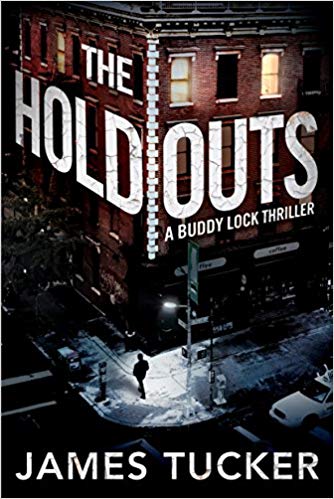
"The Holdouts"

James Tucker is the author of the acclaimed Buddy Lock thrillers Next of Kin and The Holdouts. He holds a law degree from the University of Minnesota Law School and has worked as an attorney at an international law firm.

Currently he manages real estate strategy at a Fortune 50 company, where his work includes frequent travel throughout the United States. Fascinated by crimes of those in power, he draws on these cases for his novels.

One of four fiction writers awarded a position at a past Mentor Series at the Loft Literary Center in Minneapolis, Tucker has attended the Community of Writers at Squaw Valley and the Tin House Writers’ Workshop in Portland, where he was mentored by author Walter Kirn. He lives near Minneapolis with his wife, the painter Megan Rye, and their family.

Tucker applied the Page 69 Test to The Holdouts and reported the following:
While The Holdouts is a police thriller, family is a hugely important part of the story. Buddy, his fiancée, the ten year old boy they’re trying to adopt, and Buddy’s half-brother play essential roles. On page 69, Buddy’s half-brother confesses to the way Buddy kept him alive during a dark time—a time when Ward repeatedly considered suicide. The brothers, who haven’t always gotten along, shake hands. They realize that they’re “competitors and rivals, but brothers, too.”
Visit James Tucker's website.

My Book, The Movie: The Holdouts.

--Marshal Zeringue

Thursday, November 1, 2018

"The Quantum Magician"

Derek Künsken writes science fiction and fantasy in Gatineau, Québec and tweets from @derekkunsken. In previous incarnations, he did molecular biology experiments, worked with street kids in Honduras and Colombia, and served in the Canadian Foreign Service. His short fiction has appeared in Asimov’s, Analog and BCS, as well as in several year’s best anthologies, and earned him the Asimov's Award. The Quantum Magician is his first novel and is published by Solaris Books in English, by SFWorld in Mandarin, and by Albin-Michel in French (early 2020).

The Quantum Magician has been described as "Ocean's Eleven in space" and is about a genetically-engineered con man who is able to perceive the quantum world. He takes a job to move a dozen advanced warships through the wormhole of an enemy nation, a virtually impossible task, even with the right crew.

Künsken applied the Page 69 Test to The Quantum Magician and reported the following:
I opened the book to page 69, and found the client and the con man arguing, which is pretty representative of the novel. The job, a heist to move some warships across a wormhole, is phenomenally dangerous, and even if Belisarius succeeds for his employer, he'll start a war.
“He looks young enough to be my grandson,” Rudo said to Babedi.

“Mister Arjona broke into the vault of one of the big Plutocracy Banks and stole an experimental AI when he was still a teenager,” Babedi said.

“That wasn’t proven,” Belisarius said. “I wasn’t even charged.”

“He’s also wanted for questioning by the Congregate on suspicion of espionage,” Babedi said. “Congregate defense secrets were compromised.”

“The charges were withdrawn,” Belisarius said. “There was no evidence linking me to anything. I’m free to move through Congregate space.”

“So Mister Arjona has a habit of getting into trouble,” Rudo said.

“He has a habit of getting out of it, which is what we need, ma’am,” Babedi said.

“Just so,” she agreed.

“What will you do on the other side, Major-General?” Belisarius asked quietly. “The Congregate will want what you’ve got. Just like the Puppets.”

“They can try to take it,” she replied. The hum of conversation lowered as officers strained to hear their commanding officer. “A hundred and twenty-five years ago, the Venusian state signed an accord with the Sub-Saharan Union. In the last century, in service and in blood, the Union has paid out its debt.”

“The Congregate owns a lot of real estate in the Epsilon Indi system,” Belisarius said. “Two fortified Axis Mundi wormholes. Battleships bigger and more numerous than your cruisers. And I think they’ve got a dreadnought in system.”

“They do,” Babedi said.

They were going to die. They were all going to die if they faced the Congregate navy, and they needed him to get to a place where they could die.
So this is a weirdly hyper-representative portion of the novel, one that cements the stakes of everything that's come before and establishes what will happen from here on out. I may use this for a reading at a book store in two weeks!
Visit Derek Künsken's website.

--Marshal Zeringue