Tuesday, August 12, 2014

"A Distance to Death"

Holly Menino grew up in a small Ohio college town, where her passionate interest in animals showed itself by age three, about ten years before she heard the call to be a writer. A graduate of Smith College, she has worked in both scholarly and popular publishing and is the author of Murder, She Rode.

Menino applied the Page 69 Test to her new book, A Distance to Death, and reported the following:
If you start to skim A Distance to Death on page 69, you'll find Charlie Reidermann explaining that "we couldn't get a quorum." But Charlie should take a look around page 69 because it brings together at a guest ranch in the Sierra Nevada a quorum of the story's major characters.

You may have met Tink Elledge, Charlie, and stepson Stephen in Murder, She Rode, the first Tink mystery. Tink is a former world-class rider—headstrong, intuitive, and confronting the erosion of her athletic ability. Charlie, her third husband and a successful investor, has a much cooler head and a big business deal at risk. Stephen, Tink's much-doted-on stepson now under Charlie's tutelage, has an equal stake in the deal. Also present—in one way or another—are a dead guy, the woman he has left behind in an uneasy legal status, and Tink's first husband.

The dead guy hasn't been dead very long. He was a geneticist made quite wealthy by his pharmaceutical innovations. He was old. Died in his sleep, no reason to question that. Tink doesn't, so I hope you won't either. At least not right now.

But you'll see right away that Tink has sympathy for the unmarried woman the dead guy left behind—and that she is withholding some important information from Charlie. Tink is just one of the people who are guarding information. The dead guy, for starters, has been quietly devoting his later years to discovering a balance between evolution, as proposed by Darwin, and the life of the spirit, as proposed by Christianity. But then....[time to stop skimming]

When I set A Distance to Death in the midst of a debate about evolution versus religion, I assumed that debate was nearly dead and thought it would be fun for Tink to stir it back to life again. But in the past month the evolution-creation issue has popped back up into the public eye. As reported by New York Times commentator Charles M. Blow, a new Gallup poll reveals a contradictory mix of beliefs about evolution and the work of God. A movie due out later this summer will probably make a broader impression. I, Origins dramatizes the evolution-religion conflict that apparently exists in the minds of many people—and Tink rides right into the thick of that.
Visit Holly Menino's website.

Writers Read: Holly Menino.

--Marshal Zeringue

Monday, August 11, 2014

"Resurrection"

Mandy Hager is an award-winning writer and educator based on the Kapiti Coast, New Zealand. She has a drive to tell stories that "matter" -- direct, powerful stories with something to say. She won the 2010 NZ Post Children’s Book Award for Young Adult Fiction for The Crossing, the first book in the Blood of the Lamb trilogy.

Into the Wilderness is the second book in the trilogy, and Resurrection is the third.

Hager applied the Page 69 Test to Resurrection and reported the following:
From page 69:
It was well after dark before she and Aanjay were released. When at last Charlie ushered them out of the gloomy cell block Maryam was surprised to find a large contingent of women still waiting outside. They clapped and cheered as Aanjay emerged from the building, rushing in to bury her in welcome.

Back in their hut, Maryam settled down with Ruth to tell her of the decision to seek deportation. Her heart thumped with excitement. At last she could make real her promise to return Ruth safely home.

“I don’t know why I didn’t think of it before,” she said, as Ruth stared at her open-mouthed. “I think I was too scared to trust them, imagining it might be better to do it on my own.”

Ruth’s hands flew to the small mound of her belly, and she spread her fingers over the bump as if to protect it. Her eyes grew glassy as she gnawed at her bottom lip, and Maryam couldn’t read what was going on inside her head.

“Aanjay says they’ll put us on a big boat like the one that brought us here and take us all the way back home.” Maryam tried to sustain enthusiasm against Ruth’s odd response. “Think of it: we won’t have to worry about a thing.”

“Except what they might have in store for our people there,” Ruth muttered.

“What?” She didn’t understand Ruth’s reaction. Isn’t this what she’d prayed for from the start? “They’ll drop us off and leave. The last thing the Territorials want is to make a fuss and let the people of Onewēre know they’re there.”
This comes from the start of Chapter Five and, in many ways, is a pivotal part of this climactic book in my dystopian Blood of the Lamb trilogy. Maryam, along with her friend Ruth, is imprisoned by The Territorials in a detention camp on a small prison island off the coast of what was once Australia. She has finally realised how she can escape – and how to take Ruth with her. Until now her desire to return to her home island of Onewēre has been theoretical, as she had no idea how to achieve this, but now she must face the fact that her return will bring her face to face with the very people who she fled from to escape certain death. But, despite Ruth’s reluctance, Maryam knows she must return: she has the means to cure the disease that has kept her people under the control of the deadly Apostles of the Lamb – and she means to free them even if it costs her life.
Learn more about the book and author at Mandy Hager's website and Facebook page.

My Book, The Movie: Into the Wilderness.

The Page 69 Test: Into the Wilderness.

Writers Read: Mandy Hager.

--Marshal Zeringue

Sunday, August 10, 2014

"Beneath the Neon Egg"

Thomas E. Kennedy’s many books include novels, story and essay collections, literary criticism, translations, and anthologies. Beneath the Neon Egg is the final book in his Copenhagen Quartet, following In the Company of Angels, Falling Sideways, and Kerrigan in Copenhagen.

Kennedy applied the Page 69 Test to Beneath the Neon Egg and reported the following:
From Page 69:
“You take a year off, you may never get back to it,” [Bluett says to his son, Timothy]. “Then you'll be stuck. I know what I'm talking about. I took a leave of absence at the beginning of my university studies, and it took me three years to get back to it. I couldn’t finish until I got here [to Copenhagen], and it ruined my chances for an academic career.”

“Who wants an academic career?” [Timothy asks.]

“You might. You can't know yet for sure. Don't cut yourself off. Don't shut the door on yourself.” Bluett hears what he is saying, hears cliché after cliché, knows that he is saying what he wishes his own father had said to him all those years before instead of giving him permission to do as he pleased, make his own mistakes, his father who was too lost in his. Yet at the same time he senses that nothing can be accomplished with this conversation. Perhaps it is enough just to register his resistance…

“If you need money, Tim – or anything at all, you only have to ask. If I can help you, I’ll be glad to.” Will you reach that far to me? But the boy is staring out the window, lips pursed.
These are the words of divorced 43-year-old Patrick Bluett to his college-age son, and I believe these were some of the lines the Kansas City Star had in mind when calling the novel – in an earlier incarnation from an Irish publisher – one of the noteworthy books of the year, adding, “No one writes about the loves and lives of men better than Kennedy, including their relationships with their own children.”
Learn more about the book and author at Thomas E. Kennedy's website.

The Page 69 Test: In the Company of Angels.

--Marshal Zeringue

Saturday, August 9, 2014

"The Good Know Nothing"

Ken Kuhlken’s stories have appeared in Esquire and dozens of other magazines and anthologies, been honorably mentioned in Best American Short Stories, and earned National Endowment for the Arts Writing Fellowship. His novels have been chosen as an Ernest Hemingway Best First Fiction Book, a Private Eye Writers of America Best First Novel, and a Shamus Awards Best Novel. The novels are Midheaven and the Tom Hickey California Crime series.

Kuhlken applied the Page 69 Test to the new Tom Hickey novel, The Good Know Nothing, and reported the following:
The scene features L.A. police detective Tom Hickey, a film producer named Hopper, and a man who calls himself Hal Croves, whom Tom suspects is actually Ret Marut, the author who goes by the pseudonym B. Traven, and who Tom believes stole and published his missing father's novel manuscript and perhaps killed his father to get it. The three are in a bar, the Pitcairn, on Santa Catalina Island where Hopper, at Tom's behest, has lured the author by offering the possibility of a film adaptation of The Death Ship, the novel in question.
The men [Tom and Marut] sat crouched like bare knuckle boxers consigned to their respective corners. So he [Hopper] returned, seated himself, and rested a hand on Marut’s shoulder. “Mind I call you Hal?”

“If you prefer.”

The producer made a fist as if to reach across and give Tom’s arm a good-natured tap, which he then chose not to deliver. “Hal rode the train the whole godawful way [from Mexico City]. How about that? What, a couple thousand miles, mostly desert.”

“Twenty five hundred kilometers.”

“Pullman car?”

“Yes.”

“Hot as hell?”

“I have known worse.” Marut spoke English with a slight Germanic gruffness and diction.
The waiter arrived, costumed in an eye patch and his head wrapped with a bandana. “What’ll it be, blokes?” he rasped.

Hopper called for a bottle of Irish whiskey and three tumblers.

Tom had already convicted the man across from him. Back on the dock, on account of Marut’s reaction to his appearance and to his mention of Charlie Hickey, he had shed all doubt.
Still, he would need to convince Florence, Madeline, and perhaps a judge and jury. So he continued to collect and memorize evidence, such as the book thief’s every expression and move appearing either nervous or sly.

The bottle arrived. The producer poured, two fingers in each tumbler. A long and a short swallow helped Tom speak in level tones. “Let’s take it from the top. Charlie Hickey goes to sea, comes back home and writes about his travels.” He shoved the bottle at the man. “Take it from there. Where’d you bump into him, Mister Traven?”

The man poured a second dose and sipped. “Traven, I am not.”

“Then you’re going to take me to Traven. Correct? And he’s going to take me to Charlie Hickey. Correct?”

“This is not possible,” the man said in a voice that hinted of apology.

Tom reached for the bottle. He sensed, or detected from the man’s face, what was coming. He closed his eyes.
The page offers a glimpse of the quest that drives the whole story, and it shows Tom's dark and restless state of mind and his determination to get at the truth, no matter how painful it might be.

So it passes the page 69 test, right?
Visit Ken Kuhlken's website.

Writers Read: Ken Kuhlken.

--Marshal Zeringue

Friday, August 8, 2014

"Palmetto Moon"

Kim Boykin is the author of The Wisdom of Hair from Berkley, Steal Me, Cowboy and Sweet Home Carolina from Tule, and the newly released Palmetto Moon, also from Berkley.

Boykin applied the Page 69 Test to Palmetto Moon and reported the following:
The last time I was graciously invited to this blog, I was a little disappointed my book didn't pass the Page 69 Test. I'm delighted to report Palmetto Moon passes with flying colors. The story picks up on Frank and Vada's first date. They've just been in a dance hall full of writing couples, some of whom were tossed out for public displays of affection that didn't jive with the dancehall rules that were on a 4X6' plywood sign. Frank and Vada have stepped out back to an area where lovers, no doubt many of whom were just tossed from the dance. It's a fragile moment for Frank, and of course Vada. Here's the scene through Frank's eyes.
“I wouldn’t do that if I were you.” She stretches out her long legs and smiles at him, teasing before she scoops up a handful of water and flicks it on him. Frank laughs, and she laughs, too, shutting out all the lovers’ sounds and the night sounds, too. He sits beside her and pulls her close so that her feet aren’t dangling over the edge anymore. “See that?” He points out into the lily pads that are lovingly choking the pond to death. She peers out onto the moonlit lake until she sees the massive gator impersonating a log, and then she draws her knees up to her chest like a little girl.

“Vada?” She nuzzles closer to him. “Can I kiss you?”

She turns her face up to his, and her smile dissolves into yearning as they move toward each other. His lips graze against hers, nuzzling them so that when she runs her tongue across her lips it touches his. He can’t help but be tentative, like she’s breakable, like what they have is breakable, but the kiss deepens. Her breathing quickens, and Frank is sure he can feel her heart beating against his.

Floodlights come on, blinding them, and the old woman who took their ticket hollers that the dance is over and everybody has to clear out. Frank’s forehead is still pressed against Vada’s. He’s afraid to move, afraid the spell will be broken. He helps her up, and she looks up at him and smiles. “Frank?” There’s something monstrous and wrong about this night ending, about taking her back to the boardinghouse. Frank wants to take her away from here, but he doesn’t think she’s ready for happily ever after with him, at least not yet. She puts her hands on his face and runs her thumbs across his stubble. “Thank you. This was the most perfect evening ever.”
Learn more about the book and author at Kim Boykin's website.

The Page 69 Test: The Wisdom of Hair.

My Book, The Movie: The Wisdom of Hair.

Coffee with a Canine: Kim Boykin & Wylie, Molly and Toby.

Writers Read: Kim Boykin.

--Marshal Zeringue

Thursday, August 7, 2014

"City of Ghosts"

Kelli Stanley is a critically-acclaimed, multiple award-winning author of crime fiction (novels and short stories). She makes her home in Dashiell Hammett’s San Francisco, a city she loves to write about.

Stanley is best known for the Miranda Corbie series of historical noir novels and short stories set in 1940 San Francisco. The first novel of the series, City of Dragons, introduced Miranda, the unforgettable protagonist Library Journal calls "one of crime’s most arresting heroines.”

City of Dragons won the Macavity Award for Best Historical Novel, and was nominated for the Los Angeles Times Book Prize, a Shamus Award, a Bruce Alexander Award and an RT Book Reviews Award, was a Mystery Guild selection of the month, and placed on many “best of the year” lists.

City of Secrets, the sequel to City of Dragons, was released by Thomas Dunne/Minotaur to great critical acclaim, was nominated for a number of awards and won the Golden Nugget for best mystery set in California.

Stanley applied the Page 69 Test to the latest novel in the series, City of Ghosts, and reported the following:
From page 69:
Miranda blinked, brown- green eyes focused on the blurred outline of Angel Island and Alcatraz.

No time to think about Spain, about Phyllis Winters. It was a little over four months since Eddie Takahashi’s murder, four months since she’d killed Martini, and only a few weeks since she’d run in the Napa woods, dogs baying, breath coming out in stabs, waiting for the men in white suits.

Waiting to kill herself.

She arched her neck, rubbing it with her right hand, and sat up against the seat, straightening her hat.

Twenty-five hundred dollars lay crisp and cool in her rusty Wells Fargo safe, payment for chasing a Nazi spy. Mrs. Hart lay colder on a slab in the morgue, dead client, dead victim, the priceless jade, funereal green, missing once again and presumably the motive.

And somewhere in England, last bulwark against the Dark Ages, was Catherine Corbie ... or at least a woman who knew enough about her to send a message.

Miranda carefully took the photo postcard of Westminster Abbey out of her purse and read it again:

Would like to meet you. Your loving mother.
City of Ghosts is about a lot of things … art and what it means to a culture, espionage in an America bracing for the war, solving a vicious murder, and whom or what (a nation, an authority figure, a news story) we can trust. Beyond these plots, themes and metaphors, however, City of Ghosts is a story about a woman trying to build her identity.

Miranda doesn’t define herself by the traditional roles of wife, mother, sister, daughter. That alone makes her a transgressive figure, especially in 1940. Relationships have only caused her pain; her father was an abusive alcoholic incapable of nurture and she lost the one great love of her life in the Spanish Civil War.

As a very young child, Miranda never had a chance to really know her mother—who, she believes, abandoned her. Abandonment manifests its own agony of rejection, but the adult Miranda took her mother’s name, not her father’s … a clue to how she has tried to reconstruct her own identity and just how crucial it is for her to find the woman who claims to be Catherine Corbie.

Finding her mother is finding herself … a life-long hero’s journey for Miranda Corbie, and her motivation for risking her life in a city of ghosts.
Learn more about the novel and author at Kelli Stanley's website.

Coffee with a Canine: Kelli Stanley & Bertie.

The Page 69 Test: City of Dragons.

My Book, The Movie: City of Dragons.

My Book, the Movie: City of Secrets.

The Page 69 Test: City of Secrets.

--Marshal Zeringue

Wednesday, August 6, 2014

"The Mountaintop School for Dogs and Other Second Chances"

Ellen Cooney is a fiction writer who lives in midcoast Maine. She is the author of nine novels; her stories have appeared in The New Yorker and many literary journals.

Cooney applied the Page 69 Test to her new novel, The Mountaintop School for Dogs and Other Second Chances, and reported the following:
From Page 69:
Shadow plopped down across my outstretched legs and made the weak little whine-sounds of dogs who want to bark, but don’t. I looked over at Giant George to see if he was getting this on video. He wasn’t. He was strolling to the bins. Hank took no notice, due to his feeling that nothing was more important than pacing. But the rest of them forgot about me and took off for Giant George. They were all looking up at the treats he held in his hand. He lavished them with Good looking up, guys, and Way to go with learning looking up. All I could do was listen to the clicking of Hank’s paw-nails on the floor as he paced, and the peacefulness of three dogs eating biscuits.

Giant George took hold of Hank and snapped on a leash. While he was doing this, Tasha jumped him, as if he had a treat in a pocket, just for her. He pushed her away and told her, Bad move. She didn’t seem sorry. Shadow and Josie looked at her like they were proud of her, like she was the coolest one in the room. Hank tried to start pacing again. But the leash was too short. And that was how it went with my first class.

I watched from a lobby window as Giant George set off in his snowshoes, away from the inn, holding the leashes of Hank and Shadow and Tasha. Josie was in a pack on his back, her little white head sticking up like the head of a toy. Giant George had left the Jeep on the mountain road, so he and the three bigger dogs could get some exercise. I wondered how high up the mountain it was, but I couldn’t go after them, not in all that snow.

When they were out of sight, I knocked on the kitchen door. Mrs. Auberchon came to see what I wanted. I was not invited in. I asked her, were there snowshoes anywhere around the inn I could borrow, to go out and practice on? She said there weren’t.
To my surprise, the random pick-a-page test shows a basic element of The Mountaintop School for Dogs and Other Second Chances. It’s about a young woman named Evie who journeys to a mysterious, snowy sanctuary for rescued dogs—Evie wants to become a dog trainer, although she’d made the decision impulsively, as she knows zero about animals, and she never ever had a pet. She’s only 24, but she’d done a good job of messing up her previous chances. She’d felt like an outsider in her own life; in this excerpt, she’s an outsider (for now) at her new “school.” About the snowshoes: she had lied by telling everyone she knew how to walk on them, and got found out. She had lied about her animal-experience too!

Funny how, in this random-ness, the three major characters of the novel are all there: Evie, the teenage boy called “Giant George” who works with the dogs, and Mrs. Auberchon, the manager of the inn connected to the sanctuary, and also a helping member of the staff. Plus, the major dog-characters are here, doing their thing of being dogs. And there’s a sense of Evie’s dawning connections to both humans and dogs. I lucked out with this test—it’s like a whole body of water in one drop!
Visit Ellen Cooney's website.

Read--Coffee with a Canine: Ellen Cooney & Andy, Skip, and Maxine.

My Book, The Movie: The Mountaintop School for Dogs and Other Second Chances.

--Marshal Zeringue

Tuesday, August 5, 2014

"A History of the Future"

James Howard Kunstler was born in New York City in 1948. He is the author of numerous novels, including World Made By Hand and The Witch of Hebron, and four nonfiction books, including The Long Emergency. He is a frequent lecturer at colleges and professional organizations across the country. He lives in Saratoga Springs, New York.

Kunstler applied the Page 69 Test to his new book, A History of the Future: A World Made By Hand Novel, and reported the following:
In the post economic collapse world of A History of the Future, the law enforcement system and the courts have ceased to function. A double murder has taken place. A young woman has killed her husband and infant son. Five of the village’s leading citizens meet to determine how to proceed, including the congregational minister, Loren Holder, who also serves as constable, and wealthy farmer Stephen Bullock, the elected magistrate, who serves reluctantly. I like to advance the story and reveal character via dialogue. Here’s a passage from Page 69:
“What have you got, Loren?” Bullock said.

“Not much. A diagram of the scene. Notes on interviews, I guess you’d call them, with those who came to the house in response to the screaming.”

“Well, what the hell, Loren?”

“What the hell do you mean ‘what the hell,’ Stephen?”

“I mean… is that it?”

“It’s what we’re able to do,” Loren said, his voice rising. “We don’t have a professional police force here, in case you haven’t noticed.”

“Believe me, I’ve noticed—”

“Is there some crime lab I haven’t been informed about where I’m supposed to send materials?

“Okay, okay. Calm down. What about the murder weapon?”

“I left it in place,” Loren said.

“Where?” Bullock said. “What place?”

“In the chest of the victim,” Loren said.
Visit James Howard Kunstler's website.

Writers Read: James Howard Kunstler.

--Marshal Zeringue

Monday, August 4, 2014

"Avoidable Contact"

Before trying her hand at fiction, Tammy Kaehler established a career writing marketing materials, feature articles, executive speeches, and technical documentation. A fateful stint in corporate hospitality introduced her to the racing world, which inspired the first Kate Reilly racing mystery. Kaehler works as a technical writer in the Los Angeles area, where she lives with her husband and many cars.

Kaehler applied the Page 69 Test to her new novel, Avoidable Contact, the third Kate Reilly racing mystery, and reported the following:
Page 69 of Avoidable Contact is one of my favorite parts of the book. Kate’s behind the wheel of her #28 Corvette C7.R, in her first stint at the 24 Hours of Daytona endurance race. Already that day, she’s absorbed the news that her boyfriend, Stuart Telarday, was critically injured in a hit-and-run just outside Daytona International Speedway. But despite Stuart’s grave condition, Kate—who can’t be of any use to him while he undergoes hours of surgery—is soldiering on and racing with her Sandham Swift team.

And then, near the end of her first hour in the car, Kate witnesses a terrible accident right in front of her. The team’s sister car, with a friend behind the wheel, is punted off track and into a wall, very hard. Kate has to circle the track for many laps behind the safety car, wondering if her friend, Ian, is all right. The page starts with the Sandham Swift team owner, Jack, speaking to Kate:
“… We think he was an innocent victim of something going wrong in the Porsche.”

“Other than incompetence?”

“Easy,” Jack put in. “We don’t know anything yet.”

I knew Race Control and anyone with a scanner—including other teams—could be listening to our conversation. But I’d exhausted my small store of calm, and I didn’t care. “All I’m saying is some of the amateur drivers in this race have been a menace.”

My hands tightened on the Corvette’s steering wheel. “And they’re going to need to watch out if Ian and the 30 car end up paying the price for their mistakes.”
It’s only a 100-word selection, but page 69 perfectly captures the flavor of the book’s mystery and of the racing world—a setting that delivers incredible drama and tension even without a mystery attached. Tension is high. Kate’s “at work,” behind the wheel of the racecar, focused on her car and her race. But she’s also ready to do battle for what’s right and just—whether that’s catching a killer (later in the book) or making sure a poor driver doesn’t have the opportunity to hurt anyone else. Keep reading!
Learn more about the book and author at Tammy Kaehler's website and blog.

The Page 69 Test: Dead Man’s Switch.

My Book, The Movie: Dead Man's Switch.

The Page 69 Test: Braking Points.

Writers Read: Tammy Kaehler.

--Marshal Zeringue

Sunday, August 3, 2014

"The Half Life of Molly Pierce"

Katrina Leno grew up in Connecticut and spent her childhood summers by the shore in Massachusetts, where The Half Life of Molly Pierce, her first novel, takes place. Leno was first published at the age of sixteen in the Connecticut Review and now holds an MFA in creative writing.

She applied the Page 69 Test to The Half Life of Molly Pierce and reported the following:
The Page 69 Test definitely works on my book! In fact, Epic Reads included The Half Life of Molly Pierce in a blog post they did on this very topic. I’ve included the full text of page 69, because it happens to be the last page of a chapter and it’s pretty short.
But inside, nobody says anything. I go up to my room and I lie down on the bed and all I see is Lyle’s face on the ceiling of my room. Lyle’s face on the inside of my eyelids.

Lyle, dead.

Lyle throwing a whiskey bottle against a wall.

Sayer driving me home.

Sayer kissing my forehead.

And I don’t know where to put any of it, so I let it swirl around until I fall asleep. I fall asleep and I dream of green eyes. Gravestones. A hand on someone’s shoulder and my forehead, burning and hot.
Page 69 is very indicative of the tone and structure of the novel as a whole, and you get a good glimpse inside the main character’s head. I think it’s a good indicator of whether or not someone will like the rest of the book!
Visit Katrina Leno's website.

Writers Read: Katrina Leno.

--Marshal Zeringue

Saturday, August 2, 2014

"Paw and Order"

Spencer Quinn is the author of the Chet and Bernie mystery novels: Dog on It, Thereby Hangs a Tail, To Fetch a Thief, The Dog Who Knew Too Much, A Fistful of Collars, and The Sound and the Furry. He lives on Cape Cod with his dogs Audrey and Pearl. When not keeping them out of mischief, he is hard at work on the next Chet and Bernie mystery.

Quinn applied the Page 69 Test to Paw and Order, the seventh book in the Chet and Bernie series, and reported the following:
Page 69 of Paw and Order begins with Chet in a panic:
I flung myself down the rest of the stairs in one leap, bounded to the front door. Closed and bolted. It had a round knob, and I was getting much better at those, but we’d only just started working on bolts, me and Bernie, and I couldn’t bring back what Bernie had told me – couldn’t bring it back now when I needed to the most! All I could remember was the lovely sound of his voice as he took one of my front paws in his hand – and showed me something or other about bolts.
Those of you who didn’t know probably know now that Chet, the narrator of the series, is a dog. But not a talking dog! That’s the most important thing happening behind the curtains in this series. Chet is not a human in a dog suit. He’s as canine as I can make him (and in that way dogs have, he seems to have taken over my life). Just before the passage above, Bernie has been arrested and taken away, and now Chet finds himself alone with Suzie (Bernie’s girlfriend) in her Washington DC house. The reader knows that Bernie has stumbled into some sort of deadly international plot, but all Chet knows is that he has to somehow get out of the house and find him.

The scene is characteristic of Paw and Order in many ways – action, suspense, the telling details (paws versus round door knobs) – the most important of which is the glimpse we get of the engine that drives this whole series: the love between Chet and Bernie. That’s always a good day, when a writer finds an engine under the story’s hood. Not all novels have them! I’ve been lucky with Chet and Bernie.
Visit Chet the Dog's blog and Facebook page, and Peter Abrahams's website.

The Page 69 Test: Spencer Quinn's The Dog Who Knew Too Much.

Coffee with a Canine: Peter Abrahams and Audrey (September 2011).

Coffee with a Canine: Peter Abrahams and Pearl (August 2012).

--Marshal Zeringue

Friday, August 1, 2014

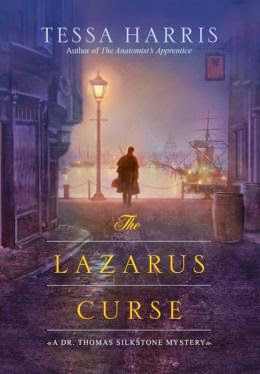
"The Lazarus Curse"

The Lazarus Curse is the fourth novel in Tessa Harris’s award-winning Dr Thomas Silkstone Mystery series. It deals with the theme of slavery in an increasingly liberal 18th century England.

Harris applied the Page 69 Test to the new novel and reported the following:
From page 69:
Thomas edged forward on the small landing. “Then I shall certify the death,” he said, looking toward the open door of the attic room.

Mistress Carfax’s back stiffened. “Is that really necessary, Dr. Silkstone? He was only a…” She broke off as she read Thomas’s disapproving expression.

“A slave, ma’am?” He finished her sentence for her.

There was little room to maneuver on the cramped landing and only a few inches separated them. The woman’s breaths came in short, sharp pants. She nodded and stuck out her chin defiantly, stiff-faced, as if her cheeks and lips had been starched. “Yes,” she said finally. “A slave.”

Thomas leaned closer to her and lowered his gaze to meet hers. Her eyes were as cold and unseeing as those of the fish in his laboratory. Flattening his lips in a smile, he began to shake his head. “The law may be ambiguous as to whether a slave is an animal or a human, but I would be failing in my duty as a physician if I did not examine the child.” He let his words linger on the air until the woman blinked and agreed with a sullen nod.

“Very well, Dr. Silkstone,” she muttered, letting Thomas pass into the room.

He walked in to find Venus comforting Phibbah, trying to still her sobs. Her long thin arms were wrapped ’round the girl, whose head was nestled on her shoulder.

“I am a physician,” he told her, walking toward the boy. As Venus nodded, Phibbah pulled away. She eyed Thomas suspiciously as he knelt down, took the child’s emaciated wrist, and felt for his pulse. There was none. Lifting his lids, Thomas looked at the boy’s pupils. They were fully dilated. He was satisfied that his short life had ebbed away.

“The fever?” he asked, lifting his gaze and looking at Venus. She simply nodded.

Pulling back the coarse sheet, he looked at the boy’s torso. His ribs showed through his brown skin like the veins of a leaf. He was evidently malnourished, thought Thomas, so that his guard was already down before the fever struck.

Mistress Carfax returned to the room, without the dog, and walked over to Thomas, fixing cold eyes on the corpse.
My page 69 excerpt finds Dr Thomas Silkstone at the London home of a sugar merchant who owns vast estates in Jamaica. Samuel Carfax divides his time between the West Indies and England, accompanied on his travels by his vicious and cruel wife, Cordelia, and their house slave entourage. The irony is, of course, that slavery was not legal in England in the 18th century, but plantation owners were allowed to be accompanied by their slaves, who were often treated in a most barbaric manner. Moreover, such treatment seems to have gone unquestioned in ‘polite’ circles. After Thomas has treated Mr Carfax, he hears wailing from the servants’ quarters and finds a slave boy has recently died, seemingly of fever. Over the next two pages Thomas offers to write out the boy’s death certificate, even though he was sure the child’s body would, in all probability, be dumped in an unmarked grave. He also offers to treat Mistress Carfax’s slaves at no charge if another should fall ill, even though he knows she would never permit it. She cares for the dog mentioned in the passage more than her ‘Negroes’ and we later learn that while Cordelia Carfax’s dead pets all have headstones, her slaves do not.

What this random pull from the text shows is the contrast between the acceptance of slavery in English society and the enlightened attitude of our hero, Thomas Silkstone. Appalled by the hypocrisy of the time that sees dogs treated better than humans, he finds himself battling against dark forces in the depraved world of sorcery, slavery and murder to order. It’s also a world where money, politics and power all hold sway, and where then, as now, such notions are rightfully challenged by a few good men.
Visit Tessa Harris's website.

My Book, The Movie: The Devil's Breath.

--Marshal Zeringue