Saturday, May 25, 2013

"The Caretaker"

A .X. Ahmad was raised in India, educated at Vassar College and M.I.T., and has worked internationally as an architect. His short stories have been published in literary magazines, and he’s been listed in Best American Essays. The Caretaker is his first novel, to be followed by Bollywood Taxi next year. He lives in Washington, D.C.

Ahmad applied the Page 69 Test to The Caretaker and reported the following:
Much to my chagrin, page 69 of my thriller, The Caretaker, was a quiet scene.

The protagonist, a recent Indian immigrant, has just come home, and stands in the doorway of a borrowed house in Martha’s Vineyard, looking in at his wife and young daughter. At first glance, just a quiet, domestic moment.

And yet: things are not what they seem.

Someone wants to kill this man. He has just been attacked by a savage dog, and killed it with a knife, utilizing skills learned years ago in the Indian Army.

He hides his wounds from his wife and daughter, because they are, for once, happy. In the midst of a brutally cold winter, he has illegally moved them into a rich man’s empty mansion. Here his family, warm and safe, can wear Indian clothes and pretend they are back in India.

This is why the man hesitates at the doorway. Looking in at his own life, he savors this moment of domestic bliss. But he knows that it cannot last, because there is a darkness out there.

The Caretaker is, after all, a thriller. Here’s an excerpt from page 69:
It is dark by the time Ranjit gets back to Aquinnah. He parks outside the house and unbuttons his shirt to check for scratches: his shoulder is bruised, but, thank the Guru, his skin is unbroken, the thick canvas jacket having absorbed the impact of the dog’s assault. The jacket is ripped and useless now. Taking it off, he stuffs it into his toolbox before entering the house.

He expects Preetam to be on the phone, but instead it is quiet, and he can hear the low murmur of voices.

Standing in the entryway, he sees Preetam sitting on the gray leather couch, with Shanti on the floor below her. He watches as Preetam gently combs through the tangles in Shanti’s long, curly hair, then pours oil from a bottle and massages it into her daughter’s scalp. The sickly sweet fragrance of coconut oil fills the room.
Learn more about the book and author at A.X. Ahmad's website and Facebook page.

--Marshal Zeringue

Friday, May 24, 2013

"Angel Baby"

Richard Lange is the author of the story collection Dead Boys, which received an award from the American Academy of Arts and Letters, and the novel This Wicked World. He is the recipient of a Guggenheim Fellowship, and his fiction has appeared in Best American Mystery Stories 2004 and 2011. He lives in Los Angeles.

Lange applied the Page 69 Test to his new novel, Angel Baby, and reported the following:
Angel Baby is the story of Luz, the beautiful, abused wife of a Tijuana drug lord, who decides to escape her husband’s clutches and return to the U.S. to reclaim her young daughter, who is being raised by relatives. The getaway doesn’t go as smoothly as she planned, however, and she finds herself on the run with a bag of her husband’s money and his pimped-out Colt .45. In the course of her journey across the border and through Southern California, she crosses paths with an alcoholic human smuggler nursing a tragic secret and a death wish, a ruthless ex-gang member ordered to track her down, and a corrupt border cop who will go to any lengths to get his hands on the money she’s carrying.

Page 69 is the first meeting between Luz and Malone, the man who’ll be driving her across the border. It takes place in a Tijuana body shop under the watchful eye of a pollero named Freddy.
The car’s horn bleats twice, and a voice calls out in English, “Open up, already.”

Goyo waddles over and takes hold of the gate, drags it sideways. A beat-up silver BMW pulls into the lot. The engine sputters and dies, and darkness and quiet return. Luz lowers the gun into the pack but stays where she is, back pressed against the chain-link fence.

A white man steps out of the car, some beach bum, tall and thin, older, maybe thirty, thirty-five. He’s wearing a T-shirt advertising a surf shop, plaid shorts, and black Converse tennis shoes. Surely this isn’t the guy Freddy’s been talking up all day, his best driver. This pendejo can’t even keep his hair out of his eyes, keeps having to brush it back every time he turns his head.

“Just so you know, this isn’t going to be a regular thing,” he says to Freddy. “Nighttime is the wrong time to be fucking around down here.”

“If you have trouble with anyone, tell them you know me,” Freddy says.

“Yeah, right,” the bum says. “I do that, I’ll end up in the river.”

“Hey, we’re all going to end up in the river someday,” Freddy says.

He leans in close to speak quietly to the bum. The bum listens for a while, nodding agreeably, but then suddenly stops Freddy and says, “In the morning? You didn’t say anything about in the morning.” Apparently, there’s a disagreement over the details of the trip. Not being able to hear what’s being said, all Luz can do is watch the men argue in urgent whispers. The bum puts up a fight, but Freddy is relentless and eventually gets his way. He slaps the bum on the back and steers him to where Luz is waiting.

“Now come and meet our friend,” he says. “She needs our help.”

“There any beer around?” the bum asks.

“Goyo,” Freddy calls and tips an imaginary can into his mouth. Goyo grunts and walks into the office.

Freddy brings the bum over, and Luz moves away from the fence, standing up straight to look down her nose at him. His blue eyes are bloodshot, and he looks as if he could use a shower.

Señorita Luz, this is Kevin Malone, who’s going to take you across,” Freddy says.

Malone lifts his chin by way of greeting, doesn’t even meet her gaze. It’s like he could take or leave this job. This infuriates Luz. She can’t believe she’ll be putting her life in the hands of this cabrón.
Angel Baby zooms along at a relentless pace; you’ll be hanging on for dear life after the first page, I promise. But there are also characters you’re going to care about, cheer on, and grieve for, because all the thrill and chills in the world don’t mean anything if you’re not emotionally involved with the people in peril. It’s a lean, mean crime novel, one that takes you on a wild ride, but also breaks your heart.
Learn more about the book and author at Richard Lange's website.

Writers Read: Richard Lange (August 2007).

The Page 69 Test: This Wicked World.

--Marshal Zeringue

Thursday, May 23, 2013

"Benjamin Franklin's Bastard"

Sally Cabot lives in Brewster, Massachusetts, with her husband, Tom. A lifelong resident of New England, she is active in the local historical society and creates tours that showcase the three-hundred-year history of her village.

She applied the Page 69 Test to her new novel, Benjamin Franklin's Bastard, and reported the following:
Much to my delight, once I’d agreed to write this blog, I discovered how neatly page sixty-nine reflects several of the main themes in Benjamin Franklin’s Bastard. Franklin fathers a child with one of the “low women” he admitted in his autobiography that he visited. On discovering the child’s existence and the poor chance at life it faced in its present circumstance, Franklin claims the child, brings it home to his brand-new common-law wife, Deborah Read, and asks her to raise the child as her own. Deborah, uneducated, unworldly, and already compromised by the desertion of a former husband, feels she has little choice, if she wishes to remain with Franklin, but to accept this child. Page sixty-nine describes the scene where Deborah meets her new son:
Deborah looked at the infant and saw Benjamin; there could be no doubt of it. There was the wide forehead and the dimpled chin; there, already, were the round, intelligent eyes that looked at every new thing with such great interest. But what of those things that hadn’t come from Benjamin? By now Deborah knew every inch of her husband’s square, solid flesh, and it couldn’t account for the pointed little chin, the delicate nose, the long, slender fingers.

Benjamin made as if to hold the child out to Deborah but she took a step back, concealing her cowardice by saying, “Let me get his pap.” She retreated to the kitchen and Benjamin followed; she set the bowl and spoon on the table and waved Benjamin to the chair before it, but he shook his head.

“His first meal must be from his new mother,” he said, pushing gently at Deborah’s shoulder till she’d backed up into the chair, placing the child in her arms. “Meet William,” he said. “William, meet your mother.” The small face puckered. Deborah dipped the spoon and thrust it at the infant – he took it at once in a great gulp that made him sputter; he took another and settled his surprising weight against her, his eyes – Benjamin’s eyes -- fixed on Deborah’s. She felt as she looked at him that he knew more than she did already, that he knew better than to trust her. Yes, already his eyes had drifted away and fixed on Benjamin as he ate, as if they were long acquainted.
This passage signals much of importance about Deborah Read: that she loves Franklin, that she struggles all her life to keep up with his stellar trajectory, that she doesn’t handle this sudden inheritance of his bastard well. It further reflects the insecurities, resentments, and jealousies that might accompany an adoption in which the child is a constant reminder of a partner’s betrayal. The scene foreshadows two other voices/themes in the book -- the bastard son and his struggle to find his way beside a father who eclipses him and a mother who can’t quite accept him, and the “low woman” who manages to physically but not emotionally relinquish her child. These three characters lock into orbit around the sun that is Franklin and propel the book forward from this early scene.
Learn more about the author and her work at Sally Cabot's Facebook page.

My Book, The Movie: Benjamin Franklin's Bastard.

--Marshal Zeringue

Wednesday, May 22, 2013

"A Case of Redemption"

Adam Mitzner is the author of A Conflict of Interest and the new legal thriller, A Case of Redemption.

He applied the Page 69 Test to A Case of Redemption and reported the following:
At the start of A Case of Redemption we learn that Dan Sorensen is a former partner of a major New York City law firm who has left the practice of law 18 months earlier after his wife and daughter are killed in a car accident. He is approached by a family friend to take on the case of an up and coming rapper named Legally Dead, who has been accused of murdering his pop star girlfriend.

Page 69 contains an important scene in the book: a discussion between Dan and Nina in which Dan expresses his hesitancy to take on the case of Legally Dead. Nina tells him that she thinks that Legally Dead is innocent, and that's why she's on board. However, she also tells Dan that he has to have his own reasons for becoming involved. As Dan considers the issue, he realizes that representing Legally Dead might be his last, best chance to put his own life back on track. The page ends with Dan pressing the send button to file his notice of appearance with the court that he would be counsel of record in the murder trial of Legally Dead.
Learn more about the book and author at Adam Mitzner's website.

The Page 69 Test: A Conflict of Interest.

Writers Read: Adam Mitzner (May 2011).

My Book, The Movie: A Conflict of Interest.

--Marshal Zeringue

Tuesday, May 21, 2013

"Dear Lucy"

Julie Sarkissian is a graduate of Princeton University, where she won the Francis Leon Paige Award for creative writing, and holds an MFA in Creative Writing from The New School. She lives in New York City.

She applied the Page 69 Test to her new novel, Dear Lucy, and reported the following:
From Page 69 of Dear Lucy:
“‘How much longer, Baby,’ I ask.

Then we are quiet while the baby thinks about how much longer.

Then Samantha says, ‘He’s almost ready.’”
On page 69 of Dear Lucy, Lucy, a learning-disabled young woman, and Samantha, a pregnant teenager, both living and working on a mysterious farm, talk intimately on Samantha’s bed. Lucy asks Samantha when her baby will be born, and Samantha tells Lucy, just a little longer. As they are talking, an unopened letter falls from Samantha’s diary. Lucy can’t read but is nonetheless fascinated by words and considers a letter to be a scared object because it is a form of communication - something Lucy cherishes in any form. Lucy asks who the letter is for, and when Samantha admits the letter is for her, Lucy asks why Samantha hasn’t opened the letter. Samantha disregards Lucy’s question.

On the this page the reader learns that Samantha has been telling lies about the relationship between her and her baby’s father. Samantha, unwilling to taint Lucy’s naïve understanding of love and family, has been telling her that the father of the baby doesn’t know where Samantha is, and that Samantha has no way to get in touch with him. But when Lucy relays to the reader the letters addressing the envelope: TO SAMANTHA, FROM ALLEN, we know that the father of Samantha’s baby does indeed know how to contact her, though we don’t yet know why Samantha chooses not to open his letters.

Page 69 introduces Samantha’s duplicity in regards to her past, as well as highlights Lucy’s tenderness for, and lack of understanding of, the written word. Both these themes are essential emotional through-lines of Dear Lucy.
Learn more about the book and author at Julie Sarkissian's website.

--Marshal Zeringue

Monday, May 20, 2013

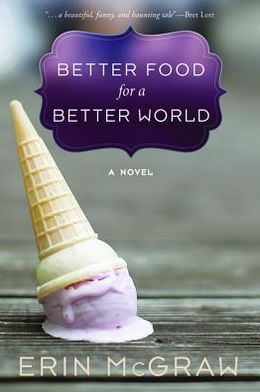
"Better Food for a Better World"

Born and raised in Redondo Beach, California, Erin McGraw received her MFA at Indiana University and has lived in the Midwest ever since. Along with her husband, the poet Andrew Hudgins, she teaches at the Ohio State University and divides her time between Ohio and Tennessee.

Her newest novel is Better Food for a Better World. Before that she published The Seamstress of Hollywood Boulevard (a novel), The Good Life (stories), The Baby Tree (a novel), Lies of the Saints (stories, and a New York Times Notable Book for 1996), and Bodies at Sea (stories).

McGraw applied the Page 69 Test to Better Food for a Better World and reported the following:
An idle reader flipping to page 69 of Better Food for a Better World might not know exactly what's going on, but that reader will figure out pretty quickly that something's going on. One of the characters, Sam, is explaining to his co-worker Nancy that absolutely nothing is wrong with him standing alongside pretty, lithe Cecilia in a dark room where Cecilia has been playing her violin. Nancy, no fool, frowns at them and says, "What would you have done if David or Vivy had walked in?" David and Vivy are Sam and Cecilia's spouses. They all work together, and Nancy thought they knew everything about one another, until she stumbled in on this.

Sam smoothly assures Nancy that nothing at all is amiss. No, nothing is peculiar about Cecilia playing her violin for him in the dark. No, sir.

Nancy cries, "Don't you listen at Life Ties?"--Life Ties being the marriage-support group they all belong to. Nancy may be a little lead-footed, but she's trying to prevent what she's sure she sees--Sam and Cecilia plunging into a marriage-wrecking mistake. And Sam and Cecilia don't have the least interest in listening to Nancy. At least not by the bottom of page 69.
Learn more about the book and author at Erin McGraw's website.

Read--Coffee with a Canine: Erin McGraw & Max and Sister.

--Marshal Zeringue

Sunday, May 19, 2013

"Onion Street"

Reed Farrel Coleman's eighth and latest Moe Prager mystery is Onion Street.

Coleman applied the Page 69 Test to Onion Street and reported the following:
Page 69 of Onion Street is more representative of the tense tone of the novel than of the novel itself.
… He’d won the rabbit’s foot in Coney Island for shooting a red star out of a piece of paper with a BB submachine gun.
The twenty year old Moe Prager sits in his brother’s car, spying on his best friend, Bobby Freidman. As Moe watches, he notices Bobby pull out his key chain and on that chain is that rabbit’s foot. Bobby, whose parents are old school Communists, don’t much care for their son because he likes money. He likes making it and he likes spending it.

As Moe watches, he recalls joking with Bobby about how he’d won the rabbit’s foot.
… “Shooting a red star,” I said. “don’t tell your parents or they’ll send you to Siberia.”

I remember he just kind of laughed, but I think he kept the stupid rabbit’s foot as a kind of Fuck you to his parents...
But there’s nothing funny about what’s happening in pg 69 or in the previous 68 pages. Moe’s girlfriend Mindy, a campus radical, has been beaten into a coma and left to die on the streets of Brooklyn. As she fights for her life in the hospital, Moe is staking out an address which he has been led to believe is somehow connected to the attack on Mindy. Just as he is about to check out the address himself, Moe spots Bobby opening the door to that address. Moe’s head fills with questions. Why is Bobby there? Why does he have keys to the front door? Moe has no answers and does the only thing he can do.
… Bobby was stepping through the white door and closing it behind him. I fought my natural curiosity, sat tight, and waited. My patience was rewarded. Less than five minutes after he went in, Bobby came flying through the white door. His head was on a swivel, turning right, then left, then right again. He was breathless, panting, his chest heaving, but it was the panicked look on his face that really got my attention. Sucking in big gulps of frosty air, blowing staccato clouds of steam out of his mouth, he seemed to be trying to calm himself down before taking another step. Then, after he’d seen that no one was walking his way from either directions, Bobby rushed into his Olds and fishtailed away, smoking his rear tires on the slick pavement at he went.
What had Bobby seen in the apartment? Moe didn’t know, but he was about to find out.
Learn more about the book and author at Reed Farrel Coleman's website.

Writers Read: Reed Farrel Coleman.

--Marshal Zeringue

Friday, May 17, 2013

"Grail of the Summer Stars"

Freda Warrington, who was born in and lives in Leicestershire, England, is the author of twenty novels. The recently released Grail of the Summer Stars is her third Aetherial Tales novel, her first series to be published in the United States. The first, Elfland, was named Best Fantasy of the Year by RT Book Reviews.

Warrington applied the Page 69 Test to Grail of the Summer Stars and reported the following:
The ‘Page 69’ test is such fun – I’ve applied it before (to Elfland) and it worked out quite nicely, showing a pivotal scene in the protagonist’s life. Of course, every page should do this but it won’t always be the scene the author would have chosen to showcase! So I’m pleased to find that page 69 of Grail of the Summer Stars – my third Aetherial Tale for Tor – contains a crucial encounter for my character Rufus.

Rufus is an age-old Aetherial (a non-human, elf-like-but-not race who live in the contemporary world) from an ancient civilisation known as the Felynx, and he's a bit of a “baddie”. He loves bringing mischief and mayhem to those around him, with the odd bit of genocide thrown in. However, believing his brother Mistangamesh to be dead (see Midsummer Night), he’s embarked on a grief-stricken orgy of self-destruction which has led him to the depths of evil – illegal arms-trading. Somewhere in the wilds of the Pakistan/ Afghanistan border, he has lost his Jeep in an earthquake and found his way to the nearest town, where he meets a seismologist calling herself Dr Orla Connelly. Rufus strongly suspects Orla of being his long-lost sister Aurata, with whom he once had an incestuous relationship. After a long day spent digging survivors out of the rubble, they are resting in Orla’s tent, playing a game of “Who’s going to admit it first?”
The ground began to tremble with a prolonged aftershock.

“Now one of us should make a joke about the earth moving,” said Rufus.

“The earthquake is due to faulting within the lithosphere of the subducted Arabian Plate as it grinds beneath the convergent plate boundaries,” she murmured.

“I’m not sure that’s funny, but the way you say it sounds incredibly sexy.”

“Oh, it is.” She smiled, more with her eyes than her mouth.

They lay in silence, waiting for the movement to subside. Orla stared upward, as if absorbing every nuance. He still couldn’t believe that she’d become a scientist, a doctor, part of a team. That was true human camouflage. He’d never troubled to learn anything in particular, still less to attend a university or give any credence to human qualifications. She’d evolved, and he felt oddly inadequate. But, after all this time, who wouldn’t change? Even the ancient, timeless Felynx. The question was not whether they’d changed, but how much the changes actually mattered?

Now they were engaged in a strange dance around each other, both secretly knowing the truth but daring the other one to speak first.

“One of us should begin,” said Orla. “What are you thinking?”

Finally Rufus said, “I used to dream about you. You were calling to me from some kind of limbo with grey walls. Nine-tenths of me was sure you perished in Azantios, but the last tenth insisted that you must still exist . . . somewhere.”

He heard her release a small breath of exasperation. “Who do you think I am? Rufus, we both know, so why can’t we say it aloud?”

“It might break the magic,” he said softly.

Her eyes narrowed, irresistibly seductive. “Magic? Rufus, please. Is it gun-selling that’s turned you so romantic?”

“All right.” He paused. “It’s gentlemanly to go first, but I hesitate because I’ve made grave mistakes in the past. I was convinced I recognized someone, so convinced that I couldn’t accept I was monstrously wrong. Now I have the same feeling about you, but I don’t trust it.”

“This time, you probably should trust yourself, Rufus. I have been calling you. Gods, it took you long enough to hear me!”

“Calling . . .?” He stared into the deep fire of her eyes. “Tell me your real name. I’ve already told you mine.”

“No. You must say it; then I’ll tell you if you’re right.”

“This is turning into a game.”

“No game.” She trailed a finger from his shoulder to his elbow. Her voice was honey. “This is more important than you can imagine.”

Grinning, he leaned off the mattress and picked up her notebook and pen lying nearby. “All right, I’m going to write your true name on a piece of paper. Then you say it out loud, and we’ll see if it matches what I’ve written.”
While Rufus isn’t the main protagonist – that role is shared by a new character, Stevie, and the supposedly dead Mistangamesh – he is a definite antagonist, a major player crucial to the plot. Was Rufus responsible for attacking Stevie and stealing an enigmatic painting from her? And why has the artist – her old flame Daniel – gone missing? The story takes Stevie and Mist from an industrial museum in Birmingham (UK), to the village of Cloudcroft (where they seek help from characters we met in Elfland) and on a weird and terrifying journey through the Otherworld to the colourful deserts of Nevada, as they try to unravel a tangle of unearthly mysteries. Each Aetherial Tale can be read on its own, but it's nice if you read all three because there's a big background arc that resolves in Grail.
Learn more about the book and author at Freda Warrington's website, blog, and Facebook page.

The Page 69 Test: Elfland.

The Page 69 Test: Midsummer Night.

My Book, The Movie: Midsummer Night.

Writers Read: Freda Warrington.

--Marshal Zeringue

Thursday, May 16, 2013

"Where the Light Falls"

Born in Atlanta, Georgia, Katherine Keenum graduated from Vanderbilt University with a B.A. in English and earned a Ph.D. in medieval studies at the University of Texas at Austin. She worked in the publicity department of the New Orleans Public Schools, taught in the expository writing program at Yale University, and served as the executive editor of the book publishing program of the Council on East Asian Studies at Harvard University.

Keenum applied the Page 69 Test to Where the Light Falls, her first published work of fiction, and reported the following:
I laughed out loud when I opened Where the Light Falls after receiving the invitation to take the Page 69 Test. Right smack-dab in the middle of the page was a chapter break with lots of white space above and below it.
The next thing they knew, they had been disgorged into Paris.

CHAPTER SEVEN

Getting Started

For their first week, Jeanette and Effie had reservations at the Pavillon des Dames, a hotel on the Left Bank recommended by Miss Whitmore. As soon as their porter found their four-wheeled fiacre, Effie handed him his tip and read off their address to the driver: Her accent was bad, but her delivery had the ring of authority. In dealing with city cab drivers, she was back in her element.
Can’t we choose something more representative? I thought. Yet the more I looked, the more I realized that applying the Page 69 Test here points to two valuable lessons. First, although the tactile sensation of turning a new page may help emphasize the change from one chapter to the next in a printed book, it cannot do so if the page design calls for continuous flow nor can it ever do so in an e-book. For writers today, therefore, it is more important than ever to make sure narrative rhythm, continuity, and contrast between chapters are controlled by the prose. Second, in this case, the end of Chapter Six and beginning of Chapter Seven were places where I had condensed in response to an editorial call for shortening the overall manuscript. Out went enlivening dialogue and incident that contributed to atmosphere more than the plot. Lesson learned: In my current work-in-progress, I am resolved that by the time an editor sees the manuscript, it will contain no extended passages that anyone would think for a moment could come out!
Learn more about the book and author at Katherine Keenum's website and blog.

Read--Coffee with a Canine: Katherine Keenum and Palmer.

--Marshal Zeringue

Wednesday, May 15, 2013

"Love Me Anyway"

Tiffany Hawk is writer living near Washington D.C. whose work has appeared in such places as The New York Times, The Los Angeles Times, National Geographic Traveler and on NPR’s “All Things Considered.” Her debut novel, Love Me Anyway, is a darkly funny look into the emotional heart of the airline industry, with all its allure, loneliness, and ever-present temptations.

Hawk applied the Page 69 Test to Love Me Anyway and reported the following:
I was looking forward to this test, but I have to admit I also wondered how I would feel if it turned out to be a lame page. I couldn’t believe what I found – the one page that is simultaneously the most and least representative of the story. Page 69 opens the chapter called How to Be a Flight Attendant, the only chapter that is written in the second person. It’s meant to speak for all of the characters, and yet it isn’t from the perspective of a single one of them, though it does hint at Emily’s soon-to-ignite love affair.
How to be a Flight Attendant

There is only one way to survive life as a new flight attendant. Appear perfect. Luckily, this comes easy for you. You have been pleasing people all your life.

Arrive twenty minutes early for your four a.m. check-in. Carefully pin each strand of your hair into a wisp-free French twist. Buff your black high-heels on the Buffmaster electric shoe shiner in the pre-flight groom room. Cheerfully welcome three hundred and twelve passengers with a well-feigned enthusiasm for pre-dawn departures. Try not to let the guy in 14E remind you of the last man you kissed. With 26,000 flight attendants, the odds of running into him are slim.

Push the beverage cart down the aisle and pass out OJs and coffees and decafs.

Make sure to place the napkins face up with the airline’s logo pointed towards the passengers. You have to be careful. A girl was actually sent home from training for blowing this one.

Ask the man in 17H. “Can I get you something to drink this morning, sir?”

“I don’t know if you can, but you may get me a sparkling water with lime,” he says with a scowl.
It’s a short page, but I like that it encompasses so much of what the book is about – the day-in-the-life details of the airline world, the anonymity and loneliness of being on the road, the constant opportunities for fleeting intimacies, some of which prove impossible to forget.
Learn more about the book and author at Tiffany Hawk's website.

My Book, The Movie: Love Me Anyway.

--Marshal Zeringue

Tuesday, May 14, 2013

"Domestic Affairs"

Bridget Siegel, author of Domestic Affairs: A Campaign Novel, has worked on political campaigns at the local, state, and national levels. A graduate of Georgetown University's School of Foreign Service, she is now an actor, writer, and political consultant. She lives in New York City.

Siegel applied the Page 69 Test to Domestic Affairs and reported the following:
Page 69 starts with a young fundraiser spewing inside-baseball campaign speak to some heavy hitting donors and ends with “Olivia sat up a little, jolted by the touch of his (the Governor's) hand on her shoulder ...". While a reader might be more intrigued with a turn of the page, when the Governor's hand falls to a comfortable resting place on the small of the young fundraiser's back, I do think page 69 is pretty representative of the book on the whole. If I've done it right it's a behind-the-scenes look at political fundraising with a behind-the-behind-the-scenes affair.
Learn more about the book and author at Bridget Siegel's website, Facebook page, and Twitter perch.

My Book, The Movie: Domestic Affairs.

--Marshal Zeringue

Monday, May 13, 2013

"Criminal"

Terra Elan McVoy has been reading and writing since she first learned how to, and her whole life has been motivated by her enthusiasm for those two things. She received her BA in English at St. Andrews University, and an MA in Creative Writing from Florida State University. She has worked as an event coordinator at a major chain bookstore; an editorial assistant at an NYC publisher; as manager of an independent children's bookstore; and as Program Director of the AJC Decatur Book Festival. She is the author of Pure, After the Kiss, The Summer of Firsts and Lasts, Being Friends with Boys, and Criminal.

McVoy applied the Page 69 Test to Criminal and reported the following:
From Page 69:
I wanted Dee holding me again, like he had been only an hour ago. Making the world only him and me and nothing else.

“Go in there,” she gestured to the bathroom around the corner, “look in the mirror, and you tell me just how happy you are.”

“Maybe you should do that yourself,” I spat, turning around and leaving her there alone in her clean kitchen.

But when I went to wash my face and brush my teeth, no matter how hard I tried, I couldn’t meet the eye of my reflection for more than a few seconds at a time.

Bird and I had fought before. Usually, after, we didn’t even apologize. She didn’t like dwelling on much of anything, but especially not ugliness. But apparently she’d been dwelling on her dislike for Dee even more than I thought. And now that it was out, I didn’t know how long it was going to stay around.

The next morning, I kept out of her way. I was still mad, too. She had to do her KFC job though, and I had to go to work myself, so that made avoiding her easier. When I got home we ate dinner at the TV and then went to bed, not talking more than we had to. I was calmer at that point, but it was clear she still needed space. I understood she was mad about the police, because they freaked me out too. But they hadn’t come around to ask me anything else today...
Surprisingly enough, this is a nice little microcosm of Criminal. It mentions Dee (Nikki’s boyfriend), and Bird (Nikki’s roommate/best friend), and also how much Bird dislikes Dee. It also mentions the police, and that Nikki isn’t feeling so great about what’s going on, so you get a touch of the crime element here too.

Bird and Nikki’s relationship is actually one of the most emotional parts of the book for me. Bird is the foil in Nikki’s life for Dee, but unfortunately, Nikki favors the destructive love she gets from her boyfriend, over the stronger, more difficult love of her best friend. The arc of this friendship —how Nikki betrays Bird, and what Bird does as a result— is one of the ways in which Criminal is not actually so different from my other books, though. As somebody who is blessed with amazing, long-term friends —with whom I’ve experienced a variety of ups and downs—I really enjoy writing about the bonds between friends, how and why they get broken, and how you make amends over time (if at all). I think if you look at all of my books, actually, that’s a consistent theme with me.
Learn more about the book and author at Terra Elan McVoy's website, Facebook page, and Twitter perch.

My Book, The Movie: The Summer of Firsts and Lasts.

My Book, The Movie: Being Friends with Boys.

Writers Read: Terra Elan McVoy.

--Marshal Zeringue