Monday, March 21, 2011

"You Can Make Him Like You"

Ben Tanzer is the author of the books Lucky Man, Most Likely You Go Your Way and I’ll Go Mine, Repetition Patterns and 99 Problems. He also oversees day-to-day operations of This Zine Will Change Your Life.

He applied the Page 69 Test to his new novel You Can Make Him Like You and reported the following:
"Liz looks at me. She wants to believe, she wants to not think of me as that kind of guy, the guy who stays up all night talking to the hot chick from his past, who might not be willing or able to truly to do anything, but is willing to embarrass his wife and a marriage she holds sacred, by playing along."
--An excerpt from page 69 of You Can Make Him Like You.

The question is whether or not Page 69 of my new novel You Can Make Him Like You is representative of the rest of the book and would someone skimming that page read on? In terms of the latter question I am contractually obligated to tell you that of course they would read on, You Can Make Him Like You is like a magnet, or more accurately the Death Star, though a good literary kind of Death Star, drawing you in to a magical world where everything everywhere else but the world you've been drawn in to ceases to momentarily exist.

There are no contractual anythings related to the former question, however, just hard data and facts, and the data tells me that yes, Page 69 is reflective of the book overall, or more generally anyway one of the kernels that the book's foundation is built on, some males, maybe many males, and females as well, desire, need, something, to test just how far they will let themselves wander outside the confines of their marriage without allowing themselves to break the marriage itself.

A desire that only seems to be further highlighted, or maybe it's illuminated, no magnified, when it comes to people from our past who we sort of feel like just kind of got away, but maybe represent what might have been or could be, a theme only further exaggerated in real life by high school reunions and, or, if you prefer this new invention you may have heard of called the internet, though maybe more specifically, this thing called Facebook, you may also have heard of, where anyone you've ever met, talked to or may have smiled at you are a couple of keystrokes away.

I should add here, strike that, I am also contractually obligated to add here, that while this is one of the foundational themes of this truly engrossing book, there's more, so much more, it's also an homage to the music of The Hold Steady, pop culture as common vernacular, Obama's presidential campaign, Ray Bradbury, interns, because really where would be without them, breast feeding classes, and a serious debate, well serious may be strong, but a debate none-the-less about not only whether U2 or REM is the true super group of the late eighties and early nineties, but whether you are even allowed to engage in this debate if you or anyone you know has ever listened to Hootie and The Blowfish.

As I said it's like the Death Star. A good one. Enjoy.
Read an excerpt from You Can Make Him Like You, and learn more about the book and author at the official website.

Check out the complete list of books in the Page 69 Test Series.

--Marshal Zeringue

Saturday, March 19, 2011

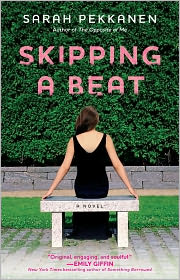
"Skipping a Beat"

Sarah Pekkanen is the author of The Opposite of Me and Skipping a Beat. Her work has been published in People, The Washington Post, USA Today, The New Republic, The Baltimore Sun, Reader's Digest, and Washingtonian, among others. She writes a monthly Erma Bombeck type column for Bethesda Magazine, and has been an on-air contributor to NPR and E! Entertainment's "Gossip Show." She is the winner of a Dateline award and the Paul Miller Reporting Fellowship.

She applied the Page 69 Test to Skipping a Beat and reported the following:
Page 69 of Skipping a Beat is representative of the rest of the book in some ways, but not in others. Although my novel is about the marriage of Julia and Michael Dunhill, it weaves in many scenes from their pasts, starting in high school, which is when Julia and Michael - then simply Julie and Mike - first met. They both came from broken families, and page 69 of Skipping a Beat reveals a flashback to Julia's childhood. It's darker than many of the other passages of my novel (which the Washington Post just called "Intelligent, engaging... and delightful" yay!) And yet, in a way, it shows how Julia was shaped. It's a kind of building block of her character - a scene that explains many of her actions in the book.

Skipping a Beat opens with a crisis. Julia's incredibly wealthy husband, Michael, has just collapsed at the head of the table in his company's boardroom. He is revived four minutes and eight seconds later - but he's a different man. He now wants to give away all of their wealth, and change the unspoken rules of their marriage. Julia has three weeks to decide whether to stay with him or leave and begin a new life without Michael. Page 69 explains her choices, in some way. It informs her actions. It's a piece of an important scene, but one that probably isn't the best representative example of the book.
Read an excerpt from Skipping a Beat, and learn more about the book and author at Sarah Pekkanen's website.

Visit the complete list of books in the Page 69 Test Series.

--Marshal Zeringue

Thursday, March 17, 2011

"You Know Who You Are"

Ben Dolnick grew up outside of Washington, D.C., and currently lives in Brooklyn with his wife. He is the author of a novel, Zoology, and his work has appeared in various publications, including The New York Times and Five Chapters.

He applied the Page 69 Test to his new novel, You Know Who You Are, and reported the following:
Page 69 of my book comes smack in the middle of a chapter in which the main character, Jacob Vine, is learning to navigate the social waters of his new school. He’s in seventh grade, standing in the courtyard of a Maryland movie theater with the girl he likes, watching the couples around him with nervous fascination.
Somehow everyone in the courtyard had come to believe that a kiss ought to last as long as possible. A couple would stand at the center of a circle and kiss, their arms encircling each other’s waists, their mouths in greedy sloppy motion. Friends would stand and count, sometimes with a watch in hand. When the couple finally pulled apart, their mouths glistening, their eyes glassy and relieved, the timekeeper — often it would be a tiny boy, someone who’d seen that he couldn’t be a romantic protagonist himself and so had turned himself into an elf, a mascot, willing to be dropped into trash cans or pushed into swimming pools — would race around the courtyard announcing, ‘Thirty-two seconds! Pete and Ellen just went for thirty-two seconds!’
Each chapter in the book covers a different period in Jacob’s life (ending when he’s in his mid-twenties), and middle-school was probably the era that was most painful, in the revisiting.
Read an excerpt from You Know Who You Are, and learn more about the book and author at Ben Dolnick's website.

The Page 69 Test: Ben Dolnick's Zoology.

Visit the complete list of books in the Page 69 Test Series.

--Marshal Zeringue
Tuesday, March 15, 2011

"The Paris Wife"

Paula McLain received an MFA in poetry from the University of Michigan and has been a resident of Yaddo and the MacDowell Colony. She is the author of two collections of poetry, as well as a memoir, Like Family, and a first novel, A Ticket to Ride.

She applied the Page 69 Test to her new novel, The Paris Wife, and reported the following:
Page 69 of The Paris Wife is representative of the whole, and very much hooked in to one of the principal tensions of the book. In it, Ernest and Hadley Hemingway are newly married. It’s 1921, Chicago, and Hadley is witnessing a major depressive episode in Ernest for the first time. Worried, she begins to wonder about the nature of his sadness, how deep it goes, and where it comes from, and if there’s any way she can truly help him through it. The situation is further attenuated by Hadley’s history: her father committed suicide when she was thirteen.

Here’s an excerpt. Note, when Ernest talks about being “shot up,” he’s referring to his trench mortar wound in WWI….
Hours later, Ernest woke up and called out for me through darkened room.

“I’m here,” I said, going to him.

“I’m so sorry,” he said. “I get like this sometimes, but I don’t want you to think you’re getting a bum horse in the deal.”

“What sets it off?”

He shrugged. “I don’t know, it just comes.”

I lay down quietly next to him and stroked his forehead lightly as he talked.

“When I got shot up, I had it pretty rough for a while. If it was daytime and I was doing something, fishing or working, anything, I was okay. Or at night, if I had a light on and could think about something else until I fell asleep. If I could name all the rivers I’d ever seen. Or I’d map out a city I’d lived in before, and try to remember all the streets and the good bars and people I met there and things they’d said. But other times it was too dark and too quiet, and I’d start to remember things I didn’t want in my head at all. Do you know how that is?”

“I do a little, yes.” I held him tightly. “It scares me, though. I never knew my father was so unhappy, but then he was gone. It all got to be too much for him.” I paused, trying to get this part right. “Do you think you’ll know when it’s too much for you? Before it’s too late, I mean.”

“Do you want a promise?”

“Can you?”
Read an excerpt from The Paris Wife, and learn more about the author and her work at Paula McLain's website.

Visit the complete list of books in the Page 69 Test Series.

--Marshal Zeringue

Monday, March 14, 2011

"Nude Walker"

Bathsheba Monk is the author of Now You See It ... Stories from Cokesville, PA.

She applied the Page 69 Test to Nude Walker, her new novel, and reported the following:
On page 69 of Nude Walker, Duck Wolinsky has waylaid Max Asad, his rival for the affections of Kat Warren-Bineki. Duck says he wants Max to teach him backgammon, but he really wants to find out what the attraction between Kat and Max is all about. Duck thinks that if he can find a chink in Max’s armor he can make Kat lose interest in him. But that’s not how love works, is it?
Read an excerpt from Nude Walker, and learn more about the book and author at Bathsheba Monk's website and blog.

--Marshal Zeringue

Sunday, March 13, 2011

"Aftertime"

Sophie Littlefield's crime novels include A Bad Day for Sorry and A Bad Day for Pretty.

She applied the Page 69 Test to Aftertime, the first installment in her new dystopian series, and reported the following:
By this point in the book, main character Cass Dollar has woken up in a field, filthy and dressed in unfamiliar clothes, with half her hair pulled out and the flesh torn from her back, evidence she’s been attacked by a cannibalistic Beater. She makes her way to a shelter where citizens make do with few resources, and a communal bath in a trough of creek water is the best anyone can do for washing. The women at the bath show Cass the kindness of including her without comment on her appearance, even though Cass is embarrassed by the dirt she leaves in the water.

Nance made a show of pretending to look into the trough. “Can’t even tell,” she said. “We’ll be able to wash all the kids and a few stray dogs in here, too.”

I included this scene to show two things: first of all, a hunger for community is unquenchable, even in the direst circumstances, and friendships are possible even when everything is gone. And second, assaults on our dignity that would devastate us in the world we know – like sharing dirty bath water – become meaningless when necessity dictates that we make do.

I was remembering a visit to a loved one in a nursing home when I wrote that scene. Conventions of dignity are lost in the interest of helping the frail in as efficient a manner as possible. And yet humanity prevails, and the best caregivers talk and encourage and share laughter even as they provide care for the failing. I like to think that, no matter what we our faced with, our essential natures prevail.
Read an excerpt from Aftertime, and learn more about the book and author at Sophie Littlefield's website and blog.

Visit the complete list of books in the Page 69 Test Series.

--Marshal Zeringue

Friday, March 11, 2011

"So Close the Hand of Death"

J.T. Ellison is the bestselling author of the critically acclaimed Taylor Jackson series, including All the Pretty Girls, 14, Judas Kiss, The Cold Room, and The Immortals.

She applied the Page 69 Test to So Close the Hand of Death, the sixth book in the series, and reported the following:
Page 69 of So Close the Hand of Death is from the point of view of a crime blogger who is the first to realize something dreadful is happening all across the country. Colleen Keck is her name, and the blog is called FelonE. Colleen is a vital character to the story, the vehicle through which multiple plot points are tied. She popped onto the screen nearly unannounced, in an early draft, and I didn’t know the who, what or where about her. But as I got to know Colleen, a single mother whose cop husband was killed in the line of duty, I realized how important she was. Colleen holds all the keys, and if Taylor can put aside her own vengeful path for a moment, she’d see that.

In this scene, Colleen has just heard about a shooting in North Carolina, and the memories of her past and hurtled to the surface. She’s overwhelmed, but so strong, and so resourceful, that she’s able to pull herself together. I like Colleen’s character a great deal, admire her strength and resilience to go on after she’s lost her husband. She truly is the lynchpin to the story. And in a fun twist, she was named for an auction winner, so I am doubly grateful to the real Colleen Keck for allowing me such incredible license with her name.
"Update, there are seven officers involved in two separate shootings. We have a total of seven down. We need extra personnel, my location. Send out a BOLO on a black Lincoln Town Car, North Carolina plate, state owned, numbers to come. Suspects are armed and dangerous, repeat, armed and dangerous. Last seen heading west on Highway 64. Put roadblocks in place all the way out to 95. Switch to channel eighteen, code three, code three. Switching channels now." The scanner went dead. They'd switched to a private channel to avoid people like her. It wouldn't have mattered if the voice had continued, she wasn't hearing anything but the roaring in her own ears.

Oh, my God.

Colleen's breath came short, and she gagged a little, unable to resist a brief glimpse into her own hell after hearing the words officers down. Seven cops hurt in the line of duty. Seven families torn apart. Seven.

The memories assailed her anew, and she barely made it to the bathroom in time. She vomited in the sink, tears mingling with sudden beads of sweat that popped up on her forehead.

Oh, Tommy. Why did you have to leave me? Why did you have to be so freaking brave?

After a few minutes, her cries died down, and she gathered herself. She rinsed her mouth out with cool water, splashed some on her face, which managed to smear her already desiccated day-old mascara even further. She swiped furiously at the dark smears with a bit of toilet paper. Weakness was not allowed.
Learn more about the book and author at J.T. Ellison's website and blog.

My Book, The Movie: the Taylor Jackson series.

Check out the complete list of books in the Page 69 Test Series.

--Marshal Zeringue

Wednesday, March 9, 2011

"The Last Jewish Virgin"

Novelist, short story writer, and essayist Janice Eidus has twice won the O. Henry Prize for her short stories, as well as a Pushcart Prize, a Redbook Prize, and numerous other awards.

She applied the Page 69 Test to her latest novel, The Last Jewish Virgin, and reported the following: and reported the following:
Page 69 comes at a very dramatic moment in my novel, The Last Jewish Virgin, which I like to call my literary, Jewish, feminist, fashionista, vampire novel. It’s the story of Lilith Zeremba, a young woman rebelling against her intellectually complex, feminist Jewish mother. Determined to make her own way – on her own terms – as a successful Jewish woman in the world of fashion, Lilith lands headfirst in a place where mythology and sexuality collide, as she’s drawn to two men in ways that feel dangerous and yet inevitable: the much older, wildly mercurial and mesmerizing Baron Rock, her art professor, and Colin Abel, a young, radiant artist determined to make the world a better place, one socially progressive painting at a time.

In the preceding pages, Lilith, fiercely-virginal-by-choice, has despite herself fallen under the spell of her dazzling, alternately seductive/alternately sadistic art professor, Baron Rock.

And now, on page 69, we find her sitting alone in her art school’s cafeteria, so obsessed with Mr. Rock that she’s unable to eat, feeling like an outsider, an “expatriate” in her own school.

Suddenly, her other male obsession, blond, blue-eyed Colin Abel, the young, socially progressive artist who’s the polar opposite of Mr. Rock, appears. To her surprise, he offers to take her for lunch at an Indian restaurant in the West Village, near the river, where she forces herself to take a few bites of the aromatic, curried food before her, as she struggles internally and externally with her various obsessions:

* Should she lose her heart and her hard-won virginity to the vampire-like, mysterious Mr. Rock, or to the socially progressive, talented Colin Abel, who prides himself on being the “anti-Andy Warhol?”

* Should she remain a committed virgin and concentrate solely on becoming a successful fashion designer?

* Should she continue to reject, in favor of secularism and fashion, her mother’s earnest, non-materialistic, Jewish-faith-based feminism?

* Should she be herself? But who is she since meeting Mr. Rock?

My intent while writing The Last Jewish Virgin was to merge the timeless romantic myth of the vampire with contemporary life in volatile New York City – and beyond.

Page 69:
I also read the first few chapters of my History of Fashion textbook, but had trouble concentrating on the text, because the book’s illustrations of beautiful women reminded me so much of Mr. Rock’s collection of portraits.

Although I still had no appetite, I now and then forced myself to take a bite of a stale muffin or a gooey, cheese-filled pastry as I sat working alone in the cafeteria. The other students sat together in chatty groups, chomping down on hamburgers and forkfuls of “pasta of the day,” which was always stringy spaghetti in a lumpy red sauce. I was constantly on edge, fearing, yet half-hoping that Mr. Rock would suddenly appear to make some strange and irresistible demand of me.

On Friday, Colin, wearing a snug, gray T-shirt that complemented his pale-blond hair, was waiting for me after my History of Fashion class. At least my emotions toward him weren’t contradictory; I felt nothing but pleasure at seeing him. “Let’s have lunch,” he offered, and that pleased me, too. It was a symbol of how little Mr. Rock had to do, day-by-day, with my real life, despite my obsession with him.

“I know this Indian restaurant around here,” Colin said, as we began to walk together. “My father’s an anthropologist who’s done a lot of field work in India, and he swears that the food at this place is the real thing.”

“I love Indian food,” I said as we walked, even though I still wasn’t hungry. I wondered how expensive this place was, since I was absolutely broke. Mr. Rock hadn’t yet paid me a penny for my first session with him. And eventually, my mother would get around to remembering that I supposed to find a part-time job to help her pay my tuition. But I refused to let these concerns destroy my mood.

The pungent scents of incense and curry permeated the restaurant, while hypnotic sitar music played in the background. The waiters wore white turbans, white suits, with baggy, long jackets, and white running shoes, which seemed a wonderful mix of traditional and contemporary, old and new, past and present.
Read an excerpt of The Last Jewish Virgin, and learn more about the book and author at Janice Eidus's website.

Visit the complete list of books in the Page 69 Test Series.

--Marshal Zeringue

Monday, March 7, 2011

"Separate Beds"

Elizabeth Buchan is the author of several highly acclaimed and bestselling books of fiction, including the bestselling Revenge of the Middle-Aged Woman, The Good Wife Strikes Back, Everything She Thought She Wanted, and Consider the Lily.

She applied the Page 69 Test to her new novel, Separate Beds, and reported the following:
Strangely enough, page 69 does encapsulate a central theme of Separate Beds (US edition) which is how the recent financial collapses and cataclysms impact on you and me, and how the family can offer a life raft when trouble hits. Tom has just lost his job with the BBC World Service and he is going to see his mother in a care home for the elderly in order to tell her and he is finding it very painful. He is bracing himself for a new kind of existence… and even though he is at very low point indeed there is a sense that he will pick himself up… and a process of repairing both his life and the things he truly cares about is about to begin.

It was important to show Tom (and the rest of the family because the book is about a family and how they renegotiate their relationships with each other) at this nadir in order to build the emotional drama up to a high point by the end of the novel.
Learn more about the book and author at Elizabeth Buchan's website and blog.

Visit the complete list of books in the Page 69 Test Series.

--Marshal Zeringue

Saturday, March 5, 2011

"Instruments of Darkness"

Imogen Robertson is a writer based in London. Her first book Instruments of Darkness was published in the U.K. in May 2009, and is now available in America. Her second novel Anatomy of Murder comes out at the end of April 2010 in Britain.

She applied the Page 69 Test to Instruments of Darkness and reported the following:
This is an interesting exercise. On page 69 of Instruments of Darkness Gabriel Crowther has waylaid Hugh Thornleigh on a dark country lane in Sussex, and is interrogating him about the identity of the body of a man Harriet Westerman has discovered between her estate and that of Hugh’s father. It does give a flavor of the book, I’m sure. It is obvious that it is a crime novel, and historical. I hope it also has a certain dark humor to it. Of course, there is no Harriet on this page, and that makes it unusual. Her relationship with Crowther, a mix of admiration and frustration, is one of the driving forces of the novel. It is also almost all dialogue, and though there is plenty of talk in Instruments, I also enjoy the opportunity writing prose gives you to hear what characters are thinking, and see what they are seeing too.

Would it make someone want to read on? I certainly hope so, but I couldn’t possibly tell!
Hugh was surprised enough to jerk at his reigns, and his horse whinnied and shook her head in protest.

‘Mr. Crowther! You have a talent for coming up on my blind side. What do you mean skulking around the bushes?'

'It is a pleasant evening. I have no reason to hurry home.'

'Aye! This is a coincidence is it? You sent Joshua running away did you? Damn it, what business of it of yours whom I choose to meet and where?'

Crowther opened his eyes innocently wide, and waited for Hugh to calm his ride before he replied.

'I think it may be a matter of more general interest at the moment, Mr. Thornleigh. Who is Carter Brook, and in what way was he to assist you?'

'Again I ask what business is it of yours? By what right do you, Sir, question me?'

'In cause of the general good, of course.'

Hugh snorted, and Crowther stepped forward a little. 'And as I spent the better part of the day examining this Mr. Brook's body, I would say my curiosity is both right and natural in the circumstances.'
Learn more about the book and author at Imogen Robertson's website and blog.

Visit the complete list of books in the Page 69 Test Series.

--Marshal Zeringue

Friday, March 4, 2011

"The Old Romantic"

Louise Dean's novels include Becoming Strangers, which was awarded the Betty Trask Prize in 2004 and was longlisted for the Man Booker Prize and the Guardian First Book Award, This Human Season, and The Idea of Love. She lives in Kent, England.

She applied the Page 69 Test to her new novel, The Old Romantic, and reported the following:
Page 69 dwells on a rather minor theme on the book but one which may appeal, given its a very common preoccupation. Looks and how to lose them - casually, quickly, slowly, graciously or very begrudgingly. I think most of us choose the latter. On this page, Astrid, the beautician, suggests she lost her looks one day last November, and gives in evidence her crows feet. With amiable indifference, her partner Nick, suggests they show only when she smiles, which she retorts is one way to make sure she doesn’t. Astrid is full of insecurity as she approaches forty and this is relieved somewhat in the book when she realizes that Nick - hoorah for manhood!- is either so self absorbed or short sighted that he doesn’t notice whether she’s wearing make up or not. She realizes that ‘Nothing can be perfect; only misery’.... and when she understands how much he loves her, she goes to her beauty salon and assembles the other beauticians, calling them forth from the treatment rooms, in a scene reminiscent of Jesus and the fishes and loaves, to give them donuts.
....notwithstanding the poor woman on her knees with her eyes screwed shut, holding the paper knickers up her crack in the waxing room, ready for part two of the Brazilian.

‘She wanted to tell them, There’s more to life than beauty. But they were young and there was a time for everything. For now all she said was, Help yourselves.

Downstairs, in the plasterboard-partitioned treatment rooms, on towel-clad gurneys, women lay pending beauty. Immobile, cotton pads on eyelids with lashes tinting, fingers splayed with varnish drying, face masks congealing, they lay still as still, breathing slow.’
And that scene parodies an earlier scene, set in the morgue.

For in this book, my octogenarian who thinks he’s dying, like Astrid, realizes there’s more to life, and gets busy living. Which is far harder to do, in writing and in life. And honesty’s really the least of it. Doing it with humour’s the thing.
Learn more about the book and author at the publisher's website and Louise Dean's website.

Visit the complete list of books in the Page 69 Test Series.

--Marshal Zeringue

Wednesday, March 2, 2011

"Finding Jack"

Gareth Crocker has worked as a journalist, copywriter, news editor, public relations manager, publishing editor and, most recently, head of communications and spokesperson for a multinational corporation.

He applied the Page 69 Test to Finding Jack, his first novel, and reported the following:
As a happy co-incidence, page 69 in Finding Jack is a very important page in the novel. It deals with the moment when Fletcher (our soldier protagonist), rescues Jack (the wounded yellow Labrador) and has to account for his actions to an apoplectic Lieutenant who believes that his conduct has jeopardized the safety of the entire platoon.

If we stand back from this moment, we realize that the Lieutenant’s concerns are almost ironic when compared to the reality of the war. Finding Jack deals with the hundreds of tracker, scout and sentry dogs that were abandoned in South East Asia at the end of the Vietnam War. All told, some 4,000 dogs were sent into the war to protect U.S. and allied soldiers. Amongst other things, they were able to track down enemy soldiers, sniff out ambushes and traps, detect enemy holdings and even lead at point during incursions. It’s widely believed they saved more than 10,000 lives. Yet, despite this, and in an effort to save money at the end of the conflict, the majority of the dogs were either euthanized or abandoned and left to fates unknown.

Within this real-life landscape, Finding Jack is the inspirational story about one soldier who refuses to abandon his dog and the remarkable plan he hatches.

How far would you go to save your best friend?
Learn more about the book and author at Gareth Crocker's website and blog.

Check out the complete list of books in the Page 69 Test Series.

--Marshal Zeringue