Thursday, February 11, 2010

"Law & Disorder"

Mary Jane Maffini is the author of three mystery series and a number of short stories.

She applied the Page 69 Test to Law & Disorder, the latest Camilla MacPhee mystery, and reported the following:
People die in mysteries. That’s the attraction of the genre and one that helps the authors through the rougher patches of life, fictional and otherwise. Cut us off in traffic and you’ll find yourself dead on a page before you know it. Trust me. So I would have been disappointed if all was sweetness and light on page 69 of Law & Disorder, the sixth book in the Camilla MacPhee series. But no danger of that: Camilla, Ottawa lawyer, victims’ advocate and occasional pain in the butt, is having a cozy chat with a reporter friend about the recently deceased defense hack, Rollie Thorsten. By the end of the first paragraph it’s obvious that she’s not heartbroken and no one else is. When the chief suspect is introduced, along with his seemingly unshakeable alibi, really, I felt a little thrill.

After my initial worry that the page would fizzle like a damp firecracker, I cheered up when I hit the second paragraph. It gives a sense of Camilla’s personality and the relationships she has with people, a bit of banter and a glimpse of Alvin Ferguson, the world’s worst – or at least most challenging – office assistant, currently converting Camilla’s upstairs office into a guest room. Ray Deveau is the man in Camilla’s life and his daughters are arriving to participate in the Dragon Boat Races. Of course, it had been agreed that Alvin would not paint anything else – some residual annoyance over the Italian frescos in the previous book, The Dead Don’t Get Out Much. But veterans of the series will not be taken in by that.

Alvin isn’t much for beige. His argument is: “It needed brightening.”

I was proud of Camilla for her measured response: “Well, it’s certainly bright now. You know, I never would have considered Chinese Red myself.”

How calm is that? You’d hardly guess she was in the middle of investigating a gruesome murder while trying not to think of the arrival of two teenage girls who keep trying to sabotage her relationship.

Over all, I’m pleased, although I wish there could have been a lawyer joke like the one that Camilla received the day Rollie Thorsten landed in the Rideau River aerated by a pair of bullets:

How do you keep a lawyer from drowning?

Shoot him before he hits the water.

There’s not a joke in sight. But then, you can’t have everything.
Watch the video trailer for Law & Disorder, and learn more about the author and her work at Mary Jane Maffini's website.

Read--Coffee with a Canine: Mary Jane Maffini & Daisy and Lily.

Visit the complete list of books in the Page 69 Test Series.

--Marshal Zeringue

Tuesday, February 9, 2010

"Boca Mournings"

Steven M. Forman is the author of Boca Knights, which was his first novel. He and his wife divide their time between Massachusetts and Boca Raton, Florida.

He applied the Page 69 Test to his new novel, Boca Mournings, and reported the following:
Boca Mournings, the sequel to Boca Knights, is about the changes we all experience in life and the mourning period between the “old days”… and the “new ways.” Eddie Perlmutter, the protagonist from Boca Knights, mourns…”I’m not the man I used to be,” while the woman in his life assures him…”I like the man you are.”

Page 69 deals with a phase of Eddie’s metamorphosis from knockout puncher to strategist while never abandoning his principles or losing his sense of humor.

The end of Boca Knights takes place in front of the Palm Beach Courthouse in a clash between the forces of good and evil. The evil was Aryan Army, a white supremacist hate group. The good was represented by a makeshift militia of Boca Knights determined to fight for the right to live in peace. The issue that created the confrontation was the pending indictment of neo Nazi Randolph Buford, the eighteen year old son of Forest Buford, a virulent, violent white supremacist. Buford attacked two black women in the Boca Mall parking lot and was caught in the act by Eddie and taken into custody by the police. Boca Knights ended with no conclusion to the conflict.

In Boca Mournings we learn Buford was indicted and held in jail without bail pending his trial. While waiting for justice to be served Eddie determines that only three outcomes are possible with a trial. One… Buford could be found innocent and go free. Two…Buford could go to jail, become a hero for his cause and come out worse than he went in. And three…Buford could go to jail and get killed by fellow inmates. Eddie finds all three options unacceptable and, in his new capacity as a strategist, he develops an alternative plan. He spreads a false rumor that Buford is cooperating with the police in exchange for a shorter sentence. Aryan Army believes the rumor and is infuriated. Buford begins receiving death threats in prison. Eddie has created an untenable situation for the Buford family which makes them more likely to accept the bizarre alternative he wants to present to them. Buford’s mother asks for a meeting with Eddie to convince him to retract his false rumor.

On page 69 Eddie is at the Boca Police station ready to confront Buford’s parent’s request. He is talking to Frank Burke, chief of the Boca Police, who arranged the meeting.

Page 69-
“What’s up Chief?” I asked cheerfully.

He looked up at me tiredly.

“The Bufords will tell you,” Frank said as he got up. “They’re in the conference room. Mrs. Buford asked for this meeting. She’s a very distressed mother.”

I knew Randolph had a mother. I just never gave it any thought.

“What’s her problem besides living with Hitler and Eichman?”

“Threats to her son’s life seem to be bothering her,” he said. “Someone, I not saying who, spread a rumor that Randolph was cooperating with the prosecution against Aryan Army. His parents think you’re the source.”

“Why would I do that?”

“You tell me,” Burke said.

Frank and I were friends but my methods were a lot different than his.

“I have nothing to tell you except I think you should put the little storm trooper in isolation until his trial …for his own protection,” I said.

“He is in isolation,” Frank told me.

“Then this is an isolated incident,” I said. Frank didn’t laugh so I moved on. “What do Mr. and Mrs. Hitler want from me?”

“They want a retraction of the rumor,” Frank informed me.

Napoleon said, ‘Never interrupt your enemy when he is making a mistake.’”

Frank wasn’t amused. “Do you often quote Napoleon?”

“No, he gives me a complex.”
Eddie’s alternative plan to Buford’s mother sends the book spiraling off in an entirely new direction.
Read an excerpt from Boca Mournings, and learn more about the book and author at Steven M. Forman's website.

Check out the complete list of books in the Page 69 Test Series.

--Marshal Zeringue

Monday, February 8, 2010

"Roses"

Leila Meacham is a writer and former teacher who lives in San Antonio, Texas.

Spanning the 20th century, her new novel Roses takes place in a small East Texas town against the backdrop of the powerful timber and cotton industries, industries controlled by the scions of the town's founding families. Cotton tycoon Mary Toliver and timber magnate Percy Warwick should have married but unwisely did not....

Meacham applied the Page 69 Test to Roses and reported the following:
Oddly--amazingly--Page 69 of Roses is a near enough summation of the novel's conflict. Mary is pitted against those she loves to preserve the family legacy of Somerset without realizing she is sacrificing her family to do so. Her brother Miles' dry statement to her: "Oh, I don't think you want to hear the consequences of that," pertains only to the moment at hand, but more broadly, it reflects Mary's flaw--her unwillingness to hear from anyone, not even herself, that her choices on behalf of Somerset will carry consequences she will someday bitterly regret.
Read an excerpt from Roses.

Learn more about Roses at the publisher's website, and visit the Roses Facebook fan page.

Visit the complete list of books in the Page 69 Test Series.

--Marshal Zeringue

Sunday, February 7, 2010

"Death by the Book"

Lenny Bartulin is a crime writer who lives in Sydney, Australia.

He applied the Page 69 Test to his first Jack Susko mystery, Death by the Book [Australian title: A Deadly Business], and reported the following:
Death by the Book follows second-hand book dealer Jack Susko as he becomes embroiled with a wealthy Sydney family and eventually finds himself in the middle of a whole load of trouble. Jack’s involvement is complicated by his growing attraction to Annabelle Kasprowicz, the daughter of the man who has employed him to locate some obscure poetry books. Page 69 is part of an important chapter in the novel, when Jack arrives at the Kasprowicz house to have dinner with Annabelle and his relationship with her takes a deeper, more intimate turn. But before they sit down to eat, a friend of Annabelle’s is there to greet him. Page 69 is part of their exchange as they wait for Annabelle to enter the scene. It’s a good representation of the style of the book, and particularly of Jack’s cynical, wisecracking tone. And for the purposes of the story, it’s an important scene as it gives Jack an outside perspective on what’s happening between himself and Annabelle, i.e. the best friend giving him an idea of where he stands:
[Sabine and Jack are sharing wine and olives in the kitchen as they wait for Annabelle]

Sabine dropped the pip into an ashtray. ‘That’s a lovely suit,’ she said. ‘Ermenegildo Zegna?’

‘Is that the little Italian guy in Leichhardt?’

‘Sorry?’ she replied. Then she smiled, shook her head. ‘Oh, yes. Anna said you were a smart-arse.’

‘Nice to know she’s been talking about me.’

‘Not really. She won’t tell me anything.’ Sabine picked up another olive. ‘Must be serious.’
The exchange continues and for the rest of the chapter important details are revealed that continue to build the plot. Sabine’s overall role in the novel is small: but I must admit, for a walk-on character, she’s one of my favourites.
Read an excerpt from Death by the Book, and visit Lenny Bartulin's blog.

The Black Russian, the second Jack Susko mystery, is already available in Australia.

Check out the complete list of books in the Page 69 Test Series.

--Marshal Zeringue

Friday, February 5, 2010

"Raining Cat Sitters and Dogs"

Blaize Clement is the author of the Dixie Hemingway mysteries: Curiosity Killed the Cat Sitter, Duplicity Dogged the Dachshund, Even Cat Sitters Get the Blues, and Cat Sitter On A Hot Tin Roof.

She applied the Page 69 Test to Raining Cat Sitters and Dogs, the fifth novel in the series, and reported the following:
I laughed when I turned to page 69 of Raining Cat Sitters and Dogs to see if it met the "Page 69 Test." The page opens mid-conversation between pet sitter Dixie Hemingway and one of her clients. Dixie says, "I don't go around carrying a sign that says, 'Tell me your problems,' but somehow everybody who has one ends up on my doorstep."

Well, of course they do! Otherwise, a protagonist who's not a professional sleuth wouldn't get involved in mysteries. So page 69 definitely begins with a line that illustrates the entire book, not to mention the entire series. Better yet, it goes on to summarize an important part of the plot. "Saying doorstep made me think of Maureen and what I'd promised to do that night... If I'd told Tom about our plan to stuff a million dollars in a duffel bag and give it to kidnappers, he'd have given me the lecture of a lifetime."

Being a confirmed skeptic, I immediately flipped to random pages to see if every page contained elements of the plot of this particular book or of the series as a whole. They all had some passages that had something to do with character development or with place or with theme, but page 69 truly was more descriptive of plot than any of the other pages I sampled. Ford Madox Ford may have been right about pages 99 and 69 being keys to a book's character.

While page 69 only refers to one part of the book's plot -- two other people are missing in addition to the wealthy man whose wife has agreed to pay the ransom demand -- it provides a look inside the mind of a smart, capable woman who lets loyalty to old friends make her do some dumb and dangerous things. By the time the story ends, Dixie has learned that love is not for sissies, and that loyalty carried to an extreme becomes self-destructive martyrdom.
Read an excerpt from Raining Cat Sitters and Dogs, and learn more about the book and author at Blaize Clement's website and blog.

Visit the complete list of books in the Page 69 Test Series.

--Marshal Zeringue

Wednesday, February 3, 2010

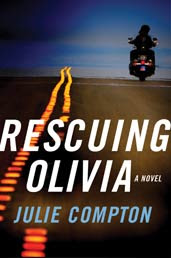
"Rescuing Olivia"

Julie Compton is the author of the legal thriller Tell No Lies, set in her hometown of St. Louis, Missouri. An attorney by profession, she most recently worked as a trial attorney for the U.S. Department of Justice in Delaware and now lives with her family near Orlando, Florida, where she is the proud owner of a Kawasaki Vulcan 500.

She applied the Page 69 Test to Rescuing Olivia, her new novel, and reported the following:
Kirkus Reviews aptly called Rescuing Olivia a hybrid between a modern-day fairy tale and a contemporary thriller. It's a novel about an unassuming Florida biker, Anders, whose girlfriend Olivia mysteriously disappears from the hospital after a suspicious motorcycle accident. In his search for answers, he unearths her traumatic past only to find it shares similarities to his own that he's spent years trying to forget. He finally accepts he must face his own demons if he is to have any chance of saving Olivia from hers.

Is Page 69 representative of the novel? Indeed, I think it is. The passage takes place the morning after Anders was told by Olivia's father that she had died from her injuries. In despair, Anders showed up drunk in the middle of the night at his friend Lenny's house. Page 69 begins with Anders waking up, hung over, on Lenny's couch.
"Andy's up," Joey announced.

The boy padded from the kitchen in his bare feet and climbed onto the couch with him.

“Hi, Andy.”

“Hi, Joey.”

Anders grunted when Buster, Joey’s large Labrador given by Lenny as a guilt gift just after his divorce, leapt up to the couch with his small master and landed on Anders’ gut. The dog panted its bad breath on his face, and he tried unsuccessfully to push it away. He'd wanted nothing to do with dogs since the day Levi died.

“Your bike got wet,” Joey informed him.

He groaned again and sat up to escape the dog, but the movement caused a pounding against the front of his skull. He noticed the full beer bottle from the night before still on the coffee table, and the sight of it made his stomach turn.

“I moved it to the breezeway for you,” Lenny called from the kitchen, picking up on Joey’s comment. He came in with a mug of steaming coffee; his hair and T-shirt still showed the evidence of his trip into the rain.

Anders nodded thanks and took a sip. “What time is it?”

“It’s still early, about seven thirty.” Lenny motioned his head toward Joey by way of explanation. “Sorry.”

Anders grabbed Joey and pulled him close for a hug. Joey squealed but let him do it.

“Did I wake you up last night, buddy?”

“Dad thinks so, but no. I was already awake.” He waited until Anders released him, and then he asked, “It is true that Olivia died?”

Anders looked in Joey’s eyes and swallowed. How did such questions come so easily to little kids? Adults could dance around something for days. “Yeah.” His forehead continued to throb; his nose felt congested and he wanted to be outside, on his bike and heading back to the house. He couldn’t feel her presence here like he could at the beach. He tried to remember why he'd decided to come to Lenny’s, but the night before was a blur.
This passage provides important foreshadowing of events to come. There is mention of Levi, which the reader knows from an earlier scene was Anders' mother's dog, and that it died when Anders was a boy. The reader doesn't know the circumstances of Levi's death, only that Anders is still disturbed by it. The passage also features Lenny, Anders' best friend and the person he goes to when he feels overwhelmed by the task of finding answers about Olivia. Lenny plays an even more crucial role as the novel progresses. Finally, the reader sees a bit of Anders' relationship with Joey, Lenny's son, a relationship that will have a subtle but important influence on Anders later in the story.
Read an excerpt from Rescuing Olivia, and learn more about the book and author at Julie Compton's website and her blog.

The Page 69 Test: Tell No Lies.

My Book, The Movie: Tell No Lies.

Check out the complete list of books in the Page 69 Test Series.

--Marshal Zeringue

Tuesday, February 2, 2010

"The Fourth Assassin"

Matt Beynon Rees is the author of the acclaimed series of novels featuring Palestinian detective Omar Yussef: The Collaborator of Bethlehem, which won the CWA John Creasey (New Blood) Dagger award, A Grave in Gaza, The Samaritan's Secret, and the newly released The Fourth Assassin.

He applied the Page 69 Test to the new novel and reported the following:
The first three novels in my Palestinian crime series take place in the West Bank and Gaza. All the characters are Palestinian, with the exception of a couple of foreign aid workers. But I want my series to show the full extent of Palestinian life, and half the people in the world who call themselves Palestinian don’t live in Palestine. So my hero Omar Yussef hits the road.

The Fourth Assassin, the new book in my series, takes place in the UN on the east side of Manhattan, and in the section of Bay Ridge, Brooklyn, that’s becoming known as “Little Palestine,” as immigrants from the Jerusalem area make it their home.

Page 69 hits the two main topics that make the book compelling.

First, the alienation felt by a foreigner when confronted with the enormity and chaos of New York. I wanted to show how immigrants might turn inward, rejecting the society around them, becoming religious fundamentalists. Here’s the description of a subway ride from Omar’s point of view:
The train rumbled at low speed onto the strangely terrifying superstructure of the Manhattan Bridge. Downriver, beyond the massive girders and the mesh of electric lines, the Brooklyn Bridge arched over the water. Its famous towers sprayed thick cables along its span. Omar Yussef felt as though he were flying out of control through the air, high above the river and the tangle of highway along the shoreline. An old Vietnamese man screamed into his cell phone over the noise of the train. The wheels rang like the slow beating of a giant steel kettledrum until the train slipped back under the earth, jumped to a different track, and picked up speed. ‘This is an unnatural way of traveling,’ Omar Yussef whispered.
Second, Page 69 contains an important spark for the mystery at the heart of the book. Up to this point, no one but Omar Yussef acknowledges that things seem awry. But now his sidekick, Bethlehem Police Chief Khamis Zeydan, says to him:
‘My brother, I have a bad feeling about this visit. Some danger that I can’t predict.’
Now if that doesn’t hook you, nothing will. Read on to page 70, eh?
Watch Matt Beynon Rees read the first chapter of The Fourth Assassin.

Visit Matt Beynon Rees' website and blog.

--Marshal Zeringue

Monday, February 1, 2010

"Requiem in Vienna"

J. Sydney Jones is the author of twelve books, including the first in the Viennese Mystery series, The Empty Mirror, the nonfiction Hitler in Vienna, 1907-1913, the guides Viennawalks and Vienna Inside-Out, and the Vienna-based suspense novel Time of the Wolf. A long-time resident of Vienna, he currently lives near Santa Cruz, California.

He applied the Page 69 Test to Requiem in Vienna, the second Viennese Mystery, and reported the following:
Requiem in Vienna, the second novel in my “Viennese Mystery” series, is set in 1899 and features the new Court Opera Director and composer Gustav Mahler. A series of mysterious accidents at the Opera have led to the death of a young soprano. Alma Schindler, the future Alma Mahler, hires my protagonist, the lawyer Karl Werthen to protect Mahler, whom she is certain someone is trying to kill. Werthen teams up once again with Dr. Hanns Gross, one of the pioneers of modern criminology, to get to the bottom of things.

Page 69 of the novel finds Werthen and Gross called to the scene of the suicide death of Friedrich Gunther, the third violinist at the Court Opera by Detective Inspector Drechsler. The pair has let it be known that they are interested in anything that has to do with the Opera, but at first glance, this seems just a tawdry suicide brought on by despair and drink. The body is hanging from a chandelier in the violinist’s apartment, a chair tipped on its side underneath. After carefully examining the scene and forbidding the gathered policemen from cutting the corpse down, Gross discovers something that convinces both him and Werthen that they are, indeed, dealing with murder both here and at the Court Opera:
Musicians earned little enough, Werthen knew. The job was a sinecure--at least it had been before Mahler’s reign of terror at the Opera and Philharmonic--but such security came at a high price. Herr Gunther clearly had made barely enough for a single man to subside on; whether by design or necessity, his violin had also become his wife. A sad sort of life, Werthen thought. Devoted to art, yes. But then to come home from the lofty world of music to such a depressing environment. Once again, Werthen marveled that a sense of beauty was not something that was generalized to all aspects of one’s life. That is, he was amazed that a man such as Gunther who, one assumed, had been filled with the beauty inherent in music, could still live in such unaesthetic surroundings. Or, like much of Vienna, perhaps Herr Gunther had spent his free time in his favorite coffee house and not in the restricted confines of his unwelcoming apartment.

Werthen’s ruminations were cut short by a snort from Gross.

“Suicide. Utter nonsense.”

Drechsler also perked up at this comment.

“Well, I admit that the lack of any suicide note looks suspicious. But what makes you say so without even examining the body?”

To which comment Gross simply righted the dining chair, placing it under the dangling feet of Gunther. The tips of the dead man’s boots were suspended two inches above the chair seat.

“I’ll be damned,” Drechsler said. “Cut him down.” He motioned to the constables who now finished the work they had earlier begun.

They laid the body gently onto the floor, and Gross leaned down to make a quick examination. Drechsler, his hawk-like face marred by a rather unattractive overbite, squatted next to him.

The inspector assumed control now, slipping a forefinger under the front of the noose. The skin underneath was neither bruised nor rope-burned. He worked around to the back of the man’s head, feeling for broken vertebrae with his eyes closed. He shook his head.

“Amateur,” Gross spluttered, as if it was the worst offence he could imagine. “As if he didn’t care enough to even try to deceive us.”
Read an excerpt from Requiem in Vienna, and learn more about the book and author at J. Sydney Jones' website and blog.

The Page 69 Test: The Empty Mirror.

Check out the complete list of books in the Page 69 Test Series.

--Marshal Zeringue
Sunday, January 31, 2010

"City of Dragons"

Kelli Stanley is the author of the critically acclaimed Nox Dormienda, which won the Bruce Alexander Award for best historical mystery and was nominated for a Macavity Award. She lives in San Francisco, California.

She applied the Page 69 Test to her new novel, City of Dragons, and reported the following:
Miranda took two steps at a time, holding her hand against the wood shutting her out. “I think you do.”

The woman looked at her again. “Who are you?”

“I’m the woman who found Eddie. I was with him when he died.”

The woman met her eyes. This time she nodded. She opened the door, and Miranda stepped over the threshold into another small, dark foyer. It was as clean as the Braeburn but claustrophobic, with cherry-wood furniture and altar incense burning behind a lacquered screen.

“I get them.”

She walked up the narrow stairway, her small feet soundless. Miranda heard a knock, and then several voices, raised in discussion, speaking Japanese.

Time to meet the Takahashis.
So concludes page 69 and Chapter 7 of City of Dragons, at least in my advanced readers copy. This slice represents a couple of motifs that are central to the novel … PI Miranda Corbie’s tenacity in pursuing justice for the dead numbers runner, Eddie Takahashi, and her odyssey through 1940 San Francisco, from a Chinatown soda fountain called Fong Fong to Laurel Heights Cemetery to a high class bordello on Grant Avenue—where Miranda once worked as an escort.

There are other issues, too, of course—the tensions between Chinese-Americans and Japanese-Americans during the Sino-Japanese War and the aftermath of the Rape of Nanking … the casual racism and taken-for-granted brutality of the era. The ugliness that existed side by side with Benny Goodman jazz and Art Deco architecture and that breathtaking urban siren known as San Francisco.

I’ve tried to make City of Dragons a fresh take on classic noir … 1940 without the censorship of the era, and with a femme fatale as the hero rather than the villain. It’s both an homage and, I hope, an original … as is Miranda, former Spanish Civil War nurse, ex-escort, and now private eye.

She’s also a native San Franciscan. And on page 69, she’s entering a city she’s never known.
Read an excerpt from City of Dragons, and learn more about the novel and author at Kelli Stanley's website and blog.

Check out the complete list of books in the Page 69 Test Series.

--Marshal Zeringue

Friday, January 29, 2010

"Breaking Out of Bedlam"

Leslie Larson is the author of the novel Slipstream, which won the Astraea Award for Fiction.

She applied the Page 69 Test to her new novel, Breaking Out of Bedlam, and reported the following:
Turns out I was lucky with page 69, as the passage does a fantastic job of conveying the spirit of Cora Sledge’s voice, which was my guiding light as I wrote this story. The clip opens in the middle of an argument between Cora and Marcos Rodriguez, the medical tech who takes her vital signs each day. Their banter, and the way that Cora is once again saying something she will soon regret, captures the feel of many of the comic scenes in the novel. So I’d have to say that page 69 is very representative of the book. Fingers crossed it would entice skimmers to hang on for the rest of the ride.

Breaking Out of Bedlam begins with Cora’s children forcing her into The Palisades, an assisted care facility, when they find her living on junk food, pills, and cigarettes. Miserable at being wrenched from her home, Cora decides it’s time to die, but Marcos’ care and kindness (along with small doses of contraband junk food, telenovelas, and the occasional cigarette) get her back on her feet. Deciding that truth is the best revenge, Cora begins to write a tell-all journal that reveals once and for all the secret she has guarded since she was a young woman. Intermingled with her reminiscences is an account of the day-to-day dramas at The Palisades—her budding romance with a new resident, feuds with her tablemates, and the cloud of suspicion that descends as a series of petty crimes sets everyone on edge. True to form, Cora wonders if Marcos, her only friend, is the one who is robbing the residents. The story builds to a climax as Cora’s revelations about her past mesh with the slow unraveling of intrigue in the present.

Page 69 illustrates the contradictions in Cora’s character—her hunger for redemption and her talent for self-destruction, her capacity for both naiveté and suspicion, her desire for love and her inability to accept it. The passage shows that despite her age and a life with more than its share of disappointment and struggle, Cora holds onto her wicked humor, her vitality, and her refusal to play it safe.

Page 69:
“Don’t you dare leave!” I yelled at Marcos. “There’s no need to be so touchy!”

He opened the door without even turning around.

“What about my things?” I hollered. “I gave you money! What did you do with it?”

He stormed back. “Thank you for reminding me!” he snarled so fierce that spit flew out of his mouth. His eyes shot sparks. He reached into his carryall and pulled out a paper bag. “Here are your cigarettes!” He slammed a pack of Marlboros down on top of my dresser. He pulled out another one and slammed it down, too. Boom! Like a gunshot. “Here are your cupcakes, and your corn nuts, and your chips.” Bam! Bam! Bam! The last one, the bag of Doritos, came down so hard I knew they’d be crushed to dust.

“Oh, and your newspaper!” He whipped the National Enquirer out of the bag so fast the pages flew apart and fluttered to the ground like a bird shot from the sky. “And your magazine!” He fired People at the floor on top of the newspaper.

“Marcos!” I hollered. “Don’t! Don’t do like that!” I tried to grab his hands. “I’m sorry, now. Come on! Quit acting crazy!”

He grabbed my hand instead. “And here, Señora, is your change!” He pried my fingers open and shoved the money into my palm. “One dollar and fifty-seven cents. You want to count it now, while I’m here?”

I closed my hand around the money and looked into his eyes. Sometimes I hated myself. Just hated myself. I tried to show him with my eyes how sorry I was, but he was too mad to see anything.

“Why didn’t you tell me you bought all this stuff?” I bawled. “Why didn’t you give it to me right away?”

“I forgot,” he said, huffing and puffing. “But I will never forget again.” He tore loose from my hand, picked up his things, and stormed through the door.

What an uproar. I slumped down in my chair and stared out the sliding glass door. I felt so bad for doing Marcos like that. Accusing him, after all he’d done for me.
Read an excerpt from Breaking Out of Bedlam, and learn more about the book and author at Leslie Larson's website and blog.

Visit the complete list of books in the Page 69 Test Series.

--Marshal Zeringue

Thursday, January 28, 2010

"Bloodroot"

Amy Greene was born and raised in the foothills of the Smoky Mountains, where she lives with her husband and two children.

She applied the Page 69 Test to Bloodroot, her debut novel, and reported the following:
On page 69 of Bloodroot, Doug Cotter is watching the girl he has loved since they were children leave him behind to marry the beautiful but sinister John Odom:
A week or so later, I saw Myra and John Odom together. He was waiting for her in the school parking lot, leaning against his car. Girls stood around giggling about how pretty he was, but he looked like the devil to me. Long and lean, tall and dark as a shadow, eyes black as pits. It was like he reeled her across the parking lot by an invisible hook in her perfect lip. I was standing close enough to smell her hair as she walked by, but she didn’t even see me.
Knowing that he has lost Myra forever, Doug goes to his friend and neighbor Haskell Barnett for comfort:
The next day, for the last time, I went to see Mr. Barnett. He was in the garden pulling weeds. When he saw me he took off his cap and wiped the sweat from his brow. He didn’t ask what I was up to. We stood for a while in silence, looking toward the woods at the edge of the yard where we had walked together so many times. “You were wrong,” I told him at last. “She won’t ever come around.” Then my knees came unhinged and I sank down in the black dirt. Mr. Barnett knelt with me and hugged me tight. “You’re the one she ought to be with, Douglas,” he said. “You and me both know it’s the truth. But Myra’s got a choice. Everybody’s got a choice. She just made the wrong one.
With his final words to Doug, Mr. Barnett sums up one of the themes of Bloodroot. In the writing process, I thought about how much inheritance shapes who we become; whether or not childhood suffering causes someone to inflict pain and suffering on others; whether characters like John are cruel by nature or have been formed by childhood abuse; whether it’s possible to overcome circumstances and achieve happiness. I also explored whether or not a dark love like John and Myra’s was destined or if they could have resisted their obsessive passion and saved themselves. In ways, Myra and John might be products of genetics and upbringing, but they have free will. As hard as it is to overcome inherited traits and circumstances—as Mr. Barnett says—everybody’s got a choice.
Read an excerpt from Bloodroot, and learn more about the book and author at Amy Greene's website.

Visit the complete list of books in the Page 69 Test Series.

--Marshal Zeringue

Tuesday, January 26, 2010

"Dying Gasp"

Leighton Gage has been a copywriter, an advertising creative director, a magazine editor, and a writer/producer/director of documentary films and industrial videos.

He applied the Page 69 Test to Dying Gasp, his third novel in the Chief Inspector Mario Silva series, and reported the following:
As regular readers to this site know, a book neither passes, nor fails, the Page 69 Test. The Test isn’t about scoring, it’s about matching readers with authors, and by golly, the instrument has just proved its efficacy once again. Five lines down, on page 69 of Dying Gasp, I find this:

“Someone who casually strangles a woman, then cuts her head off with an axe...”

Suppose you’re in a bookstore, browsing, and you read that fragment of a sentence. What are you likely to do? I’d wager you have three options:
1. You keep on reading.
2. You hustle Dying Gasp to the check-out.
3. You re-shelve the book - and go on looking for a cozy.
The line is plucked out of a conversation between Chief Inspector Mario Silva and his superior, Nelson Sampaio, the Director of the Brazilian Federal Police. Sampaio, a political appointee, knows little about law enforcement – and doesn’t care to learn. Line 14: “I don’t want an explanation. I just want to know how long.” (By which he means how long it’s going to take to find the perpetrator.)

There is, of course, no answer to that question. Asking questions for which there are no answers is somewhat a specialty of the director’s. He’s a very annoying man.

The victim, the true subject of their discussion, is not the woman who’s lost her head. It is, rather, a kidnapped girl, the granddaughter of an important politician. Sampaio wants her recovered so he can look good. Silva wants her recovered because he fears something horrible will happen if she isn’t. He senses they have little time. Line 22: “And time,” the director said, “is something we’re running out of.”

It is the sole instance in the book where Sampaio and Silva are in complete agreement.
Read an excerpt from Dying Gasp, and learn more about the author and his work at Leighton Gage's website and the Murder is Everywhere blog.

The Page 69 Test: Blood of the Wicked.

My Book, The Movie: Buried Strangers.

Check out the complete list of books in the Page 69 Test Series.

--Marshal Zeringue