Friday, May 3, 2013

"A Dual Inheritance"

Joanna Hershon's books include Swimming, The Outside of August, and The German Bride. Her writing has appeared in One Story, The Virginia Quarterly Review, Post Road, the literary anthology Brooklyn Was Mine, and was shortlisted for the 2007 O. Henry Prize Stories.

She applied the Page 69 Test to her new novel, A Dual Inheritance, and reported the following:
From Page 69:
…people were climbing steps and walking in clusters toward dinner on Mass Ave. “Not you. You’re different.”

“Is that right?”

“You know you are. Listen to you. You’re taking me to task! You are so disappointed in me right now. You are disappointed in everything and everyone, and it kills you. That’s why you’re different. Because you can’t stand it. And also, although you have shown nothing near your potential and you are in some ways—let’s face it—kind of lazy, you want to save the world.

Hugh looked down at the sidewalk and, despite himself—Ed could tell—he smiled. “And you’re going to help me do that?”

“No,” Ed said, “of course not.”

They started to walk again, and when Ed suggested they eat dinner, when he said he was starving and Hugh expressed little surprise, because Ed was always hungry—always starving—Ed finally said, “I apologize.” But it lacked a certain sharpness.

“That’s okay,” Hugh replied. But it wasn’t, not exactly.
As it happens, page 69 of A Dual Inheritance is eerily representational of the whole novel. Here are Ed and Hugh as seniors at Harvard: unlikely friends who will have an unforeseen influence over each others lives, even as their friendship goes on to end just as abruptly as it began. They have just come from a particularly intense visit to Ed’s fairly squalid childhood home. This was a spontaneous trip, and not only was Hugh (from decidedly grander digs) unprepared, but Ed’s father was taken off guard. After Ed’s father behaves true to character and Ed becomes enraged and saddened, they leave, and Hugh quietly suggests that perhaps they should have both—Ed’s father and Hugh—been given fair warning. Ed knows Hugh is right, but instead of apologizing, he attacks Hugh’s character. After this outburst, Ed tries to be just as honest as he assesses Hugh’s more promising traits. The tension and love that’s evident here on page 69 is at the heart of the novel and asks the question: can a friendship define your view of the world?
Learn more about the author and her work at Joanna Hershon's website.

The Page 69 Test: The German Bride.

My Book, The Movie: The German Bride.

Writers Read: Joanna Hershon.

--Marshal Zeringue

Thursday, May 2, 2013

"Bristol House"

Beverly Swerling novels include the City of Dreams series, a four-volume historical saga set in old New York.

She applied the Page 69 Test to her new novel, Bristol House, and reported the following:
From page 69:
Dom Justin
From the Waiting Place

the great mercy you have shown in assigning me to this place in Purgatory where I might atone for my many sins.

I must go on, for as yet I have not told the worst of them, and I sense that on the other side time grows short and the woman’s danger increases...

When I left the Jew’s house, Rebecca was again waiting in the stand of trees beside the river. But this time when she pressed against me, the hair shirt of the Carthusian rule, a garment we wear always beneath our habits, scraped against my skin, and I was reminded of the suffering of eternal damnation. It was enough to overcome the carnal heat that burned my flesh, though my cock stiffened at the mere thought of the sin to which I had not as yet succumbed.

I returned quickly to the Charterhouse, but despite the urgency to be back in my cell before the bell rang for the midnight office, I was forced to pause when I saw nailed above the great doors the quarter part of the carcass of the Venerable Father. It had been put there since I left, and below it was a notice saying the thing must not be removed, “on pain of an even more terrible death for he who did the action and all who encouraged him therein.”

Giacomo the Lombard, known also as the Jew of Holborn
From the Waiting Place

I do not know why I am commanded to tell my story, nor who it is who listens. But I am grateful to be in this place that is neither earth nor Gehenna, where the eternal fire burns. I have, I know, much for which to atone, and I am promised that to tell what happened between me and my daughter and he who was known in the Charterhouse as Dom Justin will help erase their stain. So be it.

I am not required to tell everything: not how I came to leave Lombardy and smuggle myself into London to seek greater fortune, nor of the sweet young maiden I married there, a Lombard who was secretly a Jew like myself and a number of others, nor of her death hours after she gave birth to our first
Bristol House is a novel that takes place in London during both the 21st and the 16th centuries. I think anyone opening the book to page 69 after having looked however briefly at the information on the inside cover flap will know they're reading something from the historical section.

And as it happens, this page is truly evocative of the Tudor story. For one thing it offers an introduction to the two voices that tell the historical part of the novel. For another, it has just that blend of sacred and profane that I've used throughout. Mostly because that's what I think life is – sacred and profane in equal measure. Page 69 also illustrates the themes of sin and reparation which are so much a part of the story, as well as drawing attention to the mystery that links the two periods. "I sense," Dom Justin says, "that on the other side the time grows short…"

The "other side" is where Annie, the contemporary young American heroine and an architectural historian, is staying in a London apartment building known as Bristol House. And where she's trying to unravel the mystery which reaches from Justin's time into her own. You also know at once that Justin is breaking his monastic rule when he speaks of the "urgency to be back in my cell before the bell rang…" And perhaps you'll be intrigued that a man known as the Jew of Holborn is speaking from Purgatory.

I wasn't sure what genre I was writing in when I started this book. The publisher decided to call it a "supernatural thriller." I'm content with that. I hope readers are as well.
Learn more about the book and author at Beverly Swerling's website and blog.

Writers Read: Beverly Swerling (August 2011).

--Marshal Zeringue

Wednesday, May 1, 2013

"The Pink Hotel"

Anna Stothard studied English at Oxford and then moved to Los Angeles, where she was awarded a screenwriting scholarship with the masters program at the American Film Institute. Her first novel, Isabel and Rocco, was published in 2004.

Stothard applied the Page 69 Test to her second novel, The Pink Hotel, which was longlisted for the Orange Prize, and reported the following:
In The Pink Hotel a nameless seventeen-year-old girl attends her estranged mother’s raucous, drug-fuelled wake at a hotel on Venice Beach. Most of the novel is set in Los Angeles as the daughter returns her mother’s love letters to the men who knew Lily, but parts of the story flash back to the girl’s childhood in North London – like page 69.

She grew up with her father and grandparents in an apartment above a chip shop, playing football and getting into fights. It’s an emotionally drained childhood, where nobody touches each other or connects, in contrast to the decadent and sensual world she finds at the Pink Hotel.

Page 69 is actually quite sad – her grandfather dies of a stroke. The air in the room congeals slightly when he slips away and my narrator wonders if the death even matters, since he’d been ill and “not-himself” for so long. The protagonist is interested in identity, throughout the novel, so she debates when exactly her grandfather’s identity ceased. He has one lazy eye, which is looking at her when he stops breathing, the other is looking at the narrator’s father.

Most of the novel isn’t as somber as page 69!
Learn more about the book and author at Anna Stothard's website.

--Marshal Zeringue

Tuesday, April 30, 2013

"The City of Devi"

Manil Suri was born in Bombay and is a professor of mathematics and affiliate professor of Asian studies at the University of Maryland, Baltimore County. He is the author of the novels The Death of Vishnu, The Age of Shiva, and The City of Devi. His fiction has won several awards and honors and has been translated into twenty-seven languages. He was named by Time Magazine as a “Person to Watch” in 2000. He is a citizen of both the United States and India.

Suri applied the Page 69 Test to The City of Devi and reported the following:
Page 69 is part of the scene where Sarita, trying to escape an enemy plane strafing the deserted streets of Mumbai, takes shelter in an aquarium cafĂ©. She encounters the watchman there, and slowly realizes he has eaten most of the fish under his charge. Quite hungry herself, she pays him to catch and cook up one of the last fish in the display cases. However, he’s very stingy with the oil, and it ends up tasting terrible. He tells her to return the next day – she can eat for free if she helps him catch the last remaining baby shark in the aquarium, which he promises will have better flavor.

The scene is quite perfect in expressing the surreal quality that I tried to infuse throughout the book. Sarita is looking for her husband who has mysteriously disappeared in the midst of a war between India and Pakistan, and most of Mumbai’s population has fled under a nuclear threat. Which might sound very grim, except that I’ve aimed for comedy, tried to bring out the absurdness in every situation. The few people who’re left go about their business worrying about such mundane things like cell phones and jewelry, they lose no opportunity to snub those lower in social standing, and generally display all the prejudices, insecurities and weaknesses that make them human. If there’s no food available, and you’re guarding fish, why not eat them? What could be more logical?
Learn more about the book and author at Manil Suri's website.

Read about Manil Suri's top ten books about Mumbai.

--Marshal Zeringue

Monday, April 29, 2013

"Prophet of Bones"

Ted Kosmatka is the author of the novels The Games and the recently released Prophet of Bones. His short fiction has been nominated for both the Nebula Award and the Theodore Sturgeon Memorial Award, and appeared in numerous Year's Best collections.

Kosmatka applied the Page 69 Test to Prophet of Bones and reported the following:
In Prophet of Bones, the page 69 test opens into a crowded market on the island of Flores. Paul, a scientist outside his element, is exploring the crowded Indonesian town before heading back down the road to the archaeological dig where the bones of the strange dwarf humanoid Homo floresiensis were found:
He paused for only a millisecond, the slightest hint of hesitation, and the voice came out of the booth, “Hello, Mister.”

Paul turned. “How much?”

The shop owner came forward. He was old and gray and bent. His rheumy, bloodshot eyes did a quick appraisal. “With respect, sir,” he said in good English, pointing to a pair of small signs above the necklace which seemed to give two different prices for the same item. One sign read 50,000 rp, and the other 30,000. “Very nice necklace. Grandson caught shark with own hands.”

“Which price is it?”

“That depend,” the old man said.

“On what?”

“On if you want haggle. You haggle, we start this price here,” he said, gesturing to the sign with the higher price. His knuckles were knobby with arthritis.

“I’d rather start there,” Paul said, pointing to the other sign.

The man shook his head. “No, that the no-haggle price. If you want haggle, we start at 50,000rp. But don’t worry, we talk price down.”

“How far down?”

“Almost to here,” he said, pointing to the lower price.

“Almost?”

“Can’t haggle all the way to the no-haggle price. You understand, sir. I must earn something for my time.”
Learn more about the book and author at Ted Kosmatka's website.

Writers Read: Ted Kosmatka (March 2012).

The Page 69 Test: The Games.

My Book, the Movie: The Games.

My Book, the Movie: Prophet of Bones.

Writers Read: Ted Kosmatka.

--Marshal Zeringue

Sunday, April 28, 2013

"Deadly Harvest"

Michael Stanley is the writing team of Michael Sears and Stanley Trollip. Their mysteries are set in Botswana, each against a backdrop of a current issue in southern Africa. Their protagonist is David “Kubu” Bengu, assistant superintendent in the Botswana Criminal Investigation Department (CID). The third novel in the series, Death of the Mantis, was short listed for an Edgar and an Anthony, and won the Barry Award for best paperback original mystery of 2011.

The authors applied the Page 69 Test to Deadly Harvest, the fourth Detective Kubu mystery, and reported the following:
We were a little scared of page 69! What would it tell you about the book? Every page in a novel is important – or ought to be - but some are more gripping than others. Fortunately our fear was misplaced. Page 69 is a key scene and illustrates the personality of our new female character – Samantha Khama – the first woman detective in the Botswana Criminal Investigation Department.

Samantha is following the cold trail of Lesego, a young girl who has vanished, not as the victim of a rapist or serial killer, but kidnapped by a witch doctor for use in his black magic potions. Unfortunately, this is no pseudo-fantasy thriller. The belief in the power of witch doctors is prevalent in much of Africa. Most are herbalists with a smattering of magic thrown in, but a few, like Lesego’s abductor, deal in the blackest of magic requiring human body parts. It is claimed to bring them horrific powers including shape changing and invisibility.

The book builds from the effect these murders have on the families who often feel the police neglect them in favor of higher profile crimes. The police battle to solve these cases. There is no obvious link between the victim and the killer, fear of the witch doctors silences witnesses, and the police themselves are nervous of the witch doctors and their often powerful clients.

When she was a girl, Samantha had a close friend who was a victim. For her the issue is personal. And she, too, is dissatisfied with the attitude and response of her colleagues. She finds it hard to be taken seriously in the male-dominated enclave of the Criminal Investigation Department, and difficult to make progress with the cases - until she links up with Detective Kubu.

On page 69, she is interviewing the family of the missing girl: Lesego’s sister, Dikeledi, and her foster father and mother:
Each member of the family described what they recalled of that day, but no one remembered anything unusual.

Then Tole spoke about the following week.

“I asked everyone I met. But no one had seen anything. At least that’s what they said. I think they were scared a witch doctor was involved.”

“The people you talk to only want to drink at the bar,” Constance interjected.

Samantha ignored that and spoke to Tole. “Did anyone seem evasive? As though they were hiding something?” Tole shrugged and subsided.

Samantha turned to Dikeledi. “The police at the station said you were very concerned. Very loyal. That you came back several times. Did you find anything? Is there anything else you can remember that might help me?”

Dikeledi looked down at her feet. After a few moments she shook her head.

Constance stood up and put a pot of pap on the stove to cook. Samantha realized it was a signal for her to leave, but she had noticed Dikeledi’s hesitation.

“Would you show me the route Lesego would’ve taken to school, Dikeledi? Would you drive with me? It won’t take long, and I’ll bring you right back.” The girl hesitated again, but then nodded. She jumped up and left the room, reappearing a few minutes later with a jacket, despite the warm evening.

Samantha gave Tole her business card and thanked them all for their help. Constance just nodded and concentrated on the pap.
Dikeledi has something to show Samantha, something important, but she won’t do it in front of the others. The meeting starts Samantha on a course which brings her and Kubu close – uncomfortably close – to the ‘invisible’ witch doctor.
Learn more about the book and authors at Michael Stanley's website.

Read: Michael Stanley's top ten African crime novels.

--Marshal Zeringue

Saturday, April 27, 2013

"Float"

JoeAnn Hart lives in Gloucester, Massachusetts, America's oldest seaport, where fishing regulations, the health of the ocean, and the natural beauty of the world are the daily topics of wonder and concern. She is the author of the novels Addled, a social satire that intertwines animal rights with the politics of food, and the recently released Float.

Hart applied the Page 69 Test to Float and reported the following:
How nice! Look. There’s a lot of great tension on Float’s page 69. The protagonist, Duncan Leland, and his nemesis, the unsavory Osbert Marpol, have met for lunch to discuss a business deal to save Seacrest’s, Duncan’s fish dehydration plant in Maine. Osbert is a Churchill-quoting loan shark, and as desperate as Duncan is to borrow money, he becomes increasingly uneasy the more they talk. Osbert knows too much personal information about Duncan, including the fact that he is separated from his wife and living at home with his mother. Slocum, referred to in the beginning of the excerpt, is the owner of the restaurant, Manavilins. He is Duncan’s best friend, but a bit too experimental when it comes to cooking, so they are engaging in dangerous behavior just by having lunch. Not only is this page representative of Float, it is the turning point, where Duncan throws his fate into a deal that risks not just his business, but his life.

Page 69, excerpt:
“You lived with Slocum not so long ago, didn’t you?” He picked up his cigar and rolled it between his fingers.

Duncan paused, alarmed that Osbert had explored the hidden marshes of his personal life. He’d done no research at all on Osbert, as if his rumored connection with the mob told him everything he needed to know. But he realized now he knew absolutely nothing. “For a few days,” he said, coughing his words into his freckled fist. “I’m out on the Cove now.”

“Your mother’s house.”

Duncan bristled. “The family home.”

“You know, Leland, you’re not intended to live on a life raft. It's only supposed to get you away from a sinking ship.”

“Is that your buddy Churchill's saying?”

“No,” said Osbert. “In your case, it’s a popular observation.”

“Well, my marriage isn’t sinking,” said Duncan. “It’s only floating at anchor for the moment.”

“Be that as it may, Seacrest's anchor is dragging. A dangerous situation. You're lucky I'm here to help.”

Before Duncan could formulate a response, he heard something large and wet being slammed repeatedly against the building, the sound of which only added to his distress. He reached for his red plastic water glass and knocked it over, flooding the table and causing cubes of ice to spin away. Marney came running over with a towel. Densch, the busboy with a jawline beard, appeared with a fresh glass. They were keeping a very short lead on him. Everything was put to rights in a minute as Osbert watched with acid amusement.

When the workers disappeared, Duncan spoke in a low voice. “I don't need help."

“Beaky tells me that's what you'd say," said Osbert. “But we know otherwise, and so do you. Here's the deal.”
Learn more about the book and author at JoeAnn Hart's website, blog, Facebook page, and Twitter perch.

Read--Coffee with a Canine: JoeAnn Hart and Daisy.

--Marshal Zeringue

Friday, April 26, 2013

"Reconstructing Amelia"

Kimberly McCreight attended Vassar College and graduated cum laude from the University of Pennsylvania Law School. After several years as a litigation associate at some of New York City’s biggest law firms, she left the practice of law to write full-time. Her work has appeared in such publications as Antietam Review, Oxford Magazine, Babble, and New York Magazine online.

McCreight applied the Page 69 Test to her new novel, Reconstructing Amelia, and reported the following:
Interestingly, page 69 of Reconstructing Amelia is a series of text conversations between Amelia and several different people. It’s certainly a unique slice of the novel, but I’m not sure it’s exactly representative of the story as a whole. The texts will be especially intriguing to some, but I can imagine they might make other readers a little wary—fearing that the entire book is comprised of such entries.

The multimedia elements are one of my favorite aspects of the book, but they do comprise a fairly limited percentage of the story is told primarily in traditional chapters, alternating between Amelia and her mother Kate’s points of view.

That said, the texts and Facebook postings were critical to me. They give the narrative texture and supply important elements of the mystery. They also draw the reader more intimately into Amelia’s fifteen-year-old world.

Technology is a part of most people’s relationships today, particularly teens. These arms-length modes of communication have the potential to change the quality of the communication itself. With bullying for example—a major theme in Reconstructing Amelia—technology has made it more painful to be the victim of harassment. If tormentors jump on line there’s no escape, not even in the comfort of your own home. I think the psychic distance technology creates also makes it easier to bully. I think the ease with which harassing messages can be passed on—a single tap on a smartphone is sometimes all it takes—works to the disadvantage of potential bulliers as well. Some might not engage in such behavior at all, if they were forced to take a few minutes to reflect on it.

I hope that people will be intrigued by the texts on page 69 of my book, then be drawn in fully by the voices of Amelia and her mother Kate, which fill Reconstructing Amelia’s remaining pages.
Watch the trailer for Reconstructing Amelia, and learn more about the book and author at Kimberly McCreight's website and blog.

--Marshal Zeringue

Thursday, April 25, 2013

"Garden of Stones"

Sophie Littlefield grew up in rural Missouri. She writes the post-apocalyptic Aftertime series for LUNA Books. She also writes paranormal fiction for young adults. Her first novel, A Bad Day for Sorry, won an Anthony Award for Best First Novel and an RT Award for Best First Mystery. It was also shortlisted for Edgar, Barry, Crimespree and Macavity Awards, and it was named to lists of the year's best mystery debuts by the Chicago Sun-Times and South Florida Sun-Sentinel.

Littlefield applied the Page 69 Test to her latest novel, Garden of Stones,  and reported the following:
From page 69:
Back in their house on Clement Street, night was the music of a small ensemble. The ticking of the furnace, the groaning of the old walls settling on their foundation, branches from the cherry tree scratching her window when the wind blew, and the squeaking of the floorboards and flush of the toilet when her parents got up in the middle of the night to use the bathroom. All these sounds blended together in a familiar way, soothing Lucy back to sleep whenever she woke.
This bit of introspection takes place on the first night that 14-year-old Lucy Takeda spends in a Japanese internment camp. I had tried to imagine what it would be like for a young girl to find herself in such unfamiliar and unwelcome environment, and I thought she would focus on memories of home. The description is based on my own memories of night sounds in the house I grew up in. I found the familiar noises reassuring on nights when I was worried or scared, and I thought Lucy might feel the same way.

In the camp barracks, it was never quiet. Living quarters were separated by dividers that didn’t reach the ceiling, and sounds traveled throughout the building. In personal accounts, those who were interned tell about being forced to listen to their neighbors’ most private moments - grief and despair and lovemaking and whispered conversations. The lack of privacy was devastating. But the first night, perhaps it was a comfort to know that others shared your fate, only a few feet away.
Learn more about the book and author at Sophie Littlefield's website and blog.

--Marshal Zeringue

Wednesday, April 24, 2013

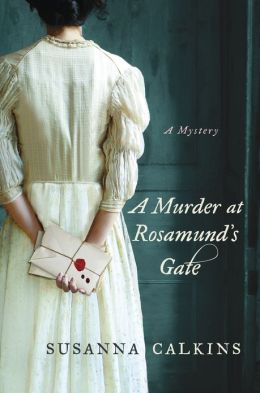
"A Murder at Rosamund’s Gate"

Susanna Calkins became fascinated with seventeenth century England while pursuing her doctorate in British history and uses her fiction to explore this chaotic period. Originally from Philadelphia, Calkins now lives outside of Chicago with her husband and two sons.

She applied the Page 69 Test to A Murder at Rosamund's Gate, her first novel, and reported the following:
Opening A Murder at Rosamund’s Gate to page 69 offers some insights into one of the emerging sub-plots of the novel: the developing relationship between Lucy Campion, a chambermaid, and Adam Hargrave, the son of her employer, the local magistrate. In this scene, Lucy is eavesdropping on a conversation between Adam and a young noblewoman, Judith Embry, that was happening in the Embry’s garden late one evening.
“Father, you know, believes—“ Lucy heard Judith say, but her words were lost in the light wind that had arisen. Although unsure why, Lucy moved closer, taking care to keep her figure hidden in the bushes.

Adam appeared to pull away slightly. “Yes, I’m well aware of what your father thinks.”

“Oh, Adam,” Judith continued. “You can do anything you want. Father doesn’t think lawyers are too important.”

Hearing her brittle little laugh, Lucy shuddered.

“Indeed?” Adam asked idly, lazily.

This time, Judith seemed to sense that she had gone too far. “Oh, dear,” Judith said soothingly, caressing his arm. “I’ve made you angry, Adam. Come, let’s have a kiss and make up.”

Lucy watched as Adam regarded Judith. She could not tell what he was thinking. She wondered if he liked what he saw. He paused. “Why not?” she heard him say.

Averting her gaze, Lucy crept away, a deep dismay rising up inside her. Adam deserves better than her, she thought. As if on cue, her nose began to throb, painfully reminding her of the odd encounter with Adam on the stairs.

Suddenly desperate to go home, she stumbled away, only to quickly become disoriented as the fog grew heavier. Without a lantern, she could not find the path. A hand on her arm made her jump.
I won’t tell what happens next, but someone—not Adam—has followed Lucy into a great open field. If I’d been asked to provide page 70, you’d have been privy to one of the darker scenes of the novel.

The excerpted scene, however, is meant to suggest Lucy’s growing confusion about her status in the magistrate’s household, and her emerging feelings towards the magistrate’s son. It also suggests something about Lucy’s lively curiosity and her tendency to poke her nose into things that don’t concern her.
Learn more about the book and author at Susanna Calkins's website and blog.

--Marshal Zeringue

Tuesday, April 23, 2013

"Shadow on the Crown"

Patricia Bracewell grew up in California where she taught literature and composition before embarking upon a writing career.

She applied the Page 69 Test to Shadow on the Crown, her first novel, which is the start of a trilogy, and reported the following:
Page 69 of Shadow on the Crown looks in on Æthelred II of England and his young Norman bride, Emma, at their wedding feast.
“Perhaps, then,” said the king, “I should have insisted on your sister as my consort, so that I would not be saddled, as I am now, with a wife who demanded the title of queen.”

Stung by his discourtesy and his apparent dissatisfaction with the marriage bargain he had struck, Emma could only stare at him for a moment while she caught her breath. Then she felt the weight of the circlet upon her head as well as the weight of her brother’s final words to her. You must demand the king’s respect. She roused herself to respond.

“I expect my brother would have made the same demand, whichever sister he sent you. And as you did not insist upon my sister,” she said, hiding her displeasure with a smile, “instead of a wife who might have been a burden to you, you have a queen who can share any burdens that fate may send you. Such is my wyrd, I think.”
In this brief dialogue the reader is introduced to one of the central conflicts of the novel. Shadow on the Crown explores, among other things, the demands made upon a peaceweaving bride who must wed a powerful enemy in order to seal a shaky alliance. The title of queen implies that Emma has been granted some power, but she discovers that in England’s hostile court she is little more than a royal hostage.

Although this is primarily Emma’s story, the wider conflicts in the novel are perceived through three additional viewpoint characters: the suspicious, haunted king; his headstrong son from a previous marriage; and the devious daughter of the highest ranking noble in the realm. It is a tale of treachery, loyalty, political ambition, passion, and the demands of duty in an 11th century kingdom that is slowly crumbling under pressures both from within its borders and from across the sea. The uneasy exchange between Æthelred and his bride at their wedding feast only hints at the trouble to come.
Learn more about the book and author at Patricia Bracewell's website and blog.

--Marshal Zeringue

Monday, April 22, 2013

"The Movement of Stars"

Amy Brill is a writer and producer who has worked for PBS and MTV, and has been awarded fellowships by the Edward F. Albee Foundation, the Millay Colony, and the American Antiquarian Society, among others. She lives in Brooklyn.

She applied the Page 69 Test to her new novel, The Movement of Stars, and reported the following:
From Page 69:
Hannah stayed next to the telescope for more than an hour, checking periodically like a mother with a feverish child, but the stars and everything else in the firmament ticked by invisibly. There was barely any wind, nothing to suggest an imminent change in the weather. A film of despair began to settle in her, lightly, like an illness just taking hold, as she contemplated her father’s decision. There was nothing she could do to alter it, short of attaching herself permanently to a male—any male—who would contract to marry her.

The idea that she had always been powerless over her own future, but not realized it, was excruciating. She’d been propelled toward mastery—over her emotions, over her equations, of the biggest and most minute parts of the Universe—for her entire life. Dr. Hall had demanded rigor, his teaching method requiring total expertise on one level before advancement to the next. Fractions came before geometry; simple maths before logarithms and algebraic equations. Until tonight, she thought she’d understood the rules that governed her life as well: work hard, sweep the skies, seek a contribution. Be rewarded. How could she have made so great a miscalculation?

Grinding her teeth, Hannah peered through the telescope again, desperate for something else to focus on. This time she didn’t hear the door to the walk open or close. When she heard Isaac’s deep voice at close range, she gasped, clapping her hand to her chest while trying to catch her breath.
Page 69, as it happens, is representative of my novel in that it encapsulates Hannah’s devotion to astronomy and her frustration at the limitations imposed upon her advancement by a society in which she couldn’t go to college, vote, hold office, hold property, or even hold a job outside of teaching or domestic work. Here, she’s doing her best to gain a foothold in the (male) astronomy community of her day by searching the night skies in search of an elusive comet. If she is the first to spot and report a new one, she can win a medal from the King of Denmark and—more importantly—the respect of her peers. The arrival of Isaac Martin—a black whaler from Azores who she is tutoring in celestial navigation—at the end of this page is fortuitous, because his appearance in Hannah’s life does both frighten and exhilarate her, as their deepening relationship fractures the stability of her life, from her beliefs to her standing in her close-knit Quaker community. All in all, page 69 passes the test! At least for these purposes. Whether it passes your test as a reader is, of course, entirely up to you.
Learn more about the book and author at Amy Brill's website.

--Marshal Zeringue