Thursday, August 4, 2016

"Local Girl Swept Away"

Ellen Wittlinger is the author of over a dozen YA and middle-grade novels. Her novel Hard Love won both a Printz Honor Award and a Lambda Literary Award.

Wittlinger applied the Page 69 Test to her latest novel, Local Girl Swept Away, and reported the following:
On page 69 of Local Girl Swept Away, Finn and his younger sister Tess are working at the arts colony run by their parents, cleaning out studios used by painters over the summer. Finn has grudgingly saved any left-behind art supplies he finds for his friend, Jackie, who's being encouraged by Finn's mother in her quest to be an artist. "I hate aiding and abetting you in this art business," he grumbles. "It's not about how good you are," he says. "It's about you thinking this is going to be your life's work. Like taking photographs is a real job... Making art that somebody wants to pay for is an unrealistic goal for ... well, you know."

This is one of the few times Finn and Jackie come to grips with one of the big issues between them, the fact that Finn comes from a wealthy family in which his mother's creativity is primarily financed by his father's prize-winning novels, and Jackie comes from a lower-middle-class family who have, for generations, made their living as fishermen. Jackie knows Finn's scorn for the arts has more to do with his relationship with his father than anything else, but still, he hurts her feelings by being so blunt about it.

"You mean it's unrealistic for somebody like me?" Jackie asks. "A poor person. You sound just like my mother. She thinks only rich people should go to art school."

"I don't know why anybody wants to go to art school," Finn says. "Is it living in Provincetown that makes people think they need to write sonnets or dab oil on canvas? Not everybody needs to express themselves creatively."

But Jackie does, as do most of my protagonists in most of my books. Maybe it's even more important for those people (like me) who were raised without much emphasis on creativity or self-expression, whose parents were practical and fearful of taking chances, to find a way to express emotions, which often happens through art. This is a moment in the book when Jackie and Finn say what they're really thinking, which they don't always. They're very different in many ways, but they do, eventually, come to understand each other.
Learn more about the book and author at Ellen Wittlinger's website.

--Marshal Zeringue

Tuesday, August 2, 2016

"The Lost Girls"

After a decade practicing law and another raising kids, Heather Young decided to finally write the novel she’d always talked about writing. She holds an MFA from the Bennington Writing Seminars, and is an alumnus of the Squaw Valley Writers Workshop and the Tin House Writers Workshop, all of which helped her stop writing like a lawyer. She lives in Mill Valley, California, with her husband and two teenaged children. When she’s not writing she’s biking, hiking, neglecting potted plants, and reading books by other people that she wishes she’d written.

Young applied the Page 69 Test to The Lost Girls, her debut novel, and reported the following:
The Lost Girls follows three generations of women linked by the disappearance of a six-year-old girl from her family’s summer house on a remote Minnesota lake in 1935. It’s told in two interwoven narratives: a journal in which Lucy, the missing girl’s older sister, reveals the secrets she’s been keeping about that summer, and the story of Justine, who inherits the decaying, isolated lake house after Lucy’s death and moves there with her two young daughters, driven by her own desperate need to escape her past.

Page 69 is from a Lucy chapter that begins to tease out the complicated relationships among the three Evans sisters and their mother. Lilith, the eldest sister at 13, has begun to grow up, leaving eleven-year-old Lucy behind at the outer reaches of childhood. In this scene Lilith is off with her new teenaged friends, leaving Lucy to hover awkwardly around Mother and six-year-old Emily, Mother’s favorite:
“Where’s Lilith?” Mother asked as I leaned against the doorway.

“At the lodge,” I said, “with Jeannette and Betty and them.” I watched her. She pursed her lips, and I could tell she didn’t know what to make of this. Lilith and I had never separated before, and although Jeannette and Betty were nice girls from good families, they were older, and she had to know what that meant. I think I was hoping she’d intervene, perhaps forbid Lilith from going, but I shouldn’t have hoped that. Even then I knew she’d relinquished any power she might have had over Lilith and me long ago.

Emily was watching me from Mother’s lap. I frowned at her, indulging a small flare of resentment. Once it had been my hands Mother guided in embroidery, and my bed she shared at night. My bed, where I’d pull Mother’s arm over my head so its soft weight closed my ear to everything but her heartbeat and mine, a thrum-thrum that sent me safely into sleep. Until the night, soon after Emily outgrew her crib, when Mother sat beside me in her white cotton nightdress, her long hair in its plait, and looked at me with a sorrowful apology in her face that in those days I thought was sweet and plain, a perfect mother’s face. “Good night, baby,” she said. Then she laid her hand on my forehead, smoothed back the curls, and kissed me, her lips light and dry, before slipping away to Emily’s room. Ever since, I’d fallen asleep alone, except for summer, when Lilith and I shared our bedroom at the lake.
The Lost Girls is about the price of loyalty, the burden of regret, and the meaning of salvation, but most of all it’s about the bonds of family, and how the secrets of past generations cast shadows that children and grandchildren must escape if they want to define their own destiny. Page 69 contains some of the earliest hints of all these themes, and I hope it’s a scene readers return to in their minds once the book is done.
Visit Heather Young's website.

--Marshal Zeringue

Sunday, July 31, 2016

"Cold Silence"

James Abel is the pseudonym for Bob Reiss, an accomplished author and journalist who has written extensively on the Arctic. He lives and works in New York City.

Abel applied the Page 69 Test to his new novel, Cold Silence, and reported the following:
Page 69 of Cold Silence plunks the reader down smack dab in the middle of the threat; that danger comes when we least expect it, and from startling directions. That in our modern era, a small group can bring the world to its knees. That when you combine fanaticism and science you can threaten a billion people, one small place at a time.

Page 69 is certainly representative of the rest of the book as far as concept, pace and issues go. It is a rare section from the perspective of the bad guys, as opposed to most of the book, which we see through the eyes of Joe Rush.
Visit James Abel's website.

The Page 69 Test: Protocol Zero.

My Book, The Movie: Protocol Zero.

--Marshal Zeringue

Friday, July 29, 2016

"Ghosts of Bergen County"

Dana Cann was born in Santa Barbara, California, and raised in the Maryland suburbs of Washington, DC. He's worked in commercial banking, corporate finance, and restructuring.

His short stories have been published in The Sun, The Massachusetts Review, The Gettysburg Review, Fifth Wednesday Journal, The Florida Review, and Blackbird, among other journals. He has received fellowships from the Virginia Center for the Creative Arts and the Mid Atlantic Arts Foundation. Cann earned his M.A. in Writing from Johns Hopkins University.

He applied the Page 69 Test to his debut novel, Ghosts of Bergen County, and reported the following:
Ghosts of Bergen County is a ghost story about overcoming grief. Page 69 features a telephone conversation between two main characters, Mary Beth and Gil, a married couple whose baby was killed two years earlier in a hit and run. Mary Beth, recovering from major depression, has developed a routine where she goes to a nearby elementary school playground for dismissal. Today she calls Gil from her cell phone, and tells him she’s out for a walk. Gil asks:
“You’re fine?”

“I’m just tired.” A child screamed behind her.

“Where are you?”

“At the School on the Ridge. Everyone’s hanging out. The ice cream man is parked at the curb like a crack dealer.” She tried on a smile. She thought he’d appreciate the joke. Instead he was earnest:

“You should get yourself a treat.”

“The line’s too long.”

She heard his breathing. Probably walking in Midtown. He worked in private equity. He bought and sold companies. She didn’t know which ones. Then a transaction would hit the press, and he’d copy the headline and e-mail it to her under the subject My Deal. He kept secrets well.
This phone call represents the first interaction between Gil and Mary Beth in the novel’s present time. It’s no coincidence that it occurs when the two are geographically miles apart and figuratively tiptoeing around each other in the things that they say. The scene is rendered from Mary Beth’s point of view. But this same phone call (and dialogue) also occurred in the previous chapter, rendered from Gil’s point of view.

I swiped this device—repeating a scene from a different point of view—from Russell Banks and his novel The Sweet Hereafter, another work about overcoming grief. The Sweet Hereafter utilizes multiple points of view to tell the story of a school bus accident and its aftermath. While Banks’s novel is largely rendered linearly, one scene—in which two characters visit the school bus involved in the accident—occurs twice, each time rendered from the other character’s point of view. It’s a fascinating, memorable scene, and I wanted to capture something like it in Ghosts of Bergen County.
Visit Dana Cann's website.

--Marshal Zeringue

Wednesday, July 27, 2016

"The Killer in Me"

Margot Harrison is an award-winning journalist and author, whose fiction has appeared, among other places, in The Saint Ann's Review.

She applied the Page 69 Test to The Killer in Me, her first novel, and reported the following:
The primary narrator of The Killer in Me is seventeen-year-old Nina Barrows, who believes she has a mysterious window into the mind of a serial killer. On page 68, I introduce a second narrator: Nina’s friend Warren, who has doubts about her sanity but is also a bit in love with her. On page 69, Warren explains why he has just allowed Nina to drag him all over a strange city in search of a killer who may not exist. He traces their friendship back to middle school, when she asked for the loan of a book.

From page 69:
It started in spring of seventh grade with the book report for Ms. Mullins. I’d stayed up all night reading The Man Who Japed, by Philip K. Dick, an old book I’d found at a library sale, and now I couldn’t seem to explain its convoluted plot. It didn’t help that every time I said, “Dick,” the whole class snickered, and Ray Welles, the class comedian, sang out, “Who you callin’ a dick, Witter?”

By the time I finished, Mullins’s voice was hoarse from shushing the class. “What does ‘japed’ mean, Warren?”

I’d read the whole book, yet my mind went blank, and sweat beaded under my collar.

Mullins made me fetch her enormous dictionary and read out the definition. When I was finally allowed to sit down again—amid mutters of “What a dick” and “Dick move, Witter”—a tiny, rolled-up note waited on my desk.

I’d never gotten a note at school that said anything good. I almost threw it away unopened, but curiosity won out. Standing at my locker after the bell, I deciphered a message written in silvery-purple ink and scrunched, adult-looking cursive: Your book sounds good. Can I borrow it? NB.
Very little of The Killer in Me is directly autobiographical (no, I have never stalked a serial killer). Page 69 is an exception: a naked steal from my own adolescence. Like Warren, I read and loved The Man Who Japed (and many other books by cult SF author Philip K. Dick). Like Warren, I delivered enthusiastic class reports on nerdy books that none of my contemporaries had any interest in. Like him, I had learned to fear handwritten notes from classmates who could smell weirdness and were prone to out-of-the-blue insults.

Unlike Warren, I did not find a soul mate to swap my books with—granted, an unlikely occurrence in rural Vermont in the 1980s. I wish I had.

While page 69 gives a decent sense of my book’s “voice,” it’s not typical of the content. Much of The Killer in Me is about dark imaginings and worst-case scenarios. This passage, by contrast, is teddy bears and rainbows. It paves the way for a romantic subplot in which Warren goes on a cross-country road trip with his long-time crush—something that, I’m guessing, many teens would jump at the chance to do.

Nina’s too preoccupied with that maybe-real killer to dwell on her feelings for her old friend. But, based on the connection we see here, Warren hopes he can change that. Some readers may hope so, too.
Visit Margot Harrison's website.

--Marshal Zeringue

Tuesday, July 26, 2016

"Monterey Bay"

Lindsay Hatton is a graduate of Williams College. She holds an MFA from the Creative Writing Program at New York University. She currently resides in Cambridge, Massachusetts with her husband and two daughters, but was born and raised in Monterey, California, where she spent many summers working behind the scenes at the Monterey Bay Aquarium.

Hatton applied the Page 69 Test to her new novel, Monterey Bay, and reported the following:
Oh man, this is crazy. Page 69 includes one of the most pivotal moments plot-wise in the book: the end of the scene in which my protagonist’s father basically throws her to the wolves. She wants to be thrown to the wolves, though, but doesn’t want him to know she wants it, so it’s a complicated interaction. This was a hard page to write. All those layers of intention, many of them completely or partially hidden. In that way, I think it’s absolutely representative of the rest of the book. One of Monterey Bay’s themes is about what’s happening behind the scenes: all the surprising internal forces that result in an external phenomenon or façade. The relationship between Margot and Anders is a façade that, in the course of the book, the reader will see crumble. This is the first major indication of serious structural instability, so to speak.

This page also reminds me how hard it is to do good exposition. Creating prose that sounds beautiful and also moves the plot forward isn’t easy. Simplicity is often a good solution, and I think I did a decent job of that here. I like his white hair, the speck of herb on his lips. These are the sorts of small, telling details that, years down the road, I feel like Margot would remember. So yes: high-five to myself. I like page 69. Not too shabby.
Visit Lindsay Hatton's website.

--Marshal Zeringue

Monday, July 25, 2016

"The Imperial Wife"

Irina Reyn’s first novel What Happened to Anna K. was published in August 2008. It was one of the “Ten Best Books of the Year” by Entertainment Weekly, one of Amazon.com’s Best Books of August 2008, and made both the San Francisco Chronicle’s and Washington Post’s “Best Books of the Year List.” It won of the Goldberg Prize for Jewish Fiction from the Foundation for Jewish Culture.

Reyn applied the Page 69 Test to her  new novel, The Imperial Wife, and reported the following:
Page 69 begins with a question, "Are you ready to meet the Vandermotters?" This is posed by a serious boyfriend of Tanya Kagan's who hopes to introduce her to his parents, Upper East Side old-money descendants from early Dutch settlers. Tanya, on the other hand, is a Russian-Jewish immigrant from Moscow by way of Queens, a junior cataloger at a major New York auction house feeling thoroughly out of her element among the Town&Country/Greenwich/Hermes-wearing set.

The answer here is both yes and no. On one hand, she has no business hobnobbing inside a milieu as foreign to her as outer space. On the other hand, as someone with her face pressed to the glass of "Americanness," she is fascinated by what they represent. Just as she tries to become the kind of woman the Vandermotters would approve of, so does she prepare for the evening by purchasing a Chanel blazer she thinks is an approximation of the "right" outfit. But she makes sure to hold on to the tag. She can't afford it and plans to return it. Whether or not she will be forced to return Carl as well, remains to be seen...
Learn more about the book and author at Irina Reyn's website.

The Page 69 Test: What Happened to Anna K.

--Marshal Zeringue

Saturday, July 23, 2016

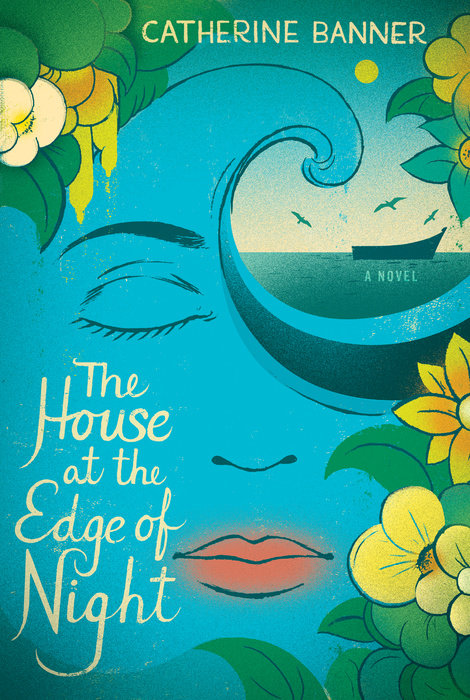
"The House at the Edge of Night"

Catherine Banner was born in Cambridge, UK, in 1989 and began writing at the age of fourteen. She studied English at Fitzwilliam College, Cambridge, before moving to County Durham where she worked as a secondary school teacher. She has published a trilogy of young adult novels, The Last Descendants.

Banner applied the Page 69 Test to her debut adult novel, The House at the Edge of Night, and reported the following:
Page 69 of The House at the Edge of Night is almost blank. And yet it’s also one of the most important pages. It’s the final page of the first part of the book, and it ends with the line: ‘On a windblown day in March 1921, the House at the Edge of Night opened for business.’ The whole first part of The House at the Edge of Night is really a gathering of force towards that sentence, which is a moment of transition. The book is about one family, the Espositos, on a tiny Mediterranean island, and their bar, the House at the Edge of Night. In the final four parts, it opens up to span almost 95 years, from the First World War to the 2008 financial crisis. But Part One, which is the most fairytale-like of the book, tells the family’s prehistory: the story of Amedeo Esposito, the island’s first doctor, who faces a dilemma when he delivers two babies in one night, one his lover’s and the other his wife’s. Everything else that happens – the opening of the bar and 95 years of struggle – is a result of that initial, personal predicament. When you tell a big, epic story, you have to make sure the reader cares first. I try to do that principally through the characters, and through the language. And my hope is that by the time the reader gets to page 69 they are utterly invested in Amedeo and his family, willing to follow them into the much wider, more epic sweep of twentieth-century history which comes after.
Visit Catherine Banner's website.

--Marshal Zeringue

Thursday, July 21, 2016

"The Way Back Home"

Alecia Whitaker grew up on a small farm in Cynthiana, KY. She is the author of The Queen of Kentucky and the Wildflower series, as well as an actress with appearances on several television programs and commercials.

Whitaker applied the Page 69 Test to her new novel, The Way Back Home, and reported the following:
The page 69 test is always interesting to me. In the case of The Way Back Home, I’d say it is a pretty strong reflection of the main conflict for Bird, my protagonist, who is finally at the top of her game musically but is constantly competing with another artist for the spotlight. Why we, as women, often pit ourselves against each other baffles me. There is room for everyone! We each have a unique voice, something new to say or at least a new way to talk about something that’s been said, something to bring artistically. High tides raise all ships so why not lift each other up? In this final installment of the Wildflower series, Bird has to find enough confidence in herself to block out the haters and focus on her own path. It’s so easy to say and so hard to do.

So I hope this passage makes you want to read more. Page 69 is the last page of chapter 7 and Bird is at the VMAs. She has just seen her arch rival perform:
…I’m just baffled that it’s "Kayelee this” and “Kayelee that”–not all of it pleasant but all of it about her.

“Your award’s up next,” Anita says matter-of-factly. “There’s no way you’ll lose this one, so forget what you just saw and be gracious.”

Bonnie clearly agrees. She grabs my arms and shakes me from side to side, smiling big and trying to pump me up. “You’ve always wanted a Moonman!”

I throw my phone back into my purse and frown. Yeah, I wanted to win, both for me and for Bonnie, but at this point, it’s not like anyone will even care.
Learn more about the book and author at Alecia Whitaker's website.

The Page 69 Test: Wildflower.

--Marshal Zeringue

Wednesday, July 20, 2016

"Vita Brevis"

Ruth Downie is the author of a series of mysteries featuring Roman Army medic and reluctant sleuth, Gaius Petreius Ruso: Medicus, Terra Incognita, Persona Non Grata, Caveat Emptor, Semper Fidelis, Tabula Rasa, and the newly released Vita Brevis.

Downie applied the Page 69 Test to Vita Brevis and reported the following:
From page 69:
Balbus raised the bottle, tipped it sideways, and watched the liquid level itself out.

“Sir, about Doctor Kleitos—”

“No sign of him, I suppose?”

“No, sir. But there’s a problem at the surgery. There was this barrel—”

“Talk to Firmicus.” Balbus winced as his fingers met the hot glass, then he twisted out the stopper and sniffed. Ruso was struck by the absurd notion that he could be handing over a poison in the guise of medicine. His patient was right: he was nervous. Ever since he had realized what was in the barrel, Be careful who you trust had taken on a sinister new significance.
By a happy coincidence, Page 69 holds a crucial turning-point in Vita Brevis—much of what happens later depends on this moment. But it makes little sense by itself, so here’s the background:

Ruso has just taken over a medical practice in Rome from the suddenly-departed Doctor Kleitos, who was supplying regular ‘just in case’ antidote medicine to wealthy landlord Balbus. Balbus is convinced that enemies—real or imagined—are trying to poison him. Now the supply of antidote has run out, and Kleitos has left no record of what was in it.

Ruso doesn’t know much about antidotes, but he does know that his patron wants him to make a good impression on Balbus. So he’s offered to cook up a harmless substitute, hoping to fool Balbus’s enemies into thinking he’s still invulnerable—at least until Ruso can track down Kleitos and ask what was in the original bottle.

Ruso’s cooking, however, has just been seriously disrupted by the discovery of a dead man in a barrel outside his front door. With this and the cryptic warning from Kleitos’s hand-over note now looming large in his mind, he can’t remember exactly what he’s put in the medicine. And when he does remember, it won’t be a great comfort to him.

Researching Vita Brevis was a delight. Many medics in the ancient world were highly skilled and—like Ruso—eager to do their best for their patients. Some of their surgical techniques were still in use centuries later. But anyone could claim to be a doctor, and in a society where human dissection was forbidden and scientific method seems rarely to have been valued above dogma and philosophy, the sick were at the mercy of the superstitious and the dangerously ignorant. I’ve slipped one or two of their more entertaining claims into the book, but didn’t have room for Pliny’s odd assertion that women have fewer teeth than men. (And no, I don’t know why he didn’t resort to the simple expedient of counting them.)

In the light of the risks involved, it’s not surprising that many patients referred themselves to the shrine of Aesculapius, where they hoped to receive healing in dreams. But if the gods failed, only the medics remained. And that’s when one of Pliny’s other assertions comes into play. Is it really true that “only a doctor can kill a man with complete impunity?”
Learn more about the book and author at Ruth Downie's website.

The Page 69 Test: Caveat Emptor.

The Page 69 Test: Tabula Rasa.

Writers Read: Ruth Downie.

--Marshal Zeringue

Tuesday, July 19, 2016

"Green Island"

Shawna Yang Ryan is a former Fulbright scholar and the author of Water Ghosts and Green Island. She teaches in the Creative Writing Program at the University of Hawai'i at Manoa. Her short fiction has appeared in ZYZZYVA, The Asian American Literary Review, Kartika Review, and The Berkeley Fiction Review. She is the 2015 recipient of the Elliot Cades Emerging Writer award.

Ryan applied the Page 69 Test to Green Island and reported the following:
1952. Taiwan. Martial law under dictator Chiang Kai-Shek.

On page 69 of Green Island, the unnamed narrator is just five years old and the youngest of four children. Her father has been arrested as a political dissident and her family has no idea if he is dead or alive. A possible widow, her mother moves the children to her own parents’ home in central Taiwan.

In this scene, the narrator has come across some of her father’s belongings, including his wallet, and she steals the money to buy some sweets. The shopkeeper sees the money—from the Japanese colonial era—and knows that it is stolen. In the culture of fear and repression under the Kuomintang in 1952, traitors were jailed for much less, so the shopkeeper rebukes the narrator and sends her away. Later that night, she comes to speak with the narrator’s mother.

The mix of yearning and fear is a theme throughout the book. Alas, it was also a key feature of that era in Taiwan, and it is encapsulated in this child’s innocent mistake.

The page closes with the mother going to the narrator, who waits anxiously in bed, pretending to sleep. You must turn the page to see if the mother punishes her or comforts her….
Learn more about the book and author at Shawna Yang Ryan's website.

The Page 69 Test: Water Ghosts.

--Marshal Zeringue

Monday, July 18, 2016

"Last Ride to Graceland"

Kim Wright is the author of Love in Mid Air, The Unexpected Waltz, and The Canterbury Sisters. A two-time winner of the Lowell Thomas Award for travel writing, she has been writing about travel, food, and wine for more than twenty years for magazines such as Wine Spectator, Self, Travel & Leisure, and Vogue. She also ballroom dances competitively.

Wright applied the Page 69 Test to her new novel, Last Ride to Graceland, and reported the following:
From page 69:
I look around the room, trying to imagine it years ago. The colors bright and unfaded, the music loud. The smell of grease and pot mingling in the air and Elvis on a bar stool holding court. The absence of chairs. His listeners must have clustered around him on the floor, sitting at his feet like the apostles of Jesus, and maybe it felt good after the big stages and venues to sneak away to a little nothing place like this and shake the glitter off. I have a million questions to ask this man but I blurt out "Did my mother smoke weed?"

He laughs again, but it's a genuine laugh this time, not a bitter one.

"You want the truth?"

"You know I do."

He spits on the floor. Puts the sunglasses back on. "Then I'll give you want you say you've come for," he says. "Your mother was a wild child. She did it all and she did it all the time."

And with that, the air seems to go out of the room.
Last Ride to Graceland opens with Cory Beth Ainsworth finding a car in an abandoned fishing shed on her family's property in Beaufort, South Carolina. But it isn't just any car. It's the Stutz Blackhawk that Elvis Presley drove on the last day of his life and it's been hidden in that shed for thirty-seven years, cocooned in bubble wrap.

Cory Beth's mother Honey, who'd died of breast cancer a few months earlier, had lived most of her life as a small town church choir director. But when she had been nineteen, Honey had spent a single year as a backup singer for Elvis. In fact, she had been at Graceland when he died, but she had always refused to talk about that day - especially about the fact Cory Beth had been born a mere seven months after Honey's return from Memphis.

The car seems like the perfect chance to get some answers. Cory Beth decides on the spot to drive it back to Graceland, following a trail of trash left in the car to replicate her mother's journey. A styrofoam cup leads her to the Juicy Lucy in Macon, Georgia - once a burger joint and pot palace and now merely am abandoned kudzu-choked shell. As page 69 shows us, Phillip, the former owner, remembers a very different Honey than the woman who raised Cory Beth.

Last Ride to Graceland has bit of a Wizard of Oz structure, with Cory Beth encountering three people from her mother's past along her winding route to redemption. Although she originally thinks she's undertaking her journey to answer the question of who is her biological father, she quickly learns that the road between Beaufort and Memphis will also tell her something even more important: who her mother really was as well.
Visit Kim Wright's Facebook page.

--Marshal Zeringue